How to Test a Car Battery With a Multimeter (Step-by-Step Guide)
Knowing how to test a car battery takes less than five minutes and tells you something a jump start never can — the actual health of the battery, not just whether it happens to start right now. This guide walks through how to test a car battery with a multimeter step by step, exactly what each voltage reading means, and how to check it even if you don’t own one.
What You’ll Find in This Guide
- 60-second voltage reference table
- What you need before you start
- Step-by-step multimeter testing method
- How to test without a multimeter
- Common mistakes that cause false readings
How to Test a Car Battery: Voltage Reference Table
| Multimeter Reading | Condition | What It Means | Action |
|---|---|---|---|
| 12.6V or higher (engine off) | Resting | Fully charged, healthy | No action needed |
| 12.4–12.5V (engine off) | Resting | Slightly under-charged | Charge and retest |
| 12.0–12.3V (engine off) | Resting | Significantly discharged | Fully charge, then retest |
| Below 12.0V (engine off) | Resting | Weak or failing | Load test before replacing |
| Drops below 9.6V | While cranking | Can’t hold load under demand | Replace battery |
| 13.8–14.7V | Engine running | Alternator charging correctly | Battery is fine, being charged |
| Under 13.5V or over 15V | Engine running | Alternator problem, not the battery | See alternator diagnostic below |
What You Need
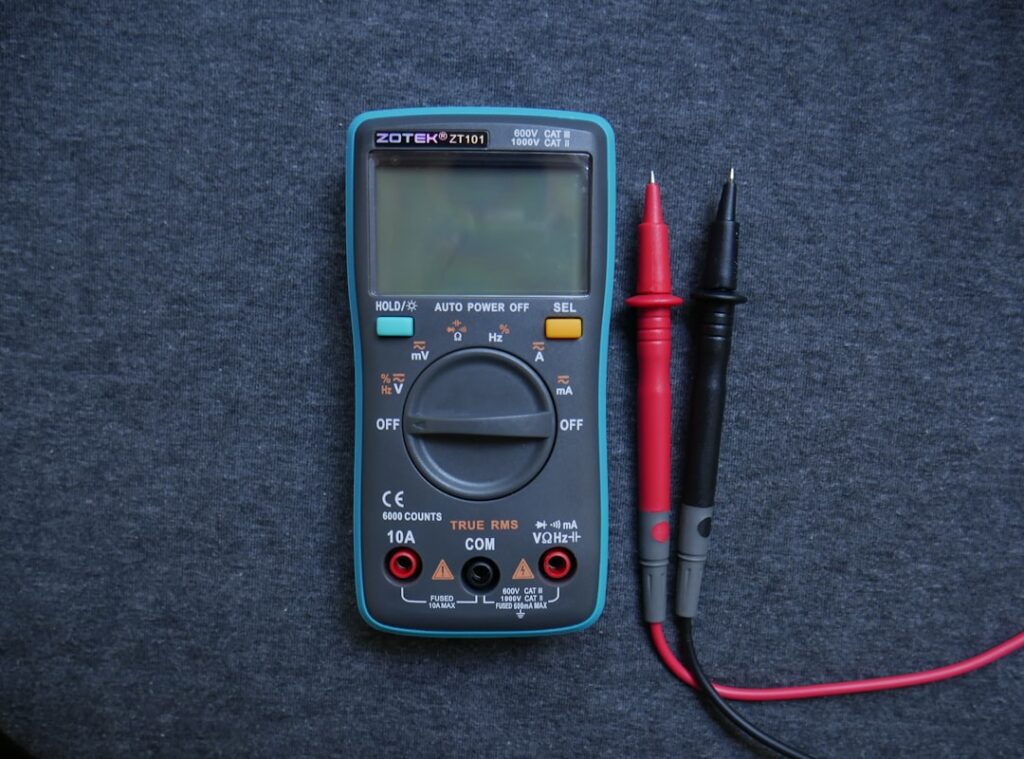
A digital multimeter ($10–25 at any hardware or auto parts store), safety glasses, and a wire brush if the terminals show corrosion — batteries contain sulfuric acid and can vent flammable hydrogen gas, so basic eye protection matters here.
How to Test a Car Battery With a Multimeter — Step by Step
1. Turn everything off. Engine off, headlights off, radio off — every accessory that draws power needs to be off for an accurate resting voltage reading.
2. Set the multimeter to 20V DC. Look for the DC voltage setting (a straight line with a dashed line above a V) and select the 20V range.
3. Connect the probes. Red probe to the positive terminal, black probe to the negative terminal. If the reading shows a minus sign, the probes are reversed — swap them.
4. Read the resting voltage. Compare against the table above. If you just finished driving, wait a few minutes first — the alternator leaves a temporary “surface charge” that makes the battery look healthier than it actually is.
5. Start the engine and read again. With the engine running, voltage should climb to 13.8–14.7V. This step actually tests your alternator’s charging output, not just the battery itself — a battery that reads fine at rest but doesn’t climb when running points to a charging system problem instead.
6. Optional — test under cranking load. Have someone crank the engine while you watch the voltage (or use a multimeter with a min/max hold function). A battery that drops below roughly 9.6V under cranking load is failing even if the resting voltage looked acceptable.
Testing a Car Battery Without a Multimeter
Most auto parts stores will test your battery for free using a conductance tester, which is actually more accurate than a resting voltage check alone — it measures the battery’s real ability to deliver current, not just its voltage. Without any tool at all, watch for: a slower-than-normal engine crank, headlights that noticeably brighten when you rev the engine, or a battery warning light on the dashboard.
Common Mistakes That Cause a False Reading
Testing immediately after driving is the most common one — the surface charge from the alternator inflates the reading for several minutes. Turning the headlights on for two minutes before testing helps dissipate this surface charge for a truer resting reading. Loose or corroded terminal connections can also read as a false-low voltage even when the battery itself is fine — clean the terminals first if you see white or greenish buildup.
Cost Guide
| Option | Cost | Accuracy |
|---|---|---|
| Digital multimeter (DIY, reusable) | $10–25 | Good for voltage, not load capacity |
| Free battery test at auto parts store | $0 | Best — tests real load capacity |
| Load test at a shop | $10–30 | Best — professional equipment |
Frequently Asked Questions
What voltage should a car battery read?
A healthy, fully charged car battery reads 12.6V or higher with the engine off, and 13.8–14.7V with the engine running. Anything consistently below 12.4V at rest suggests the battery needs charging or replacement.
Can a battery read 12.6V and still be bad?
Yes — resting voltage only measures charge level, not the battery’s ability to deliver current under load. A battery can hold a normal resting voltage yet still fail a load test if its internal plates are degraded. This is why a free load test at an auto parts store is worth doing before assuming a battery testing fine at rest is actually healthy.
Why does my battery read fine but the car still won’t start?
A battery that tests fine at rest but the car won’t start usually points to the alternator, starter motor, or a bad connection rather than the battery itself. Our bad alternator vs dead battery guide walks through the exact tests that tell these apart.
Is it safe to test a car battery myself?
Yes, testing voltage with a multimeter is one of the safest DIY battery tasks since you’re not touching both terminals simultaneously with metal tools. Just wear safety glasses, since batteries do contain corrosive acid and can vent flammable gas.
Related Guides
If the terminals show white or greenish corrosion, clean them first using our car battery terminals cleaning guide before retesting — corrosion alone can cause a false weak reading. If your battery tests weak repeatedly, our bad alternator vs dead battery guide helps confirm whether the battery or the charging system is actually at fault.
Muhammad Ahmad is an automotive enthusiast and the founder of AutoUpdateZone. With years of hands-on experience diagnosing and maintaining vehicles, he has developed a deep understanding of engine systems, electrical diagnostics, brake systems, and preventative maintenance.