Summer Road Trip Car Checklist 2026: 15 Things to Check Before You Drive
Memorial Day weekend 2026 kicks off the busiest driving season of the year — and AAA expects a record 39 million Americans on the road this summer. This 15-point checklist covers every critical vehicle check before a long drive, what to pack in your emergency kit, and the one fluid most drivers forget that causes the most summer breakdowns.
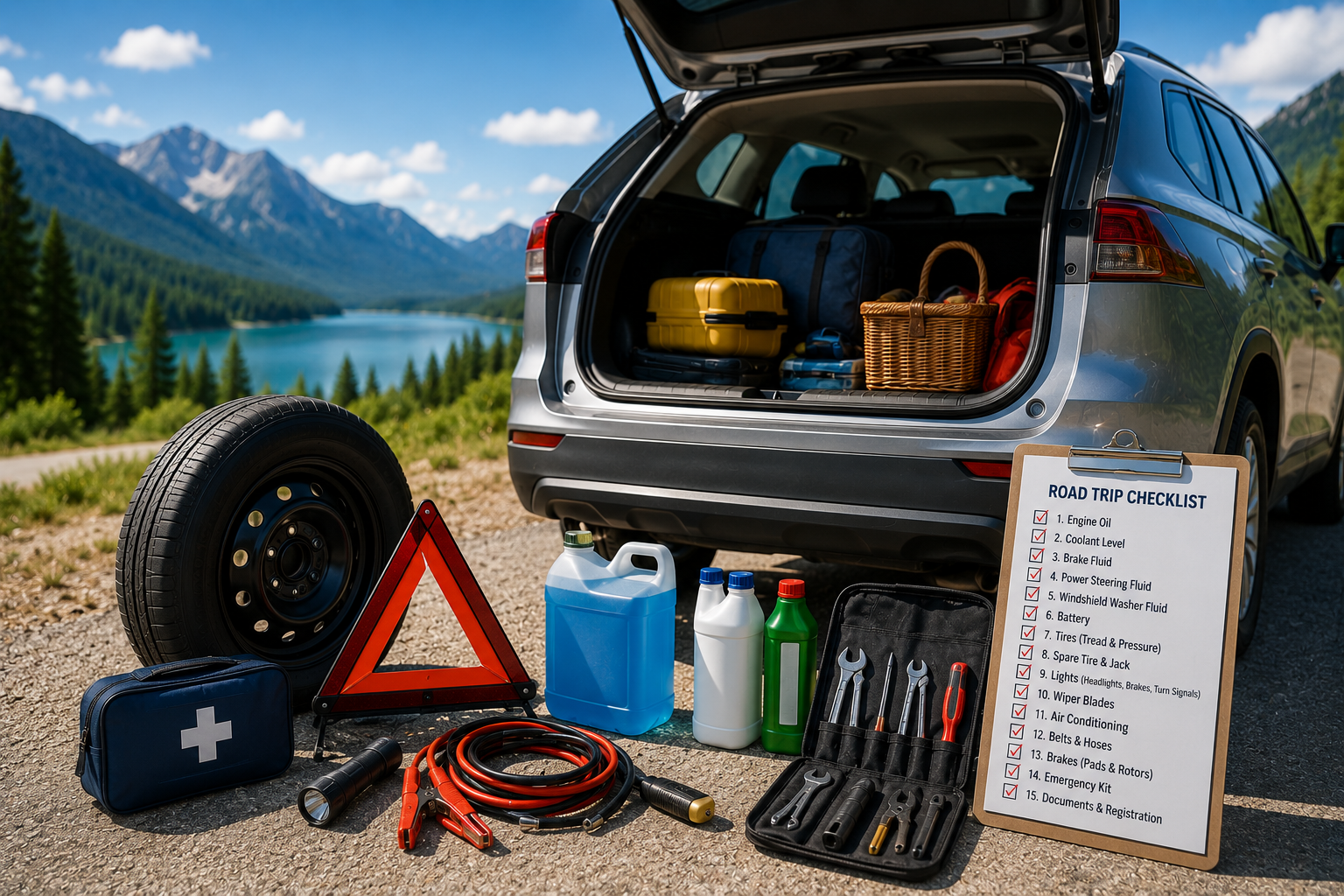
Summer 2026 is shaping up to be the most expensive and busiest road trip season in years — with gas prices topping $4.50 per gallon and record numbers of drivers expected on highways from Memorial Day through Labor Day. AAA data shows that the number one cause of summer roadside breakdowns is battery failure, the number two cause is flat tires, and the number three cause is overheating — all three of which are preventable in under 30 minutes of pre-trip inspection. This 15-point checklist covers every critical check in the correct order of impact, starting with the most common breakdown causes and ending with the items most drivers forget entirely.
There is a specific kind of anxiety that comes from pulling onto the highway with a car you have not really looked at since last winter, heading toward a destination 300 miles away, wondering if the tires are okay and whether that noise the car sometimes makes is going to turn into something expensive on I-95. Twenty to thirty minutes of attention before you leave eliminates most of that uncertainty — and more importantly, prevents the most common summer breakdown scenarios that strand families on highway shoulders in 95-degree heat.
The 15-Point Pre-Road Trip Checklist
1. Battery — The Number One Summer Breakdown Cause
Summer heat is harder on car batteries than winter cold — a fact that surprises most drivers who associate battery problems with freezing temperatures. Heat accelerates the chemical degradation of battery plates and promotes water evaporation from battery electrolyte. A battery that was marginal all winter, getting by on cold-cranking power, often fails completely during the first heat wave of summer when the combination of heat soak and high electrical demand (AC, cooling fans running maximum) finally exceeds its remaining capacity.
What to do before your trip: If your battery is 3 years or older, have it load tested — free at AutoZone, O’Reilly, and NAPA. A load test puts the battery under actual current draw and reveals failures that a simple voltage test misses. A battery that reads 12.6 volts on a resting voltage test can fail under the 200+ amp draw of cranking the engine on a 100-degree day. Load test takes 3 minutes. A failed test result means replacing the battery before the trip, not hoping it makes it. Battery replacement: $80 to $200.
Also check: battery terminal connections for corrosion. White, blue, or green powder on the terminal posts is corrosion that adds electrical resistance — sometimes enough to prevent starting despite a healthy battery. Clean with baking soda solution and a wire brush. See our battery terminal cleaning guide for the complete process.
2. Tire Pressure — More Critical in Summer Heat
Tire pressure increases with temperature — approximately 1 PSI for every 10°F rise. A tire inflated to the correct 35 PSI on a 60°F morning reads approximately 38 to 39 PSI on a 90°F afternoon. More importantly, sustained high-speed driving generates heat inside the tire from flexion of the rubber — underinflated tires flex more per revolution, generate more heat, and are significantly more prone to blowout at highway speeds in summer conditions.
Check all four tires and the spare — cold, before driving, with a digital gauge against the door jamb specification. Note the spare condition: many drivers discover during a roadside flat that the spare is also flat. Pump the spare to the specified pressure (usually 60 PSI for a compact spare, door-jamb spec for a full-size spare) and verify the jack and lug wrench are actually in the vehicle. See our tire pressure guide for the exact checking procedure.
3. Tire Tread — The Quarter Test
Insert a quarter upside down (Washington’s head pointing into the tread) into the deepest groove across the tire. If you can see the top of Washington’s head, the tread depth is at or below 2/32″ — the legal minimum in most states and the point where wet braking performance is significantly compromised. At highway speeds in summer rain, tires at this tread depth take 30 to 40 percent longer to stop than tires with adequate tread. Do this test on multiple spots across the width of each tire — uneven wear (more on inner or outer edge) indicates an alignment or suspension issue.
4. Engine Coolant — The Most Important Summer Fluid
Summer driving — particularly stop-and-go traffic in high ambient temperatures while running AC — puts maximum thermal load on the cooling system. Low coolant is the direct cause of the third most common summer roadside breakdown: overheating. Check the coolant reservoir level against the MIN and MAX markings (engine cold) and inspect the coolant color through the reservoir wall — bright green, orange, or pink means healthy, dark brown means degraded, milky means oil contamination (stop driving — head gasket issue).
If your coolant level is low before a trip — find out why before the trip, not after. A sealed cooling system should not need coolant addition between services. Low coolant means a leak. See our guide on how to add coolant correctly for the right fluid type for your vehicle. For overheating emergency procedures — which you hope not to need but should know — our car overheating emergency guide covers the exact steps.
5. Engine Oil — Level and Condition
Check oil level with the car on level ground, engine off and cool. Oil on the dipstick should be between MIN and MAX, amber to dark brown in color, and not smell burnt. If the oil is due for a change before the return trip — change it before you leave. Fresh oil provides better heat management and lubrication under the sustained high-load conditions of highway driving than oil that has 4,000 miles on it already. Do not start a 2,000-mile road trip with oil that needs changing within 1,000 miles. See our engine oil check guide.
6. Air Conditioning Function
Test the AC before you need it, not when you are on the highway in 98-degree heat. Turn on the AC to maximum cooling and verify cold air is coming from the vents within 2 to 3 minutes. The air coming from the vents should reach approximately 40 to 50°F in moderate temperatures — if you can hold your hand in front of the vent comfortably, it is not cold enough. An AC that is low on refrigerant or has a failing compressor is inexpensive to diagnose ($50 to $100) and often inexpensive to recharge ($100 to $200) but expensive to discover broken on a summer road trip with children or pets in the vehicle.
7. Brakes — Pedal Feel and Visual Inspection
During your pre-trip test drive, apply the brakes moderately from 40 mph and note the pedal feel — firm and responsive, not spongy or soft, and without vibration through the pedal. Spongy brakes indicate air in the brake fluid (time for a brake fluid flush). A pulsing pedal indicates warped rotors. During the visual inspection through each wheel’s spokes, look at the brake pad — you should see at least 3mm of friction material. For any grinding or squealing sounds, see our guides on grinding noise when braking and car squeaks when braking.
8. Wiper Blades
Summer afternoon thunderstorms — common in most of the US from June through September — happen suddenly and intensely. Wiper blades that streaked mildly all winter may become completely inadequate in heavy rain at highway speed. Test both wipers by running them on a wet windshield. Any streaking, skipping, or missed sections means replacement before the trip. New wiper blades cost $15 to $40 each and install in 10 minutes. See our wiper blade replacement guide for the exact process.
9. All Exterior Lights
Walk around the vehicle with someone pressing each control: headlights (low and high beam), turn signals (front and rear), brake lights, reverse lights, and hazard lights. A burned-out brake light is invisible to you from the driver’s seat and is both a safety risk and a magnet for traffic citations. Replacement bulbs cost $3 to $15 at any auto parts store for standard incandescent bulbs.
10. Check Engine Light
If the check engine light is on before your trip, read the codes before leaving — not after arriving somewhere without a reliable mechanic. A solid check engine light may indicate a minor issue (loose gas cap, oxygen sensor) or something that will worsen during a long drive (catalytic converter, fuel system). A flashing check engine light means do not drive on the highway until it is diagnosed — active misfires destroy catalytic converters within miles. Read codes free at any auto parts store or with a $15 Bluetooth OBD2 adapter. See our check engine light guide.
11. Transmission Fluid (Often Overlooked Before Long Drives)
Transmission fluid is the most forgotten fluid on most pre-trip checklists. Sustained highway driving — particularly with passengers and cargo — puts consistent load on the transmission that city driving does not. Degraded transmission fluid loses its ability to manage heat effectively; a transmission running on dark, depleted fluid in sustained highway driving can reach temperatures that accelerate internal wear. If you cannot remember the last time transmission fluid was checked or changed — check it before this trip. See our transmission fluid check guide.
12. Power Steering Fluid (If Applicable)
On vehicles with hydraulic power steering, check fluid level against the MIN and MAX markings. A slow power steering leak that goes unnoticed during short city driving can become a problem on a 500-mile drive where fluid level drops enough to cause heavy steering or pump damage. Two-minute check, potentially significant consequence if skipped.
13. Windshield Washer Fluid
The most underestimated fluid on the list. Summer driving produces significant windshield contamination — bugs, road tar, sunscreen from open windows, agricultural dust on rural highways. A highway encounter with a swarm of insects that empties the washer reservoir leaves the windshield progressively more obscured with each wiper stroke as dirt is smeared rather than cleared. Fill the reservoir completely before departure. Carry a spare gallon if the trip exceeds 500 miles through bug-heavy territory (Midwest and South in summer).
14. Emergency Kit Contents
| Item | Why It Matters in Summer | Estimated Cost |
|---|---|---|
| Jumper cables or jump starter | Battery failures peak in summer heat | $25–$80 |
| Bottled water (1 gallon minimum) | For occupants AND for cooling an overheated engine | $2–$5 |
| Tire pressure gauge + portable inflator | Verify and restore tire pressure on the road | $15–$50 |
| Reflective triangles or road flares | Visibility if broken down on highway shoulder | $15–$25 |
| Basic first aid kit | Minor injuries from roadside work | $15–$30 |
| Flashlight with fresh batteries | Roadside inspection after dark | $10–$20 |
| Phone charger cable + car adapter | Navigation, communication, emergency calls | $10–$25 |
| Basic tool kit (screwdrivers, pliers, zip ties) | Minor on-road fixes | $15–$30 |
15. Documents and Fuel Planning
Verify insurance card and registration are current and in the vehicle. Download offline maps for your route in case cell coverage is poor in rural areas. With gas at $4.50+ per gallon this summer, use GasBuddy or Waze to identify the cheapest fuel stops along your route before departing — prices can vary by $0.50 to $1.00 per gallon between stations in the same area, and planning fill-up locations near wholesale clubs or grocery chain stations on your route can save $20 to $40 on a 500-mile drive.
Pre-Trip Inspection Timing Guide
| Timing | Tasks |
|---|---|
| 2 weeks before departure | Battery load test, brake inspection, tire condition assessment, any overdue maintenance |
| 3–5 days before | Oil change if due during trip, wiper blade replacement if needed |
| Morning of departure | Tire pressure check (cold), fluid level checks, lights verification, documents confirmed |
| At first fuel stop (100–150 miles in) | Quick visual walk-around, tires by feel, fluid checks if anything seemed off |
Frequently Asked Questions
What should I check on my car before a road trip?
The 15 most important pre-road trip vehicle checks in priority order: battery load test (the number one summer breakdown cause), tire pressure and tread depth including the spare, coolant level and condition, engine oil level and condition, air conditioning function, brakes and brake fluid, wiper blades, all exterior lights, check engine light status, transmission fluid, power steering fluid on hydraulic systems, windshield washer fluid, emergency kit contents, and documents. Completing all 15 checks takes 20 to 30 minutes and prevents the most common breakdown scenarios.
How far in advance should I service my car before a road trip?
Service that requires a shop appointment — battery test, brake inspection, oil change — should be scheduled 2 weeks before departure to allow for any follow-up work needed. Last-minute appointments before major holiday weekends are difficult to get and rush jobs sometimes miss things. Quick checks you can do yourself — tire pressure, fluid levels, lights — should be done the morning of departure when tires are cold and the car has been sitting overnight for accurate readings.
What causes most summer car breakdowns?
According to AAA data, the three most common causes of summer roadside breakdowns are battery failure (heat accelerates battery degradation and the combination of AC load and heat soak frequently exceeds a marginal battery’s capacity), flat tires (underinflated tires in hot weather are significantly more prone to blowout at highway speeds), and engine overheating from cooling system failures — low coolant, failed thermostat, or radiator fan problems. All three are preventable with the pre-trip inspection outlined in this guide.
Related Guides
Each item on this checklist has a dedicated guide on this site. For battery terminal cleaning, see our battery terminal guide. For tire pressure, our tire pressure guide covers the exact procedure. For coolant, see how to add coolant correctly. For oil, see how to check engine oil level. And for saving on the $4.50/gallon gas prices this summer, our complete guide to improving fuel economy covers 17 proven techniques that can save $400 to $900 annually at current pump prices.