Transmission Slipping Symptoms: 8 Signs by Stage + Is It Safe to Drive?
Transmission slipping symptoms range from a barely noticeable RPM flare during upshifts to a complete inability to move despite the engine running. The stage of failure — early, mid, or late — determines both which symptoms appear and how urgently the vehicle needs attention. This guide organizes all 8 symptoms by the stage they appear, with the fluid check test and the honest answer on how long you can safely drive.
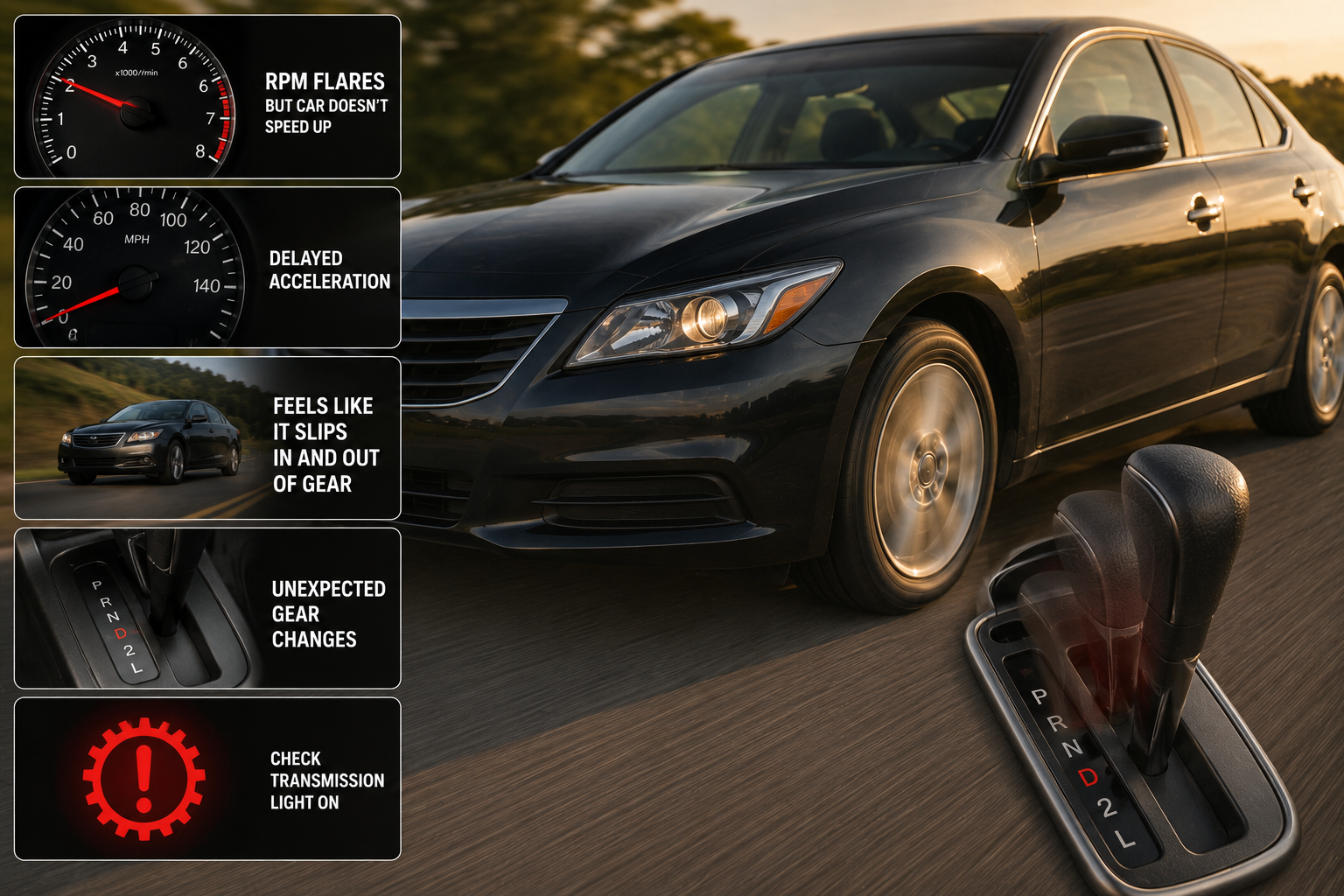
Transmission slipping symptoms do not all appear at once. They follow a progression tied to the severity of the underlying problem. Early-stage transmission slipping produces a barely perceptible RPM flare during upshifts — the engine revs a fraction of a second before the next gear engages. Mid-stage slipping produces unmistakable symptoms: the engine revs clearly higher than expected during acceleration, gear changes feel rough or delayed. Late-stage transmission slipping can leave the car unable to move despite the engine running normally. Knowing which stage you are in determines how urgently the problem requires attention and what the repair will cost.
Transmission slipping symptoms follow a progression — from barely noticeable in early stages to impossible to ignore in late stages. The engine produces power, but the connection between the engine and the drive wheels is not maintaining a firm, consistent grip. This guide organizes all 8 transmission slipping symptoms by the stage at which they typically appear, starting with the earliest warning signs that most drivers miss entirely and progressing through to the late-stage symptoms that indicate a transmission at or near failure.
Transmission Slipping Symptoms — Quick Reference by Stage
| Transmission Slipping Symptom | Stage | Which Transmission? | Urgency |
|---|---|---|---|
| RPM flare during upshifts — barely noticeable | Early | Automatic | 🟡 Diagnose within weeks |
| Delay between gear selector and vehicle movement | Early–Mid | Automatic | 🟡 Diagnose this month |
| Unexpected gear changes or gear hunting | Mid | Automatic | 🟠 Inspect this week |
| Engine revs high — vehicle accelerates slowly | Mid | Both | 🟠 Inspect this week |
| Burning smell from transmission area | Mid–Late | Automatic | 🔴 Inspect immediately |
| Check engine light — transmission codes stored | Any stage | Automatic | 🟠 Read codes today |
| Complete slip — no movement despite engine running | Late | Both | 🚨 Do not drive |
| Torque converter shudder at highway cruise speed | Mid–Late | Automatic only | 🔴 Fluid service ASAP |
The Fluid Test — Do This Before Anything Else
Before attributing transmission slipping symptoms to mechanical failure, check the transmission fluid. Low fluid is the most common and most easily fixed cause of transmission slipping — it reduces the hydraulic pressure that clutch packs need to engage firmly. Degraded fluid produces identical transmission slipping symptoms to low fluid. Both are confirmed or eliminated by a 2-minute check before any shop visit. See our complete guide on how to check transmission fluid for the exact procedure including sealed transmission identification.
| Fluid Color and Condition | What It Means | Action |
|---|---|---|
| Red or pink — transparent | Fresh, healthy fluid | Fluid not the cause — diagnose mechanically |
| Light brown — slightly darker | Normal aging | Change at next service interval |
| Dark brown — murky | Significantly degraded | Fluid change immediately — may resolve slipping |
| Black — opaque with burnt smell | Severe degradation — clutch damage likely | Professional inspection — damage may be permanent |
| Milky or foamy | Water contamination | Immediate professional diagnosis — do not drive further |
| Level below MIN — any color | Low fluid — reduced hydraulic pressure | Top up with correct fluid — retest for slipping |
8 Transmission Slipping Symptoms — Diagnosed by Stage
Early Stage Transmission Slipping Symptoms
Symptom 1: RPM Flare During Upshifts — Earliest Sign
The earliest and most subtle of all transmission slipping symptoms: during acceleration, the engine RPM rises slightly higher than expected between gear changes before settling into the next gear. Instead of a clean RPM drop as the transmission upshifts, the RPM climbs a small additional amount — a “flare” — before dropping. This flare represents a momentary period where the outgoing clutch pack has released but the incoming pack has not yet fully engaged, allowing the engine to rev freely without load for that fraction of a second.
Most drivers miss this transmission slipping symptom entirely at first — it is subtle, brief, and easy to attribute to normal behavior. The diagnostic clue: the flare is reproducible during the same gear change under the same throttle conditions. Early-stage transmission slipping symptoms addressed promptly with a fluid change are often the lowest-cost intervention available before mechanical clutch pack wear becomes significant.
Symptom 2: Engagement Delay — Pause Before Movement
Moving the gear selector from Park to Drive and experiencing a noticeable pause — 1 to 3 seconds — before the transmission engages and the vehicle begins to move is an early to mid-stage transmission slipping symptom. A healthy automatic transmission should engage within half a second. A delay means the hydraulic circuit is slow to build pressure — either from low fluid, a worn pump, or a sticky solenoid.
Engagement delay is most pronounced when the transmission is cold. If it only occurs when cold and disappears after 5 minutes of driving, degraded transmission fluid with poor cold viscosity is the most likely cause — a fluid change often resolves this. If the delay is present both cold and warm, a solenoid or hydraulic circuit issue requires professional diagnosis.
Mid-Stage Transmission Slipping Symptoms
Symptom 3: Unexpected Gear Changes or Gear Hunting
A transmission that unexpectedly drops to a lower gear without the driver requesting it, or hunts back and forth between two gears at steady speed, is displaying mid-stage transmission slipping symptoms. Unexpected downshifts feel like sudden strong engine braking — RPM rises sharply and the vehicle decelerates without any brake input. Gear hunting feels like the transmission cannot decide which gear is appropriate, cycling between two ratios repeatedly.
Both of these transmission slipping symptoms originate from the same mechanism: clutch packs that cannot maintain consistent holding force. The transmission control module detects the speed differential and commands a downshift — which may then also slip, producing the hunting pattern.
Symptom 4: Engine Revs High — Vehicle Accelerates Slowly
This is the most universally recognized of all transmission slipping symptoms — the tachometer climbs to 4,000 or 5,000 RPM during hard acceleration while vehicle speed increases slowly and acceleration feels sluggish relative to how hard the engine is working. The engine is producing power. The transmission is not efficiently transferring it to the drive wheels. The slip between engine and output shaft absorbs energy as heat in the slipping clutch packs rather than converting it to vehicle forward motion.
This transmission slipping symptom is most noticeable during hard acceleration from a stop, overtaking at highway speed, and climbing grades under moderate throttle. This RPM-rises-but-car-stays-slow symptom is the same observation that distinguishes transmission problems from engine problems — see our car won’t accelerate guide for the complete RPM behavior diagnostic.
Symptom 5: Burning Smell from Transmission Area
A burning smell from underneath the vehicle is a mid to late-stage transmission slipping symptom indicating the clutch packs or fluid are experiencing thermal damage. When clutch packs slip, the energy not transferred to the drivetrain dissipates as heat at the friction surfaces. The burning smell from slipping clutches is somewhat sweet and acrid — different from the sharper petroleum smell of burning engine oil. It is more noticeable after sustained driving under load than during light city driving.
Black, burnt-smelling fluid confirms thermal damage has already occurred. A fluid change at this point may improve slipping temporarily but may not prevent continued deterioration if clutch friction material has been significantly damaged.
Symptom 6: Check Engine Light with Transmission Fault Codes
A check engine light alongside transmission slipping symptoms almost always has stored fault codes identifying which component is involved. Common transmission slipping codes include P0730-P0736 (incorrect gear ratio detected) and P0740-P0744 (torque converter clutch fault). Reading these codes before any repair is the most valuable diagnostic step available — a P0732 code pinpoints the exact clutch pack or solenoid involved, eliminating guesswork. See our check engine light guide for the free code reading process at any auto parts store.
Late-Stage Transmission Slipping Symptoms
Symptom 7: Complete Slip — No Movement Despite Engine Running
The most severe of all transmission slipping symptoms: the engine runs normally, gear selector is in Drive or Reverse, but the vehicle does not move at all. The clutch packs have worn beyond the point of providing meaningful holding force, or hydraulic pressure has dropped to zero from fluid loss or pump failure. If no movement corresponds to no fluid on the dipstick — add the correct fluid type first. If fluid level is correct and no movement persists — the transmission requires professional diagnosis and likely rebuild or replacement.
Symptom 8: Torque Converter Shudder at Highway Cruise Speed
Torque converter shudder is a specific transmission slipping symptom unique to automatic transmissions. It feels like driving over rumble strips — a rhythmic vibration during light-throttle steady-speed cruising at highway speeds, typically 40 to 60 mph. It is not present during hard acceleration or deceleration and disappears when the driver either accelerates more firmly or eases completely off the throttle.
This occurs when the torque converter lockup clutch cannot maintain stable engagement — it alternately grips and slips rapidly, producing the characteristic shudder. This transmission slipping symptom is frequently resolved by a fluid change with the correct specification — numerous GM technical service bulletins document torque converter shudder as a fluid-related issue. The Car Care Council lists transmission fluid maintenance as a critical interval service — allowing fluid to degrade is the primary preventable cause of torque converter shudder. If fluid replacement does not resolve the shudder, torque converter replacement is typically required.
How Long Can You Drive with Transmission Slipping Symptoms?
| Stage | Typical Symptoms | Safe to Drive? | Recommended Action |
|---|---|---|---|
| Early | Subtle RPM flare, cold engagement delay | ✅ Weeks — with monitoring | Check and change fluid, diagnose solenoids |
| Mid | Noticeable slip under acceleration, gear hunting, burning smell | ⚠️ Days to weeks — avoid hard acceleration | Professional diagnosis this week |
| Late | Severe slip, barely moves, constant burning smell | 🔴 Short distances only | Professional diagnosis immediately |
| Complete failure | No movement in Drive or Reverse | 🚨 Do not drive | Tow to shop |
Driving on transmission slipping symptoms actively accelerates the damage. Every slipping event deposits heat into the clutch packs and degrades the surrounding fluid. A mid-stage transmission slipping situation that might have been repaired for $400 becomes a $2,500 to $4,000 rebuild when clutch packs are allowed to wear completely through. Address transmission slipping symptoms at the earliest stage you notice them.
Transmission Slipping Repair Cost Guide
| Repair | Cost Range | What It Addresses |
|---|---|---|
| Transmission fluid change | $100–$250 | Low fluid, degraded fluid, torque converter shudder |
| Transmission flush (all fluid + filter) | $150–$350 | Severely degraded fluid, contamination |
| Solenoid replacement | $200–$500 | Shift solenoid failure causing slip in specific gear |
| Torque converter replacement | $600–$1,200 | TCC failure, shudder not resolved by fluid change |
| Valve body replacement or rebuild | $500–$1,500 | Hydraulic circuit faults, multiple solenoid issues |
| Transmission rebuild | $1,500–$3,500 | Worn clutch packs, multiple internal failures |
| Transmission replacement (remanufactured) | $2,500–$4,500 | Severe damage — when rebuild not cost effective |
Frequently Asked Questions — Transmission Slipping Symptoms
What are the symptoms of a slipping transmission?
The eight main transmission slipping symptoms organized by stage are: RPM flare during upshifts (early), engagement delay between gear selector and vehicle movement (early to mid), unexpected gear changes or gear hunting (mid), engine revving high while the vehicle accelerates slowly (mid), burning smell from the transmission area (mid to late), check engine light with transmission fault codes (any stage), complete slip where the vehicle barely or does not move despite the engine running (late), and torque converter shudder at highway cruise speed (mid to late). Transmission slipping symptoms worsen progressively as the condition advances.
Can low transmission fluid cause slipping?
Yes — low transmission fluid is the most common and most easily corrected cause of transmission slipping symptoms. Automatic transmission clutch packs engage through hydraulic pressure generated by transmission fluid. When fluid level is low, hydraulic pressure drops and clutch packs cannot achieve full holding force — they slip under load. Check the fluid level and condition before any other diagnosis. If fluid is low, top up with the correct specification and retest. If slipping improves — fluid was the cause and a leak must be found and repaired.
How long can you drive with a slipping transmission?
Early-stage transmission slipping symptoms with subtle RPM flare: weeks with monitoring and prompt fluid service. Mid-stage transmission slipping with noticeable symptoms: days to a couple of weeks — avoid hard acceleration and sustained highway driving. Late-stage slipping where the car barely accelerates: short distances to reach a shop only. Complete slip: do not drive. Every slipping event deposits heat into the clutch packs and accelerates damage. The difference in repair cost between early and late intervention is typically $1,500 to $3,000.
What causes transmission slipping?
Transmission slipping symptoms are caused by clutch packs that cannot maintain designed holding force. The four main root causes are: low or degraded transmission fluid reducing hydraulic pressure (most common and most fixable), worn clutch pack friction material from mileage and heat cycling (requires rebuild), failed solenoids controlling fluid pressure to specific clutch packs (solenoid replacement), and worn torque converter clutch friction material producing shudder at cruise speed (torque converter replacement or fluid service if caught early).
Is transmission slipping expensive to fix?
The cost of fixing transmission slipping symptoms depends entirely on the stage at which they are addressed. Early-stage from degraded fluid: $100 to $350 for a fluid change. Solenoid-related: $200 to $500. Torque converter shudder: $150 for fluid change up to $1,200 for converter replacement. Late-stage requiring rebuild: $1,500 to $3,500. Replacement: $2,500 to $4,500. The most important factor is how early the transmission slipping symptoms are noticed and addressed — early intervention costs a fraction of late-stage repair.
Related Guides
Transmission slipping symptoms often appear alongside other drivability complaints. If the slipping manifests as RPMs rising without speed increase, our car won’t accelerate guide covers the complete RPM behavior diagnostic that separates transmission slip from fuel and engine causes. For checking transmission fluid condition and level with the correct procedure, see our transmission fluid guide. And if a check engine light is on alongside these symptoms, our check engine light guide covers reading transmission fault codes free at any auto parts store before authorizing any repairs.