How to Check Transmission Fluid — Automatic, Manual, CVT & Sealed (Complete Guide)
How to check transmission fluid correctly — automatic dipstick method, manual fill plug procedure, CVT fluid check, sealed transmission diagnosis, complete 6-color guide, and the finger texture test that reveals hidden damage before symptoms appear.
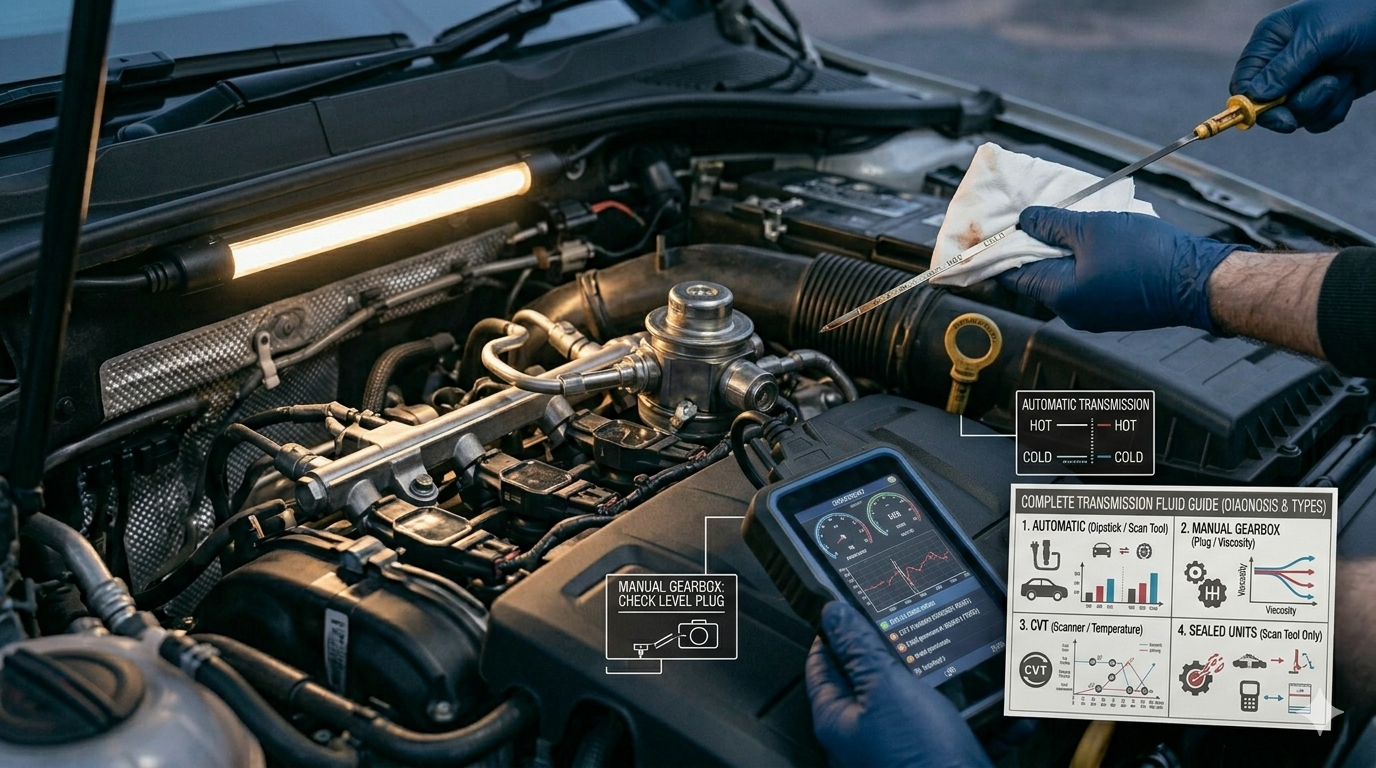
To check transmission fluid on an automatic: engine warm and running, shifter in Park, locate the red-handled dipstick near the back of the engine bay, pull it out, wipe clean, reinsert fully, pull out again, read between the MIN and MAX marks. The fluid should be bright red to dark red, nearly transparent, with no burnt smell and no grit between your fingers. Black fluid, a burnt smell, or metal particles mean internal transmission damage is either happening or about to happen — and topping up will not fix it.
Most drivers never check their transmission fluid. Not because they do not care — because nobody told them it needed checking or explained how different the process is from checking engine oil. And here is what that costs: a transmission running on degraded or low fluid wears internally at three to five times the normal rate. By the time you notice slipping gears or delayed shifts, the damage is already thousands of dollars deep. This guide covers the correct procedure for every transmission type — automatic dipstick, manual fill plug, CVT, and the increasingly common sealed units that have no dipstick at all — plus a complete color and texture diagnostic that gives you a full picture of your transmission’s health in under five minutes.
First — What Type of Transmission Does Your Car Have?
The checking method depends entirely on your transmission type. Getting this wrong means either checking the wrong fluid, using an incorrect procedure that gives a false reading, or — most commonly — spending ten minutes looking for a dipstick that does not exist on your car.
| Transmission Type | Dipstick? | Check Method | Typical Vehicles |
|---|---|---|---|
| Automatic (traditional) | ✅ Usually yes | Warm engine, running, in Park | Most pre-2010 vehicles, many current trucks/SUVs |
| Manual (standard) | ❌ No dipstick | Fill plug on transmission case — car raised | Sports cars, older vehicles, work trucks |
| CVT (Continuously Variable) | ❌ Rarely | Usually sealed — professional check or diagnostic | Honda, Nissan, Subaru, Toyota hybrids, many others |
| Dual-clutch (DCT/DSG) | ❌ No | Sealed — professional only | VW, Audi, Ford Focus, many European vehicles |
| Sealed automatic | ❌ No dipstick | Diagnostic tool + lift — professional check | BMW, Mercedes, many post-2010 vehicles |
If you open the hood and cannot find a second dipstick near the back of the engine bay — you likely have a sealed transmission. Do not keep searching. Check your owner’s manual under “transmission fluid” to confirm, then read the sealed transmission section below.
Method 1 — How to Check Automatic Transmission Fluid (Dipstick)
This is the most common method and the one most people mean when they search for this information. Follow these steps exactly — the order and engine state matter more than most guides acknowledge.
Step 1: Drive the Car First — Then Check
Unlike engine oil — which is most accurately checked cold — automatic transmission fluid must be checked warm. The fluid expands as it heats up, and more importantly, the transmission’s internal pump only circulates fluid properly when the engine is running. Checking ATF on a cold, parked car gives a reading that is typically 10–15% lower than the actual operating level, which means you could add fluid to a system that is already properly filled — causing an overfill that is worse than being slightly low.
The correct warm-up procedure: Drive the car for at least 5–10 minutes — enough for the transmission to reach normal operating temperature. Then, with the engine still running, proceed with the check. Do not turn the engine off. A transmission checked with the engine off will show a low reading on most vehicles.
Exception: Some manufacturers specify checking ATF with the engine off. BMW, Honda, and certain Ford models use this procedure. Always verify in your owner’s manual — “transmission fluid check” in the index will point you to the specific page with your vehicle’s exact procedure.
Step 2: Run Through All Gear Positions
With the engine running and parking brake fully engaged, shift through every gear position — Park, Reverse, Neutral, Drive, and any lower gear positions — pausing 3–5 seconds in each. This circulates transmission fluid through the entire system, including the torque converter and valve body, ensuring the fluid is evenly distributed and the dipstick gives a representative level reading rather than just measuring what is sitting in the transmission pan.
Return the shifter to Park before opening the hood or touching anything under the car. This is a safety requirement — never check fluid with the car in Drive or Neutral on level ground without the parking brake firmly set.
Step 3: Find and Identify the Transmission Dipstick
The transmission fluid dipstick is almost always located toward the back of the engine bay, near the firewall — the metal barrier between the engine compartment and the cabin. On rear-wheel-drive vehicles, it is typically on the passenger side. On front-wheel-drive vehicles, it usually sticks out of the top of the transaxle on the driver’s side.
| Vehicle Make | Transmission Dipstick Location | Handle Color |
|---|---|---|
| Ford F-150, Mustang, Explorer | Passenger side, rear of engine bay | Yellow or Orange |
| Chevrolet Silverado, Tahoe, Malibu | Passenger side, near firewall | Yellow |
| Dodge Ram, Jeep Wrangler | Passenger side, rear engine area | Red or Yellow |
| Toyota Camry, Corolla, Tundra | Driver’s side of transaxle (FWD) or passenger rear (RWD) | Yellow |
| Honda Accord, Civic | No dipstick on most CVT models — sealed | N/A |
| Nissan Altima, Rogue | No dipstick on CVT models — sealed | N/A |
Do not confuse the transmission dipstick with the engine oil dipstick. Engine oil dipsticks are usually bright yellow, closer to the front of the engine, and shorter. Transmission dipsticks typically sit further back, are often red or have a reddish handle, and are longer — reaching down into the transmission pan below the engine. When in doubt, the dipstick tube itself will often be labeled “ATF,” “TRANS,” or have a gear icon.
Step 4: Pull, Wipe, Reinsert, Pull Again
Pull the dipstick straight out and wipe it completely clean with a lint-free rag. Do not read the first pull — fluid coats the stick during transmission operation and the reading will be inaccurate. Reinsert the dipstick fully — it must seat all the way at the bottom of the tube. Wait 5 seconds, then pull it out again in one smooth motion. Read the level immediately before fluid can run down the stick.
Step 5: Read the Level and Condition
Most ATF dipsticks have two sets of markings — one for “warm” fluid (operating temperature) and one for “cold” fluid. Since you checked warm as instructed, use the warm markings. The fluid should sit between the MIN and MAX (or ADD and FULL) marks on the warm scale.
- At or near MAX/FULL — warm scale: Correct level — no addition needed
- Between MIN and MAX: Acceptable — no immediate action
- At or below MIN/ADD: Low — add the correct ATF in small increments
- Above MAX: Overfilled — excess must be removed at a shop
The Color and Texture Diagnostic — The Step Everyone Skips
Fluid level is only half the information the dipstick gives you. The color and texture of the fluid on the dipstick tells you more about your transmission’s internal health than any other quick check available to a driver. This is the step most guides mention in one sentence. Here is what it actually means:
Color Guide — Complete 6-State Diagnostic
| Fluid Color | Condition | What It Means | Action |
|---|---|---|---|
| 🔴 Bright cherry red — transparent | New or like-new | Fluid is fresh, full additive capacity, no contamination | No action — perfect condition |
| 🟥 Dark red — still transparent | Normal aged fluid | Fluid has absorbed some heat cycles — still protective | Monitor — change at next scheduled interval |
| 🟫 Red-brown — slightly opaque | Approaching service interval | Oxidation beginning, additive package depleting | Plan fluid change within next 10,000 miles |
| 🟤 Dark brown — opaque | Overdue for change | Significant oxidation, reduced lubrication quality | Change fluid promptly — transmission strain increasing |
| ⬛ Black — opaque | Severely degraded | Fluid is burnt and contaminated — no longer protective | Immediate fluid change + transmission inspection |
| 🩷 Pink and foamy / milky | Coolant contamination | Coolant has mixed with ATF — radiator cooler failure | Emergency — stop driving. Radiator and transmission inspection. |
The Finger Texture Test — What Most Guides Never Mention
Place a drop of transmission fluid from the dipstick between your thumb and index finger. Rub them together and pay attention to three things:
- Smooth and slippery — no grit: Fluid is clean internally — transmission components are not producing metal particles. This is what healthy ATF feels like.
- Slightly gritty — fine particles: Normal friction material wear — the clutch packs inside the transmission shed a small amount of material as they age. Moderate amounts are normal in high-mileage transmissions. Excessive amounts indicate accelerated wear.
- Very gritty — metallic feel between fingers: Metal particles from gear or bearing failure. This is not a fluid change situation — this is a transmission that needs professional inspection before you drive further. Metal particles indicate internal mechanical failure in progress.
- Slick but with black specks: Carbon deposits from overheated clutch material — transmission has been heat-stressed, possibly from towing without adequate cooling or from low fluid level operation.
The finger test catches internal transmission damage that the color test alone misses. Fluid can appear only slightly darkened while already containing significant metal particle contamination from bearing or gear wear. Combined with color assessment, the finger test gives you a complete picture in 10 seconds.
Method 2 — How to Check Manual Transmission Fluid
Manual transmissions do not have a dipstick. The fluid level is checked via a fill plug on the side of the transmission case — and accessing it requires getting under the car safely. This is more involved than checking ATF but still doable as a DIY procedure.
- Park on a completely level surface — any slope significantly affects whether fluid reaches the fill hole, which is how you determine if the level is correct.
- Safely raise and support the vehicle — use a hydraulic floor jack and support with proper jack stands. Never work under a car supported only by a floor jack.
- Locate the fill plug — on the side of the transmission case, typically a large hex bolt (usually 17mm–22mm) on the upper portion of the housing. Some vehicles have both a fill plug (higher) and a drain plug (lower). The fill plug is the one you want.
- Remove the fill plug — use the correct socket. With the plug out, insert your finger into the hole. In a properly filled manual transmission, fluid should be right at the hole’s edge or dripping slightly.
- If no fluid reaches your finger when you insert it — the transmission is low and needs fluid added through the fill plug hole using a fluid pump or flexible-spout bottle.
- Add fluid until it starts to drip from the fill hole — this is how you know it is full. Add slowly.
- Reinstall the fill plug and torque it to specification (typically 25–35 ft-lbs).
Manual transmission fluid also has a color and smell check — though the fluid type is different. Most manuals use gear oil (75W-90 or 75W-140), which is naturally darker and thicker than ATF. Fresh gear oil is amber to light brown. Severely degraded gear oil is dark brown to black and has a noticeably burnt or sulfuric smell. Metal particles in manual transmission fluid indicate synchronizer or gear wear requiring professional diagnosis.
Method 3 — CVT Fluid Check
Continuously Variable Transmissions — found in most modern Hondas, Nissans, Subarus, Toyota hybrids, and many others — use a dedicated CVT fluid that is completely different from conventional ATF. Using the wrong fluid in a CVT causes permanent belt and pulley damage. Most CVTs are sealed from the factory with no dipstick.
On the minority of CVT-equipped vehicles that do have a dipstick, the check procedure is identical to automatic: warm engine, running, in Park, check the level. However, because CVT fluid is specified more precisely than ATF, even a small amount of contamination or the wrong fluid is more damaging than in a conventional automatic.
For sealed CVTs: watch for these specific symptoms that indicate the CVT fluid needs attention — a high-pitched whining noise during acceleration, a shuddering sensation when accelerating from a stop, or a burning smell after highway driving. CVT fluid on most vehicles should be changed every 60,000–80,000 miles even though many manufacturers label it “lifetime fill.” CVT failures on fluid that was never changed are among the most expensive drivetrain repairs in current vehicles — often $3,000–$7,000 for a CVT replacement.
Method 4 — Sealed Transmission: No Dipstick (Most New Vehicles)
If your car has no transmission dipstick — increasingly common in post-2010 vehicles, and standard on virtually all European makes — the fluid level cannot be checked at home. “Sealed” does not mean the fluid never needs changing. It means the manufacturer has designed the system for professional-only service intervals.
For sealed transmissions, watch for these warning signs that indicate fluid attention is needed:
| Symptom | What It Indicates | Urgency |
|---|---|---|
| Delayed engagement when shifting from Park to Drive | Low fluid pressure or degraded fluid | 🟠 Schedule inspection |
| Gear slipping — engine revs rise without acceleration | Fluid severely low or clutch wear | 🔴 Inspect this week |
| Harsh or jerky shifts between gears | Fluid pressure issues or internal wear | 🟠 Schedule inspection |
| Whining or humming noise during acceleration | Pump or bearing wear — often fluid-related | 🔴 Diagnose soon |
| Burning smell from transmission area | Fluid overheating — low level or degraded | 🔴 Do not delay |
| Check engine light + transmission-related code | ECU detected abnormal transmission behavior | 🔴 Read code immediately |
| Complete loss of drive — no forward or reverse | Fluid critically low or mechanical failure | 🚨 Stop driving now |
Sealed transmission fluid service at a dealer or transmission specialist involves raising the vehicle, removing the fill plug, using a diagnostic tool to monitor temperature (the correct fill level is temperature-dependent), draining the old fluid, and refilling to the precise level. Cost: $150–$350 for a fluid change. This should be done every 60,000–100,000 miles on most sealed transmissions despite “lifetime” labeling.
Hot vs Cold Check — Critical Difference From Engine Oil
| Engine State | For Engine Oil | For Transmission Fluid |
|---|---|---|
| Cold — before first start | ✅ Most accurate | ❌ Gives falsely low reading |
| Warm — after 10+ min driving | ⚠️ 5-10 min wait after shutdown | ✅ Engine running — most accurate |
| Engine running | ❌ Never check oil this way | ✅ Required for most ATF checks |
| Hot — immediately after highway driving | ⚠️ Wait before checking | ✅ Acceptable — use hot markings if available |
How Often to Check Transmission Fluid
| Your Situation | Check Frequency | Change Interval |
|---|---|---|
| Normal driving, automatic with dipstick | Every 3 months or 3,000 miles | Every 30,000–60,000 miles |
| Towing, hauling, or stop-and-go driving | Monthly | Every 15,000–30,000 miles |
| Manual transmission | Every 6 months | Every 30,000–60,000 miles |
| CVT — sealed | Watch for symptoms only | Every 60,000–80,000 miles |
| Sealed automatic | Watch for symptoms only | Every 60,000–100,000 miles |
| Any transmission — after overheating event | Immediately after cooling | Likely needs change — inspect |
| High mileage vehicle (150,000+ miles) | Monthly | Every 30,000 miles maximum |
Frequently Asked Questions
How do you check transmission fluid?
For automatic transmissions with a dipstick: drive the car for 10 minutes to warm the transmission, leave the engine running in Park with the parking brake on, find the transmission dipstick near the back of the engine bay, pull it out and wipe clean, reinsert fully, pull out again, and read the level on the warm scale. The fluid should be bright red to dark red, smell normal, and feel smooth between your fingers with no grit. For manual transmissions and most CVTs, the check requires getting under the car or professional equipment — see the full procedure in this guide.
What color should transmission fluid be?
Healthy transmission fluid is bright cherry red and nearly transparent when new, transitioning to dark red as it ages normally. Red-brown fluid is approaching its service interval. Dark brown fluid is overdue for a change. Black fluid is severely degraded and potentially causing transmission damage. Pink, milky, or foamy fluid means coolant has mixed with the transmission fluid — a radiator cooler failure that requires immediate professional attention. Never use color alone — always do the finger texture test to check for metal particle contamination.
Do you check transmission fluid with the engine running or off?
For most automatic transmissions — engine running, in Park, warm. This is opposite to engine oil, which is checked cold and off. Checking transmission fluid with the engine off gives a falsely low reading because the internal pump is not circulating fluid and the cooler fluid has contracted slightly in volume. Some exceptions exist — BMW, certain Honda, and some Ford models specify engine-off checks. Always verify in your owner’s manual for your specific vehicle’s procedure.
What happens if transmission fluid is low?
Low transmission fluid reduces hydraulic pressure inside the transmission, causing delayed engagement when shifting, slipping between gears where the engine revs rise without producing acceleration, harsh or jerky gear changes, overheating from inadequate fluid cooling, and whining or humming noises from the pump. Unlike low engine oil, which causes immediate and obvious symptoms, low transmission fluid can cause gradual damage for thousands of miles before symptoms become noticeable — which is why regular checks matter even if the car seems to shift normally.
My car has no transmission dipstick — how do I check the fluid?
If your vehicle has no transmission dipstick, it has a sealed transmission that cannot be checked at home without professional equipment. Instead, watch for warning signs: delayed engagement shifting into Drive or Reverse, gear slipping during acceleration, harsh or jerky shifts, whining noises during acceleration, or a burning smell. Have the fluid level and condition professionally checked every 60,000 miles regardless of any manufacturer “lifetime fill” labeling — that designation refers to service intervals, not actual fluid immortality.
Related Guides
Transmission fluid is one part of a complete vehicle fluid maintenance routine. Our guide on how to check engine oil level covers the dipstick method for oil — similar process but different engine state requirements. For understanding the connection between overheating and transmission damage, see our car overheating emergency guide — transmission fluid also breaks down from sustained high temperatures. And if your check engine light illuminated alongside any transmission symptoms, our check engine light guide explains how to read the stored transmission fault codes before spending money on guesswork.