Car Maintenance Schedule: Complete Mileage-Based Checklist (Every Service, Every Cost)
Car maintenance schedule by mileage — every service from 3,000 to 200,000 miles with exact costs, what happens if you skip each one, DIY vs shop breakdown, and the dealer upsells you should always refuse.
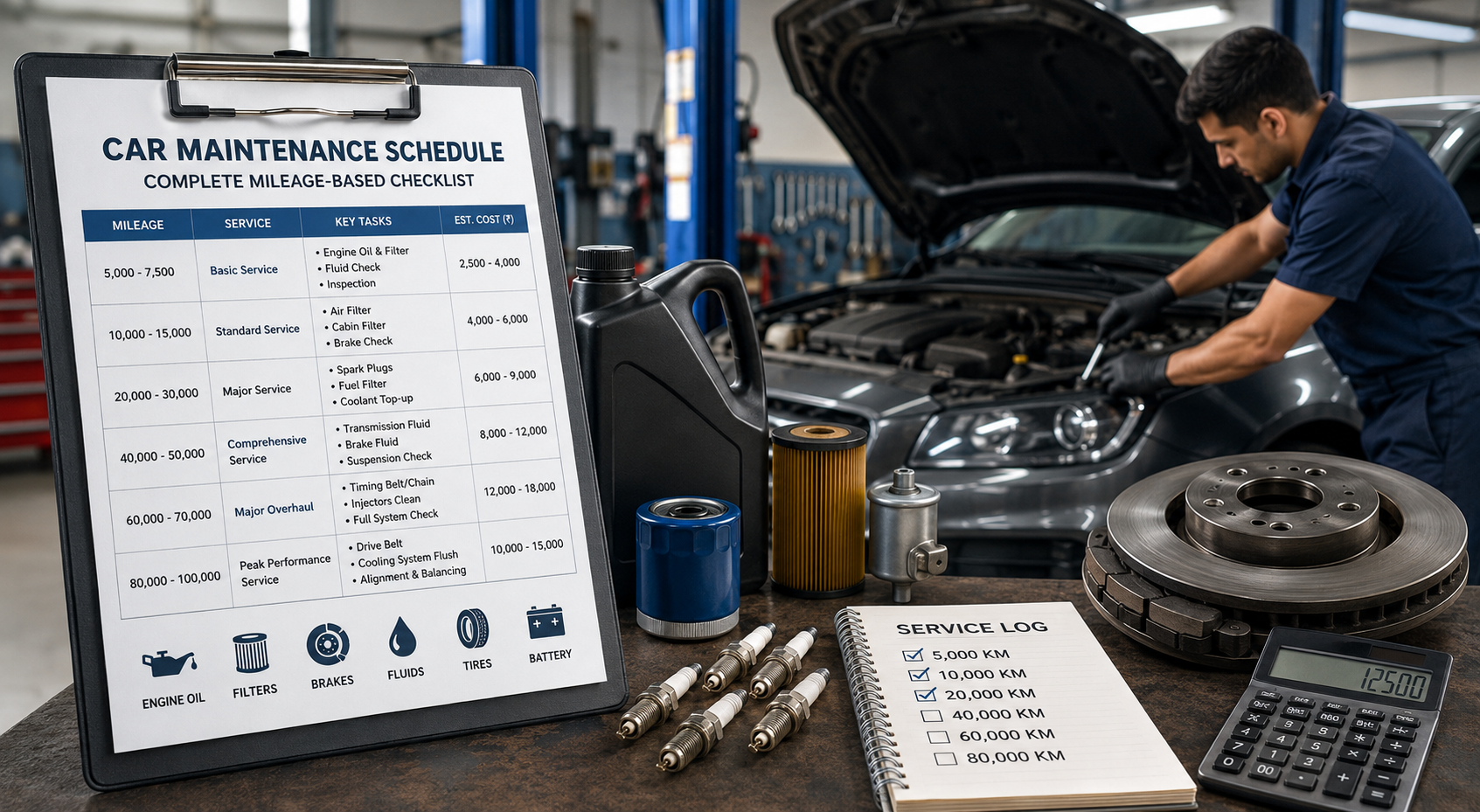
A complete car maintenance schedule runs from a 3,000–7,500 mile oil change cycle all the way to a 150,000 mile timing belt replacement — with 14 distinct services in between, each with its own interval, cost, and consequence for skipping. The average well-maintained car costs approximately $700–$1,200 per year in scheduled maintenance. The average poorly-maintained car costs $3,000–$5,000 per year in reactive repairs. Maintenance is not an expense — it is the cheapest insurance against every major repair on this list.
Every car comes with a maintenance schedule in the owner’s manual. Almost nobody reads it. So instead of following the manufacturer’s actual recommendations, most drivers operate on a mix of folklore (“change oil every 3,000 miles”), dealer recommendations that conveniently generate shop revenue, and intuition. This guide gives you the actual schedule — based on manufacturer data, not service department economics — with exact mileage intervals, realistic cost ranges, and the specific failure that follows each skipped service. Use it as your reference, not your dealer’s service reminder sticker.
Normal vs Severe Driving — Which Schedule Is Yours?
Every manufacturer publishes two maintenance schedules: one for normal driving and one for severe driving. Most drivers assume they fall into the normal category. Most drivers are wrong.
| Driving Condition | Normal or Severe? | Impact on Intervals |
|---|---|---|
| Highway commute, mixed speeds, moderate climate | Normal | Use standard intervals |
| Short trips under 5 miles, engine rarely fully warms up | Severe | Reduce oil change interval 30–50% |
| Stop-and-go city driving, frequent idling | Severe | Reduce oil and transmission intervals |
| Towing trailers or hauling heavy loads regularly | Severe | Reduce all drivetrain fluid intervals significantly |
| Extreme cold climate — below 0°F regularly | Severe | More frequent oil and battery checks |
| Extreme heat climate — above 100°F regularly | Severe | More frequent coolant and oil checks |
| Dusty or unpaved road driving | Severe | More frequent air filter and cabin filter changes |
| Track or performance driving | Severe | Significantly shortened all fluid intervals |
If two or more of the severe conditions apply to your driving — and for most urban drivers, short trips and stop-and-go traffic alone qualify — use the severe schedule. The consequence of using normal intervals in severe conditions is not cosmetic. Engine oil that should have been changed at 5,000 miles under severe conditions but was left until 10,000 miles has lost its protective film strength, has exhausted its acid-neutralizing capacity, and is actively allowing accelerated bearing and cylinder wear.
The Complete Car Maintenance Schedule — Every Service by Mileage
Every 3,000–7,500 Miles: Engine Oil and Filter
The interval depends entirely on oil type and driving conditions — not on the number printed on the service reminder sticker your shop applies to your windshield. Conventional oil: 3,000–5,000 miles. Full synthetic: 7,500–10,000 miles for most vehicles, up to 15,000 miles on some European cars with extended drain specifications. The 3,000-mile rule is a relic of the 1970s when conventional oil was less refined and engines had looser tolerances. Applying it to a modern vehicle using full synthetic oil wastes approximately $150–$200 per year in unnecessary oil changes.
What actually determines your interval: your owner’s manual. Look up “oil change interval” or “maintenance schedule” in the index. The manufacturer specifies the oil type and interval together — they are designed as a system. Using the correct full synthetic oil at the correct extended interval is not cutting corners. It is following the engineering specification.
For the complete oil type guide, viscosity selection, and what actually happens when oil is overdue, see our guide on 10 signs your car needs an oil change and our explanation of what engine oil actually does inside your engine.
| Oil Type | Normal Interval | Severe Interval | DIY Cost | Shop Cost |
|---|---|---|---|---|
| Conventional | 3,000–5,000 miles | 3,000 miles | $25–$40 | $40–$70 |
| Synthetic blend | 5,000–7,500 miles | 3,000–5,000 miles | $35–$55 | $55–$85 |
| Full synthetic | 7,500–10,000 miles | 5,000–7,500 miles | $45–$75 | $70–$120 |
| Full synthetic — extended drain spec | 10,000–15,000 miles | 7,500–10,000 miles | $55–$90 | $90–$150 |
Cost of skipping: Engine bearing damage begins gradually — invisible for months — then catastrophically. A $70 oil change skipped for 20,000 miles of extended intervals commonly results in $2,000–$6,000 engine repairs. ROI on regular oil changes: roughly 30:1 in avoided repair costs.
Every 5,000–7,500 Miles: Tire Rotation
Front and rear tires wear at dramatically different rates because of weight distribution, steering load, and braking force. On a front-wheel-drive vehicle — which is most passenger cars — the front tires bear the engine weight, steering load, and most of the drive force simultaneously. They typically wear 2–3 times faster than the rear tires. Rotating tires moves the faster-wearing fronts to the rear and vice versa, equalizing the wear rate across all four tires.
The math is straightforward: a set of tires that costs $600 will last approximately 60,000 miles with regular rotation. The same set without any rotation will need front tire replacement at 30,000 miles — $300 — and the rear tires will be unevenly worn and may not match the new fronts well. The rotation service costs $20–$50. Running without it costs the equivalent of replacing a set of tires 30,000 miles early.
Cost of skipping: Premature front tire wear requiring early replacement. On a $600 tire set, skipping rotation costs approximately $150–$200 in accelerated tire life per rotation interval skipped.
Every 15,000–30,000 Miles: Engine Air Filter
The engine air filter prevents dust, pollen, insects, and debris from entering the intake tract and passing through to the cylinders, where abrasive particles cause accelerated ring and cylinder wall wear. A clean filter allows unrestricted airflow. A clogged filter restricts airflow, causing a rich air-fuel mixture that increases fuel consumption, reduces power, and in extreme cases, causes unburned fuel to wash oil off cylinder walls.
Air filter intervals are highly environment-dependent. In a clean suburban environment, 30,000 miles is reasonable. In a dusty, rural, or construction-zone environment, 10,000–15,000 miles is more appropriate. The filter is cheap and accessible — most vehicles allow owner replacement in under 5 minutes with no tools. Open the airbox, slide out the old filter, insert the new one. The part costs $15–$30. There is no reason to pay $40–$80 for a shop to replace it.
Every 15,000–25,000 Miles: Cabin Air Filter
The cabin air filter cleans the air entering the passenger compartment through the HVAC system. A clogged cabin filter does not just reduce air quality — it restricts airflow through the heating and air conditioning system, reducing AC effectiveness, causing the blower motor to work harder (shortening its life), and in some vehicles, causing windshield fogging issues in cold weather. If your car’s AC seems weaker than it used to be, check the cabin filter before any other AC diagnosis — see our guide on car AC not blowing cold air for the complete diagnosis.
Cabin filters are almost always behind the glove box — open it, press the sides inward to release the stops, drop it down, and the filter slides out. Total replacement time: 5–10 minutes. Part cost: $15–$30. Shop charge: $60–$120. This is the highest markup service in routine maintenance — always do it yourself.
Every 20,000–50,000 Miles: Brake Fluid Flush
Brake fluid is hygroscopic — it absorbs moisture from the atmosphere over time through the rubber brake hoses and reservoir cap. As moisture content increases, the fluid’s boiling point decreases. Under heavy braking — a long mountain descent, an emergency stop, track driving — the brake fluid can boil. Boiling brake fluid creates vapor bubbles in the brake lines. Vapor is compressible. Liquid is not. Compressible fluid in brake lines produces a soft, spongy pedal and severely reduced braking force — a condition called brake fade.
Most manufacturers recommend a brake fluid flush every 2 years regardless of mileage, because moisture absorption is time-dependent rather than mileage-dependent. European manufacturers — BMW, Mercedes, Volkswagen — are particularly stringent about this and specify 2-year fluid changes. A brake fluid flush costs $80–$150 at a shop. Skipping it costs nothing until it matters — and when it matters is always at the worst possible moment. For brake system symptoms, see our guide on grinding noise when braking.
Every 30,000 Miles: Fuel Filter (Where Applicable)
Most modern vehicles have a fuel filter integrated into the fuel pump assembly inside the fuel tank — designed to last the life of the pump and not separately serviceable. However, many vehicles through the mid-2000s have an inline fuel filter in the fuel line that requires periodic replacement. A clogged fuel filter restricts fuel flow, causing hesitation during acceleration, rough idle, and eventually a no-start condition. Check your owner’s manual — if your vehicle has a serviceable fuel filter, replace it at 30,000-mile intervals. Cost: $20–$80 part, $100–$200 at a shop.
Every 30,000–60,000 Miles: Transmission Fluid
Transmission fluid — automatic, manual, or CVT — degrades from heat cycling, oxidation, and the accumulation of friction material particles from clutch packs and synchronizers. Degraded transmission fluid has reduced viscosity stability, reduced anti-wear additive concentration, and carries abrasive particles that continue to wear transmission components. The consequence of never changing transmission fluid is not theoretical — it is the primary contributing factor in transmission failures that cost $2,500–$7,000 to repair or replace.
Most manufacturers recommend transmission fluid changes every 30,000–60,000 miles under normal conditions, every 15,000–30,000 miles under severe conditions. Many label their transmissions as “lifetime fill” — meaning no scheduled fluid change. In reality, “lifetime” refers to an extended but finite service interval, not actual immortality of the fluid. Most industry experts and independent transmission specialists recommend changing “lifetime fill” automatic transmission fluid every 60,000–80,000 miles. For the complete transmission fluid guide including how to check it, see our article on how to check transmission fluid.
Every 30,000–60,000 Miles: Coolant Flush
Engine coolant’s corrosion inhibitor package depletes over time. IAT (green) coolant lasts approximately 2 years or 30,000 miles. OAT and HOAT coolants (orange, pink, blue, gold) last approximately 5 years or 100,000–150,000 miles. Once the inhibitor package is exhausted, the coolant becomes mildly acidic and begins corroding the aluminum components it was designed to protect — the radiator, water pump, heater core, and engine block water passages. The corrosion products — oxide particles and scale — build up on heat transfer surfaces and reduce cooling efficiency.
A coolant flush costs $100–$200 at a shop and can be done as a DIY service with the correct equipment for $30–$60 in parts. Skipping coolant maintenance for 100,000+ miles contributes to water pump failure ($300–$750), radiator damage ($300–$900), and in severe cases, cooling system failure that leads to overheating and head gasket damage ($1,500–$3,500). For the complete coolant guide, see our article on how to add coolant to your car correctly.
Every 50,000–60,000 Miles: Spark Plugs (Copper/Standard)
Every 80,000–100,000 Miles: Spark Plugs (Iridium/Platinum)
Spark plugs ignite the compressed air-fuel mixture in each cylinder. As the electrode erodes from the thousands of electrical discharges per minute, the spark gap widens, requiring more voltage to jump. The ignition system provides that extra voltage for a while — but at the cost of ignition coil strain and reduced combustion efficiency. Worn spark plugs cause: reduced fuel economy (typically 1–3 mpg), rough idle, misfires under load, hesitation during acceleration, and in severe cases, catalytic converter damage from unburned fuel passing through to the exhaust.
Copper plugs: $3–$8 each, replace every 30,000–50,000 miles. Iridium or platinum plugs: $8–$25 each, replace every 60,000–100,000 miles. V8 engine: 8 plugs × $20 each = $160 in parts. Shop labor for a V8 can add $200–$400. For a simple 4-cylinder with accessible plugs — a $40 part replacement that takes 30 minutes with basic tools.
Every 60,000–80,000 Miles: Brake Pads and Rotors (Inspection)
Brake pad life varies enormously — from 25,000 miles on heavy trucks in stop-and-go driving to 70,000 miles on light cars in highway driving. The wear rate depends on pad compound, vehicle weight, driving style, and whether the rear brakes are contributing proportionally. Most modern vehicles have brake pad wear sensors that illuminate a dashboard warning when pads reach the replacement threshold — but by the time the warning appears, the pads are already at minimum thickness.
Inspect brake pads at every tire rotation — look through the wheel spokes at the caliper. The visible pad material should be at least 3mm thick. Below 3mm, plan replacement. Below 2mm, replace immediately. Driving on metal-to-metal pads destroys rotors in days — a $200 pad replacement becomes a $400–$600 pad-and-rotor replacement. For brake noise diagnosis, see our guides on grinding noise when braking and car shakes when braking.
Every 60,000–100,000 Miles: Timing Belt (If Equipped)
This is the highest-stakes service on the entire maintenance schedule. Timing belts synchronize the rotation of the crankshaft and camshaft — controlling when valves open and close relative to piston position. A broken timing belt stops the engine instantly. In interference engines — the majority of modern engines — a broken timing belt allows pistons to contact open valves, bending or breaking them. The result is typically $3,000–$7,000 in engine repair or replacement.
The replacement interval is not a suggestion. It is an engineering specification based on material fatigue cycles. Most belts specify replacement between 60,000–105,000 miles. The belt itself shows no visible warning before failure — it looks fine at 98,000 miles and fails at 102,000 miles. Timing belt replacement costs $500–$1,200 at a shop. This price includes the water pump, which should always be replaced simultaneously since it is driven by the timing belt and would require the same labor to replace later.
Important: Many modern engines use timing chains rather than belts. Timing chains are designed to last the life of the engine and do not have a replacement interval. Check your owner’s manual under “timing belt” or consult your model’s specifications — this one distinction affects whether a $600–$1,200 service applies to your vehicle at all.
Every 60,000–100,000 Miles: Serpentine Belt
The serpentine belt drives the alternator, power steering pump, air conditioning compressor, and water pump from the crankshaft. A failed serpentine belt simultaneously kills the charging system, power steering, air conditioning, and on many engines, the water pump — causing immediate overheating. Unlike timing belt failure, serpentine belt failure is survivable without engine damage (on most vehicles) — but it leaves you stranded. Replacement costs $100–$250 at a shop. DIY cost: $30–$80 in parts. The belt replacement also allows inspection of the belt tensioner and idler pulleys — replace any that show bearing wear simultaneously.
Every 75,000–100,000 Miles: Power Steering Fluid Flush
Conventional hydraulic power steering fluid degrades from heat cycling and contamination over time. Degraded power steering fluid causes steering feel changes, pump whining, and accelerated pump and rack-and-pinion wear. Replacement cost at a shop: $80–$150. Note: electric power steering systems (increasingly common on modern vehicles) use no fluid and have no maintenance requirement.
Every 100,000 Miles: Major Inspection and Preventive Replacement
The 100,000 mile mark is a genuine milestone — it is when many original equipment components reach the end of their designed service life simultaneously. A thorough inspection at this point should include: cooling system pressure test and thermostat replacement, all CV axle boots inspection, all suspension bushings inspection, battery load test (most batteries are 4–6 years old at this point), oxygen sensor evaluation, and PCV valve replacement. Addressing these proactively prevents the cascade of failures that commonly follows deferred maintenance at high mileage.
Complete Maintenance Cost Table — Every Service
| Service | Interval | DIY Cost | Shop Cost | Skip Consequence |
|---|---|---|---|---|
| Oil + filter change | 3K–10K miles | $25–$75 | $40–$120 | Bearing damage — $2K–$6K |
| Tire rotation | 5K–7.5K miles | Free with equipment | $20–$50 | Early tire replacement — $300+ |
| Cabin air filter | 15K–25K miles | $15–$30 | $60–$120 | Weak AC, blower motor strain |
| Engine air filter | 15K–30K miles | $15–$30 | $30–$80 | Reduced power, fuel economy |
| Tire pressure check | Monthly | Free | Free | Blowout risk, poor MPG |
| Brake fluid flush | 2 years | $20–$40 | $80–$150 | Brake fade, spongy pedal |
| Fuel filter (if external) | 30K miles | $20–$80 | $100–$200 | Hard start, stalling |
| Transmission fluid | 30K–60K miles | $30–$80 | $150–$300 | Transmission failure — $3K–$7K |
| Coolant flush | 30K–100K miles | $30–$60 | $100–$200 | Overheating, water pump failure |
| Spark plugs (iridium) | 60K–100K miles | $40–$200 | $150–$400 | Misfires, poor economy, coil damage |
| Brake pads | 25K–70K miles | $60–$150 | $200–$400 | Rotor damage — adds $200–$300 |
| Timing belt | 60K–100K miles | Not recommended DIY | $500–$1,200 | Engine destruction — $3K–$7K |
| Serpentine belt | 60K–100K miles | $30–$80 | $100–$250 | Stranded, possible overheating |
| Battery replacement | 3–5 years | $80–$200 | $150–$300 | No-start, stranded |
Dealer Upsells — What to Accept and What to Refuse
The service writer at a dealership or quick-lube shop works partly on commission. Understanding which services are legitimate recommendations and which are high-margin, low-necessity items saves $200–$500 per service visit on average.
| Service Offered | Accept or Decline? | Reality |
|---|---|---|
| Oil change with correct interval oil | ✅ Accept | Core maintenance — do it on schedule |
| Tire rotation with oil change | ✅ Accept | Cost-effective when bundled |
| Engine air filter at every oil change | ⚠️ Check it first | Only every 15K–30K miles — inspect before agreeing |
| Fuel system cleaning / injector flush | ❌ Usually decline | Rarely needed on modern direct injection — use quality fuel instead |
| Throttle body cleaning | ❌ Usually decline | Only needed if idle issues are present |
| Power steering flush | ⚠️ Only if due | Real service but interval is 75K–100K miles, not 30K |
| Transmission fluid flush | ✅ If at interval | Legitimate — verify mileage before agreeing |
| Coolant flush | ✅ If at interval | Legitimate — verify mileage and fluid condition |
| Brake fluid flush | ✅ Every 2 years | Legitimate and important — often undervalued |
| Cabin air filter | ⚠️ Inspect first | Real service but overpriced at shops — do it yourself |
| Differential fluid flush | ⚠️ If applicable | Real service on trucks/AWD — not needed on FWD cars |
| Engine flush before oil change | ❌ Decline | Unnecessary on a properly maintained engine — wastes money |
Seasonal Maintenance Checklist
Before Winter
- Battery load test — cold weather reduces battery capacity by 20–50%; a marginal battery that starts fine at 70°F often fails at 20°F
- Coolant freeze protection check — use a hydrometer or refractometer to verify freeze protection matches your climate’s minimum temperature
- Tire tread depth check — tires under 4/32″ tread depth have significantly reduced wet and snow traction
- Wiper blade replacement — winter wiper blades handle ice and snow accumulation better than standard blades
- Four-wheel drive or AWD test — engage the system before you need it to verify it engages and disengages smoothly
Before Summer / Long Road Trips
- Check tire pressure — for every 10°F rise in temperature, tire pressure increases approximately 1 PSI. Our complete guide on how to check tire pressure covers the exact method
- Coolant level and condition — hot weather stresses the cooling system. See our guide on how to add coolant correctly
- AC system check — verify the AC is blowing cold before a road trip. Our guide on car AC not blowing cold air covers diagnosis
- Engine oil level — see our complete engine oil check guide before any major trip
The 200,000 Mile Roadmap
Reaching 200,000 miles on a vehicle requires no extraordinary maintenance — it requires consistent ordinary maintenance. The difference between a car that reaches 200,000 miles and one that is sold or scrapped at 120,000 miles is almost never mechanical fate. It is maintenance history. The following represents the approximate total maintenance investment to reach 200,000 miles:
- Oil changes (25 years of driving): $2,500–$4,500
- Tire sets (3–4 replacements): $1,800–$3,000
- Brake pads and rotors (3–4 sets): $1,200–$2,400
- Timing belt (1–2 replacements if equipped): $600–$1,500
- All other scheduled maintenance: $2,000–$4,000
- Total estimated 200K maintenance investment: $8,000–$15,000
A well-maintained vehicle worth $15,000 at 100,000 miles that costs $8,000–$15,000 to maintain through 200,000 miles carries a total per-mile ownership cost of approximately $0.08–$0.15 per mile including maintenance. Replacing that vehicle at 120,000 miles and buying another $15,000 car carries a total cost of approximately $0.20–$0.35 per mile including depreciation and purchase costs. Maintenance is not just about reliability — it is the most economical vehicle ownership strategy available.
Frequently Asked Questions
What is a car maintenance schedule?
A car maintenance schedule is a mileage and time-based plan specifying when each preventive service should be performed — from oil changes every 3,000–10,000 miles to timing belt replacement at 60,000–100,000 miles. Every vehicle manufacturer publishes a specific maintenance schedule in the owner’s manual tailored to that vehicle’s engineering specifications. Following it is the single most cost-effective action a car owner can take — routine maintenance typically costs $700–$1,200 per year, while reactive repairs on poorly maintained vehicles average $3,000–$5,000 per year.
How often should I service my car?
The most frequent service is the oil change — every 3,000–10,000 miles depending on oil type and driving conditions. Tire rotation follows every 5,000–7,500 miles. Air filters need replacement every 15,000–30,000 miles. Spark plugs last 30,000–100,000 miles depending on type. Timing belts require replacement every 60,000–100,000 miles on equipped vehicles. The complete schedule with every service, interval, and cost is in the table above — your owner’s manual provides the vehicle-specific version.
What happens if you don’t service your car?
Deferred maintenance causes cascading failures. Skipped oil changes lead to bearing damage and sludge buildup. Skipped tire rotations cause premature wear requiring early replacement. Skipped timing belt replacement on interference engines causes catastrophic engine destruction if the belt fails. Skipped transmission fluid changes cause transmission failure. Every service on the maintenance schedule exists because the consequence of skipping it is a repair that costs 10–50 times the service price. The average deferred maintenance repair is $2,000–$5,000. The service that would have prevented it averaged $100–$300.
What is a 30 60 90 maintenance schedule?
The 30-60-90 maintenance schedule is a simplified framework used by many shops — it groups major service milestones at 30,000, 60,000, and 90,000 miles. At 30,000 miles, typical services include air filter replacement, fuel filter (if applicable), and fluid inspections. At 60,000 miles, add spark plugs on copper plug vehicles, timing belt inspection, and brake system evaluation. At 90,000 miles, comprehensive inspection of all systems plus replacement of components at the end of their designed service life. The actual interval for each service within those groups varies by vehicle — the owner’s manual provides the exact schedule.
What car maintenance can I do myself?
Most routine maintenance can be DIY with basic tools: oil and filter changes, cabin air filter replacement, engine air filter replacement, tire pressure checks, battery terminal cleaning, wiper blade replacement, and fluid top-offs. Intermediate DIY includes brake pad replacement, spark plug replacement, and serpentine belt replacement. Professional service is recommended for timing belt replacement, transmission fluid changes on sealed systems, wheel alignment, and any work involving the fuel or brake hydraulic systems on late-model vehicles with complex sensors and actuators.
Related Guides
Each service on this schedule connects to a deeper guide on this site. For oil specifically: our guides on signs your car needs an oil change, how often to change synthetic oil, how to check engine oil level, and best oil for high mileage cars cover every oil maintenance question in detail. For tires: how to check tire pressure. For cooling: how to add coolant correctly. For transmission: how to check transmission fluid.