White Smoke From Exhaust: 7 Causes — Is Yours an Emergency or Normal?
White smoke from exhaust — thin wisps on a cold morning are perfectly normal. Thick, sweet-smelling smoke that persists after warm-up is a head gasket emergency. Use our thickness + smell + timing diagnostic to identify yours in 90 seconds.
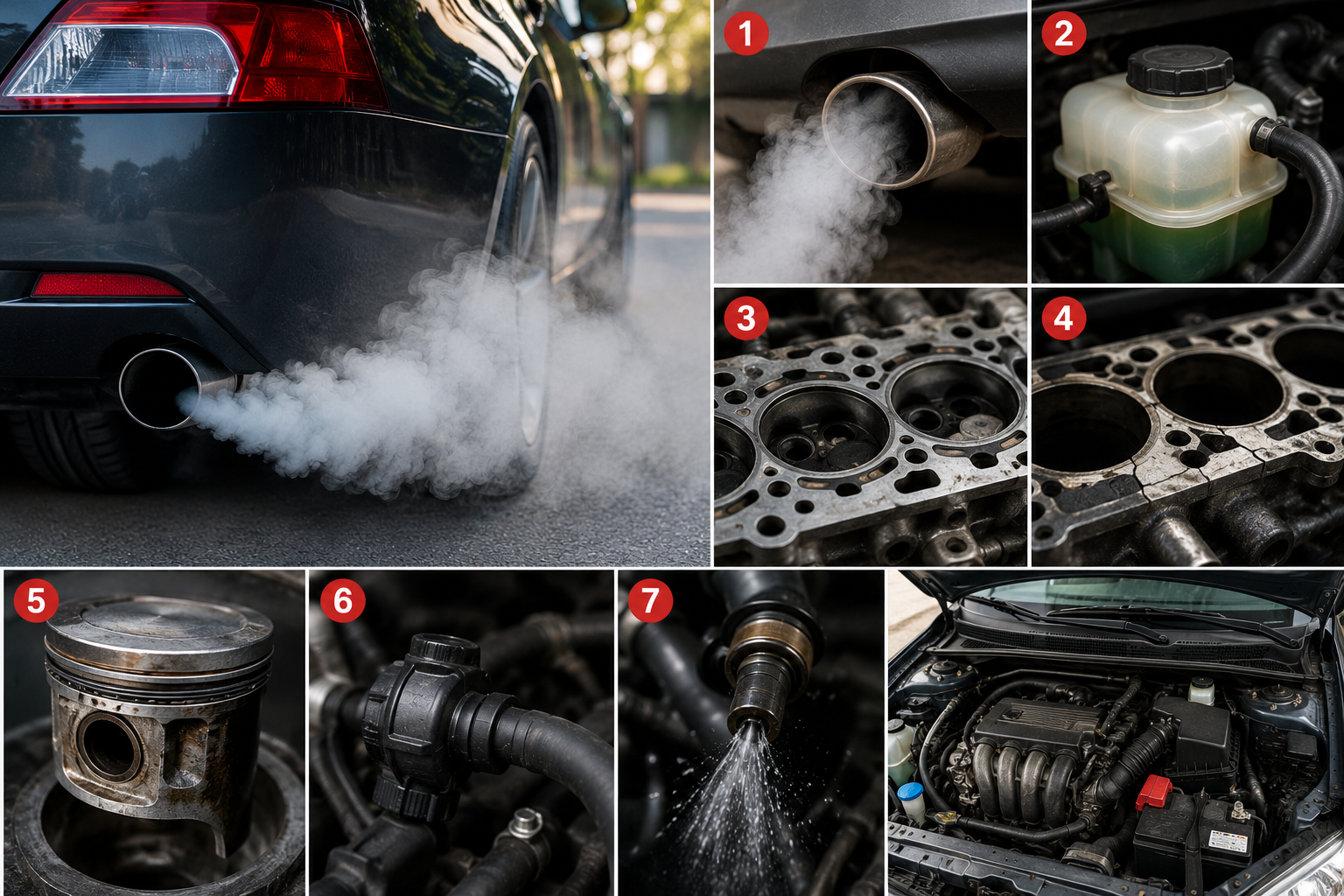
White smoke from exhaust is either completely normal or a genuine engine emergency — and the difference comes down to three observable characteristics: thickness, smell, and whether it persists after the engine warms up. Thin wisps that disappear within 60–90 seconds on a cold morning are water vapor from overnight condensation — nothing to worry about. Thick, billowing smoke with a sweet syrupy smell that continues after the engine reaches operating temperature means coolant is burning inside your combustion chamber. That is a head gasket failure or worse, and every mile you drive makes the repair more expensive.
Picture this: you walk out to your car on a cold Tuesday morning, start the engine, and watch a plume of white smoke pour from the tailpipe. Your stomach drops. Your mind goes immediately to head gaskets and four-figure repair bills. But here is what most drivers do not know — that same visual, that same white smoke, can mean nine completely different things ranging from “totally normal, do nothing” to “park this car immediately and call a tow truck.” The difference is not in what you see. It is in what you observe.
The 90-Second Diagnostic — Thickness, Smell, Timing
Every white smoke scenario can be categorized by three observable factors. Check these in order before doing anything else:
Factor 1 — Thickness
| What You See | What It Means | Urgency |
|---|---|---|
| Thin wisps — barely visible, like breath on a cold day | Water vapor / condensation — completely normal | 🟢 None |
| Light white haze — visible but translucent | Light condensation or minor coolant seep | 🟡 Monitor |
| Steady white stream — consistent, opaque | Coolant entering combustion chamber | 🔴 Diagnose today |
| Thick white clouds — heavy, billowing, continuous | Significant coolant loss — head gasket or cracked block | 🚨 Stop driving now |
Factor 2 — Smell
| Smell Description | What Is Burning | Action |
|---|---|---|
| No smell — odorless vapor | Pure water vapor — normal condensation | No action needed |
| Sweet, syrupy, almost pleasant | Coolant (ethylene glycol burning) — not good | Stop driving — diagnose head gasket |
| Acrid, harsh burning smell | Oil burning — often blue/grey not pure white | Check oil level and condition |
| Chemical / fuel smell with white smoke | Unburned fuel — rich mixture or injector issue | Diagnose fuel system |
Factor 3 — Timing: When Does It Appear?
| When White Smoke Appears | Most Likely Cause | Urgency |
|---|---|---|
| Only on cold start — disappears within 60–90 seconds | Normal condensation evaporation | 🟢 Normal — no action |
| On cold start, persists 3–5 minutes then clears | Heavy condensation buildup (frequent short trips) | 🟡 Ensure longer drives occasionally |
| On startup AND continues after full warm-up | Coolant in combustion chamber — head gasket | 🔴 Park and diagnose today |
| Only during acceleration — not at idle | Coolant leak under load pressure, or transmission fluid | 🔴 Diagnose this week |
| Constant regardless of temperature or load | Severe head gasket failure or cracked block | 🚨 Do not drive |
| Intermittent — some drives fine, some smoking | Small coolant leak or early head gasket failure | 🟠 Diagnose soon — it will worsen |
7 Causes of White Smoke From Exhaust
1. Condensation — The False Alarm That Fools Everyone
Your exhaust system is a network of metal pipes running from the engine to the tailpipe. Every night that the car sits unused, the metal cools and ambient humidity condenses on the interior surfaces as liquid water. When you start the engine the next morning, exhaust gases heat those pipes rapidly. The condensed water turns to steam and exits the tailpipe as a white vapor that looks, to the untrained eye, exactly like serious exhaust smoke.
Here is the distinguishing characteristic that separates condensation from every serious cause: it disappears. Within 60–90 seconds of running — as the exhaust system reaches operating temperature and all the condensed water evaporates — the white vapor stops completely. The exhaust returns to being invisible or nearly so. If you cannot see white smoke after 2 minutes of running, condensation is the absolute explanation and the car is fine.
Condensation is more pronounced in cold climates, on humid days, in coastal areas, and when a car has been parked overnight or for several days. It is more visible in cold air because the water vapor immediately condenses again upon exiting the warm tailpipe into the cold atmosphere — the same reason you can see your breath on a cold morning. None of this is a symptom of any mechanical problem.
One nuance worth knowing: Cars that are exclusively used for short trips — drives under 10–15 minutes that never allow the exhaust system to fully heat up — develop chronic condensation buildup inside the muffler and pipes. This accumulated water eventually causes internal rusting and can even cause the muffler to hold water audibly when you shake the car. The solution is an occasional longer highway drive that brings the entire exhaust system to full operating temperature and evaporates all accumulated moisture.
2. Blown Head Gasket — The Most Serious Cause
The head gasket sits between the engine block and the cylinder head, sealing both the combustion chambers and the coolant and oil passages that run between these two major engine components. It is a flat multi-layer steel gasket — typically 0.04 to 0.06 inches thick — doing a job that sounds simple but operates under extreme conditions: maintaining a perfect seal against combustion pressures that can reach 2,000 PSI, coolant pressures of 15–18 PSI, and temperatures cycling between 40°F cold start and 220°F+ operating temperature, thousands of times every day.
When a head gasket fails — from overheating, age, or manufacturing defect — it creates a breach between the coolant passage and the combustion chamber. Coolant under pressure from the cooling system is forced into the combustion chamber, where it joins the air-fuel mixture and burns. Coolant does not burn cleanly like fuel. It produces thick, white, steam-like smoke that is distinctly different in appearance and character from condensation: it is denser, it persists at operating temperature, and it carries the unmistakable sweet smell of burning ethylene glycol.
The five signs of head gasket failure — beyond white smoke:
- Coolant level dropping without visible external leak — coolant disappears into the combustion chamber and exits as white exhaust vapor
- Milky oil on the dipstick or oil filler cap — coolant is mixing with oil in the crankcase, creating a brown-white emulsion that looks like chocolate milk. This is catastrophic for engine lubrication
- Bubbles in the coolant reservoir — combustion gases are forcing their way into the cooling system through the head gasket breach, creating visible bubbling in the coolant when the engine is warm and running
- Overheating that comes and goes — air pockets entering the cooling system from combustion gas intrusion disrupt coolant circulation, causing intermittent overheating
- White residue on the tailpipe interior — the mineral deposits from burned coolant leave a distinctive chalky-white residue inside the tailpipe that wipes off as a white powder
At-home head gasket test: Remove the oil filler cap with the engine at operating temperature. Look at the underside of the cap. If it is coated in a creamy, tan-colored frothy emulsion — coolant has mixed with oil. Also watch the coolant reservoir with the cap removed while an assistant revs the engine — bubbles rising from the bottom of the reservoir when the engine is revved indicate combustion gases entering the cooling system through a head gasket breach.
Repair cost: Head gasket replacement is major surgery — the cylinder head must be removed, inspected for warping (caused by overheating), and either resurfaced or replaced. Shop cost: $1,200–$2,500 for a standard 4-cylinder. V6 and V8 engines run $2,000–$3,500 because of the additional complexity. If the cylinder head is warped beyond resurfacing limits, add $500–$1,200 for a replacement head. Driving on a known blown head gasket accelerates the damage exponentially — what costs $1,500 today costs $4,000 in two weeks as the cylinder head warps and the block surface degrades.
3. Cracked Cylinder Head
The cylinder head is a complex casting — aluminum in most modern engines — that forms the top of the combustion chambers, houses the valves, spark plugs, and camshafts, and contains the coolant passages that control cylinder temperature. Aluminum is an excellent heat conductor but is vulnerable to thermal shock: rapid temperature changes that cause differential expansion and contraction stress the casting at its weakest points.
A cracked cylinder head produces symptoms nearly identical to a blown head gasket — thick white smoke, coolant consumption without visible external leakage, milky oil, and the sweet exhaust smell. The distinction at home is nearly impossible — both allow coolant into the combustion chamber and both require the cylinder head to be removed and professionally inspected to identify the actual failed component. A pressure test of the cooling system and a combustion gas test of the coolant can confirm either condition.
Cylinder head cracks most commonly follow an overheating event. An engine that has overheated — particularly one that overheated severely or continued operating in the red zone — should have the cylinder head inspected even if it appears to run normally afterward. Hairline cracks in the combustion chamber may not immediately produce obvious symptoms but will worsen progressively. See our complete guide on car overheating — what to do immediately for the emergency steps that prevent head damage from reaching the cracking threshold.
Repair cost: A cracked cylinder head that can be welded or is replaceable with a quality used unit — $800–$1,800 total repair. A head that requires a new OEM or quality aftermarket replacement — $1,500–$3,000 total.
4. Cracked Engine Block
The engine block — the main iron or aluminum casting that houses the cylinders, crankshaft, and all bottom-end components — can crack under extreme conditions: a severe freezing event where coolant was not adequately protected and ice expansion cracked the casting, catastrophic overheating, or simply age and fatigue in high-mileage iron blocks. A cracked block allows coolant to enter the combustion chamber from below, producing the same thick white smoke and sweet smell as a head gasket failure.
A cracked block is the worst possible diagnosis for an older or high-mileage vehicle. Unlike a head gasket, the block cannot be practically repaired in most cases — it requires engine replacement. The economics of repairing a cracked block on a vehicle worth $4,000 typically do not make sense when a replacement engine costs $2,500–$4,000 installed. This is why a comprehensive overheating prevention strategy — checking coolant level, maintaining the cooling system, and responding immediately to temperature gauge warnings — is so economically important.
5. Coolant Leak Into Intake Manifold
The intake manifold gaskets seal the junction between the intake manifold and the cylinder head. On V6 and V8 engines, particularly General Motors’ 3.1L, 3.4L, and 3.8L V6 engines from the 1990s and 2000s, intake manifold gasket failure is extremely common and allows coolant to seep into the intake ports and combustion chambers. The resulting white smoke is often intermittent and may vary with engine temperature — more pronounced when the engine is cold and the gasket is not fully expanded, reducing or clearing as the engine warms.
Intake manifold gasket failure often also allows coolant to drip into the engine oil directly — the milky oil symptom appears here too. The repair is significantly less expensive than a head gasket because the head does not need to be removed — intake manifold gasket replacement runs $300–$700 on most V6 engines, compared to $1,200–$2,500 for a head gasket job.
6. Transmission Fluid Entering the Engine
This cause appears in almost none of the other guides on this topic — which is exactly why drivers on automatic transmission vehicles miss it entirely. Automatic transmissions use a component called a vacuum modulator (on older vehicles) or a transmission cooler line connected to the engine’s cooling system (on most modern vehicles). When the transmission cooler inside the radiator develops a leak, transmission fluid mixes with coolant and can be drawn into the engine.
Burning transmission fluid produces a distinctly different white smoke — often slightly bluish-white rather than pure white — and smells different from burning coolant. It has a more acrid, chemical smell than the sweet coolant burning smell. If you notice white-to-bluish smoke alongside a transmission that is slipping, shifting poorly, or behaving abnormally, transmission fluid contamination of the cooling system is a primary suspect. Check your transmission fluid — if the fluid on the dipstick appears pinkish or watery rather than its normal dark red color, coolant has mixed with transmission fluid.
7. Fuel Injector or Fuel System Issue
A leaking fuel injector that delivers excess fuel into the cylinder — or a failed pressure regulator causing fuel system over-pressure — can result in white or whitish-grey smoke from unburned fuel exiting the exhaust. This type of white smoke is typically accompanied by a fuel smell rather than a sweet coolant smell, a rough idle from the over-fueled cylinder, and reduced fuel economy.
Modern OBD2 systems almost always detect injector issues and trigger a check engine light with a specific cylinder misfire or fuel trim code. If white smoke appears alongside a check engine light — read the code before doing anything else. Our guide on how to reset the check engine light explains how to read codes for free at any auto parts store or with a $15 Bluetooth OBD2 adapter.
White Smoke From Exhaust — Is It Safe to Drive?
| Smoke Description | Safe to Drive? | Max Distance | Action |
|---|---|---|---|
| Thin wisps — disappears in under 90 seconds | ✅ Yes — completely normal | Normal driving | No action needed |
| Light haze — persists 2–4 minutes then clears | ✅ Yes with monitoring | Normal driving | Monitor coolant level monthly |
| Steady white stream — present at operating temperature | ❌ Not recommended | Drive to shop only | Check oil for milky appearance — book inspection |
| Thick white clouds with sweet smell | 🚨 No — park now | Zero additional miles | Stop engine. Do not restart. Tow to shop. |
| Any white smoke + coolant level dropping | 🚨 No | Zero | Head gasket failure — do not drive |
| White smoke + milky oil on dipstick | 🚨 No | Zero | Coolant in oil — engine damage already starting |
| White smoke only during hard acceleration | ⚠️ Diagnose soon | Gentle driving to shop | Check coolant level, coolant cap condition |
The Smell Test — Your Fastest Diagnostic Tool
Stand behind your car while it is running (at a safe distance in a ventilated area) and pay attention to the smell of the exhaust. This single observation gives you more diagnostic information than any visual inspection:
- No smell / clean exhaust smell: Normal — water vapor from condensation. This is what “nothing to worry about” smells like
- Sweet, syrupy, almost appealing smell: Coolant burning. Ethylene glycol has a characteristic sweet odor that is unmistakable once you know it. This means head gasket, cracked head, or intake manifold gasket failure
- Burning oil smell / acrid: Oil burning — may be blue-grey smoke rather than pure white. Related to piston rings, valve seals, or PCV system issues
- Fuel smell with white smoke: Injector or fuel system issue — unburned fuel in the exhaust stream
- Chemical / harsh smell: May indicate transmission fluid burning — check transmission fluid condition immediately
The sweet smell of burning coolant is the single most important diagnostic indicator in the entire white exhaust smoke spectrum. If you smell it, the situation is serious regardless of how thin or thick the smoke appears visually. Early head gasket failure can produce sweet-smelling exhaust with relatively thin smoke — the visual severity lags behind the actual mechanical severity.
White Smoke on Cold Start vs Warm Engine — Why It Changes Everything
The single most important question to answer about white exhaust smoke: does it persist after the engine reaches full operating temperature?
Full operating temperature means the temperature gauge has stabilized in its normal midpoint range — typically 10–15 minutes of driving. If white smoke completely disappears before or at this point and does not return during driving, acceleration, or idling — you have condensation and nothing is wrong. If white smoke is present or returns after the engine is fully warm — you have a mechanical problem that requires diagnosis.
This warm-up test eliminates condensation as a cause with certainty. It is the most important single observation you can make about white exhaust smoke and takes less than 15 minutes to perform. Do it before calling a mechanic, before buying sealant products, and before researching repair costs. Many drivers have paid for unnecessary diagnostic visits on a car that was simply showing normal cold-start condensation.
Diesel Engine White Smoke — Different Causes
Diesel engines produce white smoke from different primary causes than gasoline engines. In a diesel, white or grey-white smoke on startup is even more common than in gasoline engines — diesel combustion depends on compression heat rather than spark ignition, and a cold engine may not reach adequate combustion temperature immediately. This cold-start white smoke in a diesel is typically unburned diesel fuel vapor and is normal, particularly in cold weather.
Persistent white smoke in a diesel that continues after warm-up most commonly indicates: worn fuel injectors delivering fuel at the wrong spray pattern or timing, failed glow plugs that were not allowing adequate pre-combustion heating in cold weather (causing incomplete combustion), a coolant leak similar to gasoline engines (head gasket failure), or in turbocharged diesels — a failing injector seal or inlet manifold EGR cooler failure allowing coolant into the intake tract.
Repair Costs — Complete Guide
| Cause | DIY Possibility | Shop Cost | Note |
|---|---|---|---|
| Condensation — no repair needed | N/A | $0 | Take longer drives to evaporate buildup |
| Head gasket — 4-cylinder | Advanced DIY only | $1,200–$2,500 | Cylinder head inspection mandatory |
| Head gasket — V6/V8 | Not recommended | $2,000–$3,500 | Complex access, multiple heads on V engines |
| Cylinder head replacement | Not recommended | $1,500–$3,000 | If head is cracked beyond resurfacing |
| Intake manifold gasket | Moderate DIY | $300–$700 | Common on GM V6 engines — cheaper than head gasket |
| Engine block repair / replacement | Not possible DIY | $3,000–$7,000 | Often not economical on older vehicles |
| Transmission cooler line / radiator | Moderate DIY | $400–$900 | Flush transmission if fluid was contaminated |
| Fuel injector replacement | Moderate DIY | $300–$600 per injector | OBD2 code will identify which cylinder |
Frequently Asked Questions
Is white smoke from exhaust normal?
Thin white vapor that disappears within 60–90 seconds on startup — especially in cold weather — is completely normal condensation and requires no action. White smoke that persists after the engine reaches full operating temperature, particularly if accompanied by a sweet smell, dropping coolant level, or milky oil on the dipstick, is a serious mechanical issue requiring immediate diagnosis. The warm-up test — observing whether smoke stops after 15 minutes of running — is the definitive way to distinguish normal from serious.
What does thick white smoke from exhaust mean?
Thick, persistent white smoke from the exhaust almost always means coolant is burning inside the engine’s combustion chamber. The most common cause is a blown head gasket that allows coolant to enter the combustion chamber from the cylinder head. Other causes include a cracked cylinder head, cracked engine block, or failed intake manifold gasket. All of these are serious conditions. Do not continue driving if you see thick white smoke — the damage compounds with every mile and can turn a $1,500 repair into a $6,000 engine replacement.
What does white smoke from exhaust smell like?
Normal condensation vapor has no distinctive smell — it smells like clean exhaust or nothing at all. White smoke from a coolant leak or head gasket failure has a distinctly sweet, syrupy smell from the burning ethylene glycol in the coolant. This sweet smell is the single most reliable diagnostic indicator of a serious coolant-related exhaust problem. If white smoke smells sweet, treat it as a head gasket emergency regardless of how thin the smoke appears visually.
Can I drive with white smoke from exhaust?
If the white smoke is thin, has no sweet smell, and disappears within 90 seconds of starting — yes, you can drive normally. If the white smoke persists after the engine is fully warm, has a sweet smell, or appears alongside a dropping coolant level or milky oil — do not drive further. Park the car, let it cool, check the coolant level and oil condition, and have it towed to a mechanic. Driving with coolant entering the combustion chamber rapidly accelerates cylinder head warping and bearing damage from coolant-contaminated oil.
How do I know if I have a blown head gasket?
Five signs confirm a blown head gasket: thick white exhaust smoke with a sweet smell that persists after warm-up, coolant level dropping without any visible external leak, milky or foamy residue under the oil filler cap or on the dipstick, bubbles rising in the coolant reservoir when the engine is running at temperature, and engine overheating that comes and goes. You can confirm at home by checking the oil filler cap for white emulsion and watching the coolant reservoir for bubbles while an assistant revs the engine. A shop can use a combustion gas test kit to definitively confirm head gasket failure in minutes.
Related Guides
White exhaust smoke rarely appears in isolation. If the car has also been running hotter than normal, our emergency guide on car overheating — what to do immediately covers the critical steps that prevent head gasket damage from progressing to a cracked head. If the oil on your dipstick looks milky or abnormal, see how to check engine oil level and what every color means for the complete oil condition diagnostic. And if the check engine light came on alongside the white smoke, how to reset the check engine light shows you how to read the stored fault code — which often identifies the exact failed component before any money is spent on guesswork.