Car Jerks When Accelerating: 10 Causes Diagnosed by Speed + When It Happens
Car jerks when accelerating? The cause depends on when it happens — from a dead stop, at highway speed, or only under hard acceleration. Our speed-based diagnostic matrix identifies your exact cause before you spend a dollar, with repair costs and urgency scale for every scenario.
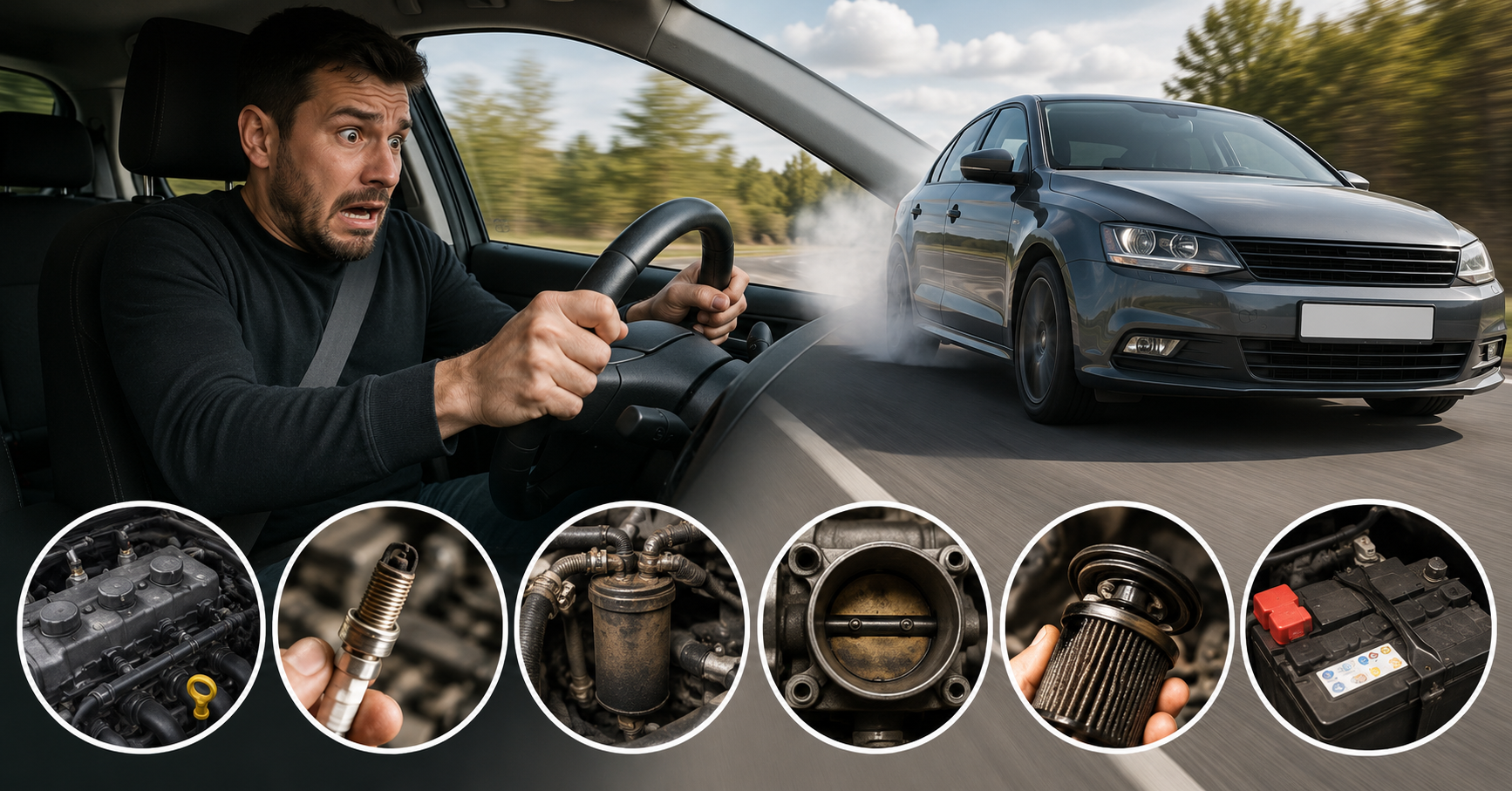
A car that jerks when accelerating is diagnosing itself — you just need to know the language. Jerking from a dead stop points to the transmission or clutch. Jerking at highway speed under load points to the fuel or ignition system. Jerking only during hard acceleration points to sensors or the throttle system. Random, unpredictable jerking at any speed points to misfires or a failing fuel pump. Each pattern is a different problem requiring a different fix — and treating the wrong cause is how a $50 air filter replacement turns into a $2,000 transmission job.
Press the gas pedal. Car surges. Hesitates. Lurches forward. Repeats. It is one of the most unsettling sensations a driver experiences — that rhythmic stuttering or sudden grab-and-release that replaces smooth acceleration. Depending on when and how it happens, this single symptom comes from ten very different mechanical sources. This guide gives you the diagnostic framework to identify yours, because every other guide on this topic lists causes without giving you the tools to find which one is actually in your car.
Diagnostic Matrix — When Does Your Car Jerk?
Before causes, narrow down the scenario. The timing and speed context of the jerk eliminates most causes immediately.
| When the Jerk Happens | Speed/Condition | Primary Suspect | Check Engine Light? |
|---|---|---|---|
| Only when moving from a complete stop | 0–10 mph | Transmission fluid low / torque converter / clutch (manual) | Maybe |
| At low city speeds, not from stop | 15–35 mph | Dirty fuel injectors / clogged catalytic converter | Often |
| Only during hard acceleration — fine at light throttle | Any speed, high load | Fuel pump failing / clogged fuel filter | Sometimes |
| At highway speed, consistent cruise | 50–70 mph | Transmission torque converter shudder / worn spark plugs | Sometimes |
| Random — no consistent speed or condition | Variable | Engine misfire (ignition coil, spark plug, injector) | Almost always |
| Only in specific gear (automatic) | Gear-specific | Torque converter clutch / transmission solenoid | Often |
| Cold start only — smooth when warm | Cold engine | Dirty throttle body / IAC valve / mass airflow sensor | Sometimes |
| Only when shifting gears (manual) | Shift moments only | Worn clutch / clutch hydraulics / syncronizer wear | Rarely |
| Gets worse as fuel tank gets low | Any speed | Failing fuel pump (draws air near empty) | Sometimes |
| After recent repair or parts replacement | Any speed | Sensor not reset / vacuum line disconnected / wrong parts | Often |
Automatic vs Manual — The Split That Changes Everything
The first diagnostic split is not speed — it is transmission type. Automatic and manual transmissions have almost no overlapping causes for acceleration jerking.
| Cause | Automatic | Manual |
|---|---|---|
| Dirty fuel injectors | ✅ Yes | ✅ Yes |
| Worn spark plugs | ✅ Yes | ✅ Yes |
| Failing fuel pump | ✅ Yes | ✅ Yes |
| Clogged catalytic converter | ✅ Yes | ✅ Yes |
| Mass airflow sensor fault | ✅ Yes | ✅ Yes |
| Torque converter shudder | ✅ Yes | ❌ No torque converter |
| Transmission solenoid fault | ✅ Yes | ❌ No solenoids |
| Worn clutch / slipping clutch | ❌ No | ✅ Yes |
| Clutch hydraulics / master cylinder | ❌ No | ✅ Yes |
| Worn syncronizers | ❌ No | ✅ Yes |
The 10 Causes — Full Diagnosis
1. Dirty or Clogged Fuel Injectors — Most Common Overall
Fuel injectors spray a precisely metered amount of fuel into the combustion chamber as a fine mist. When deposits accumulate on the injector tip — from normal combustion byproducts, low-quality fuel, and short-trip driving that never fully heats the injectors — the spray pattern degrades. Instead of a fine cone of atomized fuel, a clogged injector drips unevenly, creating inconsistent combustion in that cylinder. The engine produces normal power on most cycles and reduced power on others, creating the rhythmic grab-and-release you feel as acceleration jerking.
The diagnostic pattern: acceleration jerking that is consistent and predictable — not random — and tends to occur most noticeably at partial throttle during city driving. Often accompanied by slightly reduced fuel economy and occasionally a rough idle. On modern vehicles with individual cylinder misfire monitoring, a clogged injector may not store a fault code unless the misfire crosses a threshold, so the check engine light is not always present.
First step: Try a bottle of quality fuel injector cleaner (Techron, Lucas, BG 44K) added to a full tank of premium fuel. Drive aggressively through the tank to run hot fuel through the injectors. Repeat for two consecutive tanks. If the jerk improves or disappears — injector deposits were the cause. If not, professional ultrasonic injector cleaning ($100–$200) or replacement ($300–$600 per injector) is the next step.
2. Worn or Fouled Spark Plugs
Spark plugs that have exceeded their service life — or that have become oil-fouled, carbon-fouled, or have an eroded electrode — produce an inconsistent or weak spark. Inconsistent spark means inconsistent combustion: some cycles fire completely, others fire weakly or not at all. The result is a misfire — felt as a jerk or stutter, most noticeably during acceleration when the engine needs consistent combustion most.
Spark plug misfires almost always store a fault code. If your check engine light is on alongside the jerk, read the code before anything else — our guide on how to reset the check engine light shows how to read codes free at any auto parts store. P0300 (random misfire), P0301–P0308 (cylinder-specific misfire) directly point to spark plugs, ignition coils, or injectors. Knowing which cylinder is misfiring lets you focus the diagnosis immediately rather than replacing all plugs as a guess.
Copper plugs need replacement every 30,000–50,000 miles. Iridium or platinum plugs last 60,000–100,000 miles. A set of spark plugs costs $20–$100 depending on engine type and is one of the highest ROI maintenance items on the schedule. If your car is within 10,000–15,000 miles of the plug replacement interval and experiencing jerking acceleration — replace them before doing any further diagnosis.
3. Failing Fuel Pump
The fuel pump must maintain consistent pressure in the fuel rail at all times — especially under hard acceleration when fuel demand spikes suddenly. A failing pump maintains adequate pressure at light throttle and cruise but cannot meet the demand spike during hard acceleration. The engine momentarily runs lean — too little fuel — which causes a hesitation or jerk precisely when you push the gas pedal hard.
Two specific patterns point to a failing fuel pump over other causes. First: the jerk is most pronounced during hard acceleration (merging, passing) but the car drives fine at steady cruise and light throttle. Second: the jerk gets worse as the fuel level drops — a weak pump at the bottom of the tank draws air when fuel level is low, causing the same lean stumble.
A fuel pressure test definitively confirms or eliminates this cause. A pressure gauge connected to the Schrader valve on the fuel rail shows whether pressure drops during snap acceleration — a healthy pump holds steady pressure, a failing pump shows a momentary drop that corresponds to the hesitation you feel. Fuel pump replacement costs $400–$900 depending on whether the pump assembly is accessible or requires fuel tank removal (most modern vehicles).
4. Clogged Catalytic Converter
The catalytic converter’s ceramic substrate can fracture internally — from overheating, misfires that send unburned fuel through the exhaust, or simple old age — and the broken pieces partially block the exhaust flow. High exhaust back pressure from a clogged converter restricts the engine’s ability to expel exhaust gases, which limits how much fresh air-fuel mixture can enter in the next cycle. The restriction gets worse under high load and at higher speeds when exhaust flow is greatest.
The diagnostic pattern: jerking that worsens progressively as engine speed increases — fine at idle, mild at low speed, noticeable at highway speed, and severe during hard acceleration. Often accompanied by a sulfuric smell from the exhaust and reduced top-end power. Fuel economy may worsen significantly. A shop can test back pressure with a pressure gauge in the oxygen sensor bung, or verify with a vacuum gauge at the intake.
Catalytic converter replacement costs $400–$2,500 depending on vehicle and converter type (direct-fit OEM vs aftermarket universal). California and other CARB-state vehicles require CARB-compliant converters — verify before purchasing any replacement part.
5. Mass Airflow Sensor Fault
The mass airflow (MAF) sensor measures the volume and density of air entering the engine. The ECU uses this reading to calculate how much fuel to inject for the correct air-fuel ratio. A dirty or failing MAF sensor sends incorrect readings — the ECU injects too much or too little fuel based on bad data. The result is an air-fuel mixture that swings rich and lean, creating hesitation and jerking particularly during transitions — when you accelerate from low throttle to moderate throttle, the momentary wrong mixture causes a stumble.
MAF contamination is common on vehicles using oiled aftermarket air filters (K&N, Spectre) that are not properly cleaned — excess oil migrates onto the MAF sensor wire. Cleaning the MAF sensor with dedicated MAF cleaner spray ($8–$12 at any auto parts store) takes 10 minutes and resolves many MAF-related drivability issues without replacement. If cleaning does not help, MAF sensor replacement costs $100–$300 for the part.
6. Torque Converter Shudder (Automatic Only)
Automatic transmissions use a torque converter to transfer engine power to the transmission at low speeds, and then lock up the converter at higher speeds for direct mechanical coupling. The lockup clutch inside the torque converter engages at approximately 40–55 mph during cruise. When the converter fluid degrades or the lockup clutch material wears, the clutch engagement becomes rough and inconsistent — producing a specific shudder or vibration felt as rapid, rhythmic pulsing during light acceleration at highway speeds.
Torque converter shudder has a very specific signature: it appears during light to moderate throttle in a specific speed range (typically 40–55 mph), has a rapid vibration frequency (not a single jerk but a fast oscillation), and disappears when you either accelerate hard (converter clutch disengages) or let off the gas completely. It also disappears below or above the converter lockup speed range.
First fix: change the transmission fluid with the correct ATF type. Fresh fluid with the correct friction modifier package often resolves torque converter shudder within 50–100 miles of driving. A dedicated “shudder fix” additive (TP-10, Lubegard) added to fresh ATF resolves a significant percentage of shudder cases. If fluid change does not help, the torque converter itself may need replacement — $800–$2,500 at a shop. See our guide on how to check transmission fluid for the correct fluid change procedure.
7. Worn or Slipping Clutch (Manual Only)
A worn clutch disc in a manual transmission cannot maintain a consistent grip between the engine flywheel and the transmission input shaft. Under load — during acceleration, hill climbing, or gear changes — the clutch intermittently slips. The slip is felt as a momentary disconnect and re-engagement of drive: the engine revs slightly, then the clutch grabs again, producing the characteristic jerk. Early clutch slip is most noticeable during hard acceleration from higher gears; severe wear produces slip during normal acceleration.
Clutch wear test: in a safe, clear area, accelerate in 3rd or 4th gear at moderate speed and then push the throttle to the floor. Watch the tachometer. In a healthy clutch, engine RPM and vehicle speed rise together proportionally. A slipping clutch shows the tachometer spiking upward while vehicle speed changes slowly — the engine is revving but the power is not getting to the wheels. Clutch replacement costs $800–$2,000 depending on vehicle — includes clutch disc, pressure plate, throwout bearing, and pilot bearing.
8. Throttle Body or Throttle Position Sensor Fault
Carbon deposits accumulate on the throttle body plate over time — restricting airflow and causing the idle air control system to work harder to maintain stable idle. When the throttle opens during acceleration, the airflow change does not match what the ECU expects, creating a momentary stumble. A dirty throttle body causes jerking primarily at light to moderate acceleration and during deceleration-to-acceleration transitions.
A throttle position sensor (TPS) that is failing sends incorrect data about the throttle opening angle to the ECU. The ECU injects fuel based on throttle position — incorrect TPS data causes wrong fueling during acceleration. TPS faults almost always store codes (P0120–P0124) in the ECU and illuminate the check engine light.
Throttle body cleaning is a DIY task — remove the intake hose, spray throttle body cleaner on a rag (not directly into the throttle body on drive-by-wire vehicles), wipe the plate and bore clean. Takes 15–20 minutes, costs $5–$10 in cleaner. TPS replacement: $50–$200 for the sensor.
9. Low or Contaminated Transmission Fluid (Automatic)
Transmission fluid serves as both lubricant and hydraulic fluid in an automatic transmission. When fluid is low or degraded, the hydraulic pressure that shifts gears and engages clutch packs becomes inconsistent. The result: gear engagement that is rough, delayed, or incomplete — felt as jerking or grabbing when the transmission attempts to shift or when it slips between engagement states during acceleration.
Low transmission fluid from a slow leak causes progressively worsening jerk as the fluid level drops. Degraded fluid that has lost its friction modifier properties causes harsh clutch engagement. Both produce acceleration jerking, but the low-fluid jerk is usually worse under hard acceleration (more hydraulic demand) while the degraded-fluid jerk is consistent at all acceleration levels. Check transmission fluid level and condition — our complete guide on how to check transmission fluid covers the warm-engine procedure and the 6-color condition diagnostic.
10. Ignition Coil Failure
Modern vehicles use individual ignition coils — one per cylinder — rather than a single distributor. A failing coil produces a weak or intermittent spark to its cylinder, causing that cylinder to misfire. Unlike a worn spark plug (which fires weakly but consistently), a failing coil causes a random misfire — sometimes firing normally, sometimes failing completely. The random pattern creates jerking that feels more irregular and violent than the rhythmic stutter of a fuel injector issue.
Ignition coil failure almost always triggers a check engine light with a cylinder-specific misfire code (P0301–P0308). The code identifies exactly which cylinder is misfiring. A quick swap test — move the coil from the misfiring cylinder to an adjacent one, then re-scan for codes — confirms the diagnosis. If the misfire code follows the coil to the new cylinder, the coil is bad. If the misfire stays at the original cylinder, the spark plug or injector is the cause. Coil replacement: $50–$150 per coil at a shop; DIY is straightforward on most vehicles.
Is It Safe to Drive? — Urgency by Cause
| Cause | Safe to Drive? | Max Distance | Risk of Driving On |
|---|---|---|---|
| Dirty fuel injectors | ✅ Yes — short term | Normal with care | Worsens over time, potential catalytic damage |
| Worn spark plugs | ⚠️ Limited | Drive to shop | Catalytic converter damage from unburned fuel |
| Flashing CEL + misfire | 🚨 Stop driving | Zero — pull over | Active catalytic converter destruction — expensive |
| Failing fuel pump | ⚠️ Limited | Drive to shop | Risk of stalling in traffic — safety issue |
| Clogged catalytic converter | ✅ Short term | Normal driving to shop | Converter fails completely — expensive |
| Torque converter shudder | ✅ Yes | Normal driving | Transmission wear if left for months |
| Slipping clutch | ⚠️ Limited | Drive to shop soon | Complete clutch failure — stranded |
| MAF sensor fault | ✅ Yes | Normal driving | Poor economy, drivability — low safety risk |
| Low transmission fluid | 🚨 Limited — check first | Check before driving | Transmission damage if severely low |
| Ignition coil failure with flashing CEL | 🚨 Stop | Zero | Catalytic converter damage within miles |
Complete Repair Cost Guide
| Repair | DIY Cost | Shop Cost | Time |
|---|---|---|---|
| Fuel injector cleaner (try first) | $10–$25 | N/A | Add to tank |
| MAF sensor cleaning | $8–$12 (cleaner) | $50–$100 | 15 minutes |
| Throttle body cleaning | $5–$15 | $80–$150 | 20 minutes |
| Spark plug replacement (4-cyl) | $20–$60 parts | $100–$250 | 30–90 minutes |
| Ignition coil replacement (1 coil) | $30–$80 parts | $150–$300 | 30–60 minutes |
| Fuel injector cleaning (professional) | N/A | $100–$200 | 1–2 hours |
| Fuel injector replacement | $50–$150 per injector | $300–$600 per injector | 2–4 hours |
| TPS (throttle position sensor) | $30–$80 parts | $150–$350 | 30–60 minutes |
| Transmission fluid change | $30–$80 | $150–$300 | 1–2 hours |
| Catalytic converter | N/A recommended | $400–$2,500 | 2–4 hours |
| Fuel pump replacement | $80–$200 parts | $400–$900 | 2–4 hours |
| Clutch replacement (manual) | $200–$400 parts | $800–$2,000 | 5–8 hours |
| Torque converter replacement | N/A | $800–$2,500 | 6–10 hours |
Frequently Asked Questions
Why does my car jerk when accelerating?
A car jerks when accelerating because of an inconsistency in fuel delivery, ignition timing, or transmission engagement. The most common causes are dirty fuel injectors (inconsistent fuel spray), worn spark plugs (weak or missed ignition), a failing fuel pump (insufficient pressure during demand spikes), a clogged catalytic converter (back pressure), or transmission issues (torque converter shudder in automatics, clutch slip in manuals). The specific timing and speed context of the jerk narrows the cause — jerking from a stop points to transmission, jerking under hard acceleration points to fuel system, random jerking points to misfires.
Is it safe to drive a car that jerks when accelerating?
Depends on the cause. Mild jerking from dirty injectors or a worn throttle body is generally safe to drive to a shop for diagnosis. A solid check engine light with a misfire code means drive to the shop soon. A flashing or blinking check engine light means stop immediately — an active misfire is destroying the catalytic converter with every mile. Low transmission fluid requires checking before any further driving. When in doubt, drive directly to a diagnostic shop rather than continuing normal daily use.
Why does my car jerk when accelerating from a stop?
Jerking specifically from a dead stop on an automatic transmission most commonly indicates torque converter issues, low or degraded transmission fluid, or a faulty transmission solenoid. On a manual transmission, jerking from stop is almost always clutch-related — either worn clutch material, hydraulic clutch issues, or a mechanical linkage problem. Engine-side causes (injectors, plugs, MAF) can also cause hesitation from stop but are more likely if the jerk also occurs during acceleration at speed.
Why does my car hesitate and then accelerate?
A hesitation followed by normal acceleration — where the car briefly refuses to respond when you press the gas, then suddenly surges forward — most commonly points to a throttle position sensor fault, dirty throttle body, or mass airflow sensor issue. The hesitation is the brief moment when the ECU receives incorrect data and delivers the wrong fuel-air mixture before correcting. Hesitation that only occurs under hard acceleration (not light throttle) points more specifically to the fuel pump reaching its delivery limit or a clogged fuel filter restricting flow during demand spikes.
Can low oil cause a car to jerk when accelerating?
Indirectly, yes. Severely low oil reduces lubrication across all engine components, increasing friction and heat. This can cause misfires, reduced compression, and rough running that produces symptoms similar to acceleration jerking. However, low oil does not directly cause the fuel or ignition issues that typically produce jerk symptoms — it causes more of a general rough running or power loss. If your car jerks and the oil level is low, top up first and recheck. If jerking continues with correct oil level, the underlying cause is elsewhere. Check oil level using the guide on how to check engine oil level correctly.
Related Guides
If your check engine light came on alongside the jerk, read the fault code before any repairs — our check engine light guide shows how to read codes for free. For transmission-related jerking, our transmission fluid check guide covers the level and condition diagnostic. And if the car is also making a knocking or ticking sound alongside the jerk, that combination of symptoms points to a more serious engine issue requiring professional diagnosis before continued driving.