Car Won’t Accelerate: 9 Causes Diagnosed by RPM Behavior + Speed
Car won’t accelerate properly? The single most important diagnostic observation: do the RPMs rise when you press the gas, or do they stay flat? RPMs rise but no speed increase means the engine has power but it’s not reaching the wheels — transmission problem. RPMs stay flat means the engine itself isn’t producing power — fuel, ignition, or air problem. This guide diagnoses all 9 causes using that critical distinction.
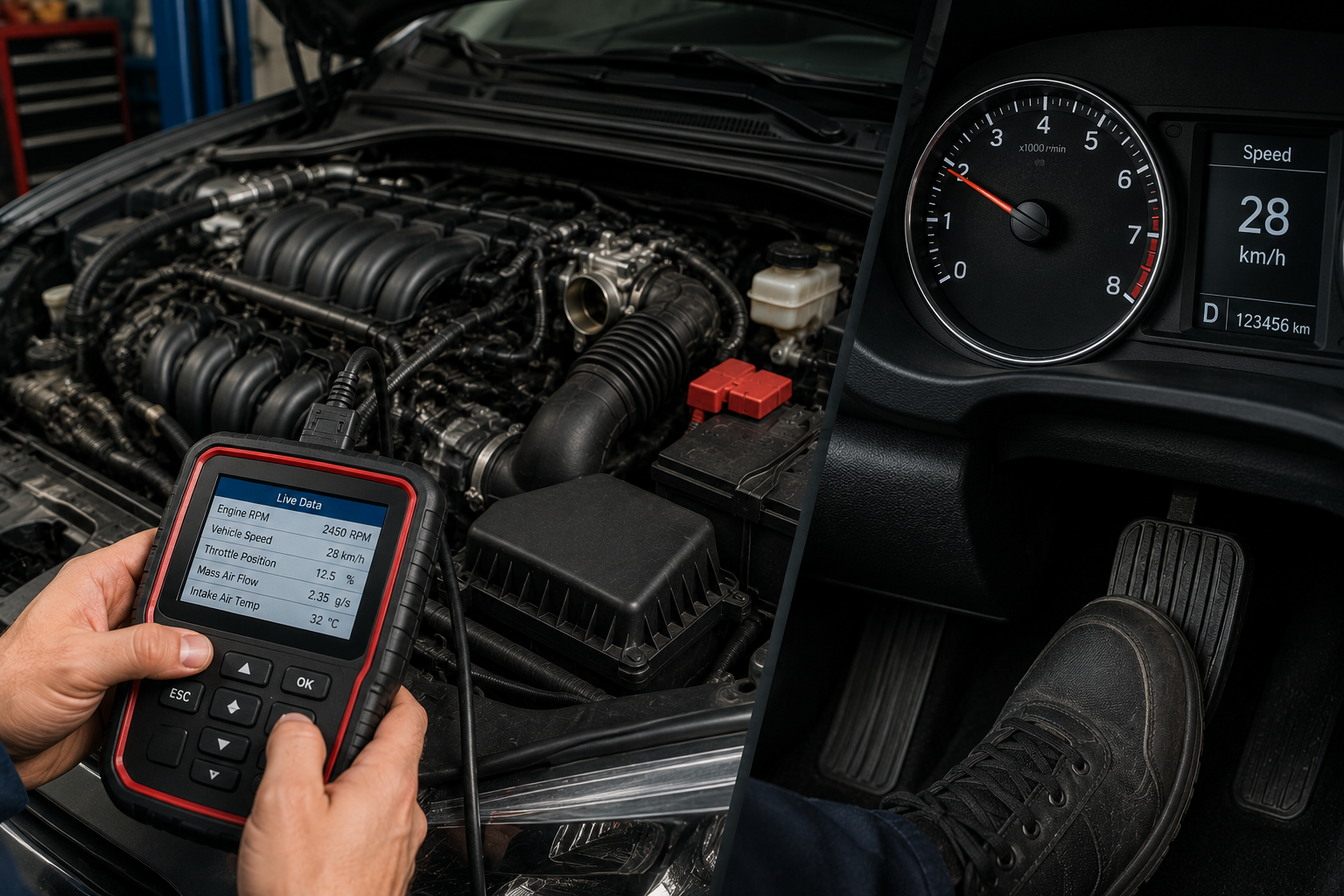
When a car won’t accelerate, the tachometer tells you more than anything else. Press the gas pedal and watch the RPM gauge. If RPMs climb normally but the car barely moves — the engine is producing power but the transmission is failing to transfer it to the wheels. If RPMs stay flat and barely rise when you press the gas — the engine itself is the problem, not the transmission. This one observation eliminates half the possible causes before any testing begins and determines whether the repair is a $300 fluid change or a $3,000 transmission rebuild.
Acceleration loss comes in two fundamentally different forms that feel similar from the driver’s seat but originate in completely different systems. A car that feels sluggish, unresponsive, or simply refuses to build speed when you press the accelerator has one of nine specific causes — and identifying which requires understanding a key mechanical distinction that most acceleration guides never explain. This guide works through that distinction systematically before diving into individual causes.
The Critical First Question — What Are the RPMs Doing?
| What Happens When You Press the Gas | What It Means | Problem Location |
|---|---|---|
| RPMs rise normally — car barely accelerates or stays slow | Engine producing power — transmission not transferring it | Transmission, clutch, torque converter, or driveline |
| RPMs stay flat — engine doesn’t rev up | Engine not responding to throttle input | Throttle system, fuel delivery, ignition, or air supply |
| RPMs rise but slowly — car accelerates but weakly | Engine producing partial power — power loss condition | Fuel delivery, clogged filter/converter, ignition weakness |
| RPMs surge then drop — acceleration unsteady | Inconsistent fuel or ignition delivery | Injectors, fuel pump, ignition coils, MAF sensor |
| RPMs and speed both normal until specific gear — then stops | Single gear or shift point problem | Specific transmission solenoid or gear failure |
| Check engine light on + poor acceleration | ECU detected fault — possible limp mode | Read codes first — determines which system |
Understanding Limp Mode — Why Your Car Deliberately Won’t Accelerate
Limp mode — also called fail-safe mode or reduced power mode — is a deliberate ECU response to a detected fault. When the engine control unit detects a sensor reading, pressure reading, or temperature that falls outside acceptable parameters and could cause engine or transmission damage if full power is allowed, it restricts engine output to a safe level. The car continues to run and can be driven, but throttle response is severely limited — typically allowing only enough power to reach 30 to 40 mph and requiring very deep accelerator input to achieve even that.
Limp mode almost always accompanies a check engine light. Reading the stored fault codes is the fastest way to identify what triggered limp mode and therefore what needs repair. Trying to diagnose a limp mode vehicle by testing components without reading codes first is working in the wrong direction — the codes often identify the exact failed component. Limp mode can be triggered by transmission temperature sensor faults, throttle position sensor faults, manifold pressure sensor faults, and several other conditions. Once the triggering fault is repaired, limp mode clears.
9 Causes of Acceleration Problems
Causes 1–3: RPMs Rise But Car Won’t Accelerate (Transmission/Drivetrain)
1. Slipping Transmission (Automatic)
An automatic transmission transfers engine power to the drive wheels through a series of clutch packs — multiple friction discs that clamp together to create a connection between rotating components. When these clutch packs wear, or when transmission fluid has degraded beyond its ability to provide the correct friction coefficient, the clutch packs slip under load. The engine revs freely because it is not meeting resistance from the drivetrain, but the slipping clutch packs fail to transfer that rotational power to the wheels. The car moves slowly or not at all despite the engine revving.
Transmission slip has a characteristic feel: the engine RPMs spike higher than expected when accelerating, then may partially engage and pull the car forward hesitantly, then slip again. It is most pronounced during initial acceleration from a stop and during upshifts. It typically worsens as the transmission warms up — cold transmission fluid is thicker and provides more friction despite worn clutch packs, but as it thins at operating temperature the slip becomes more pronounced.
First action: check transmission fluid level and condition using the warm-engine dipstick procedure. Dark brown or black fluid indicates severely degraded fluid that may have contributed to clutch pack wear. A fluid and filter change ($150 to $300) resolves slip caused purely by fluid degradation if caught early. If fluid is correct and slip persists, internal clutch pack wear requires transmission rebuild or replacement — $1,500 to $4,000 depending on vehicle. See our guide on how to check transmission fluid for the complete procedure.
2. Worn Clutch (Manual Transmission)
On a manual transmission vehicle, a worn clutch disc creates the same RPM-rises-but-no-speed effect. The clutch disc friction material has worn thin enough that under load — when you release the clutch pedal and try to transfer engine torque to the gearbox — the disc slips against the flywheel rather than gripping it. Engine speed rises freely. Vehicle speed does not follow.
The slip test for a worn clutch: in a safe area, engage 3rd or 4th gear at moderate speed and then apply full throttle. Watch the tachometer. On a healthy clutch, engine RPM and vehicle speed rise together proportionally. On a slipping clutch, the tachometer spikes upward while vehicle speed changes slowly or not at all — you can feel the engine revving but the car is not accelerating correspondingly. Clutch replacement costs $800 to $1,800 depending on vehicle — includes disc, pressure plate, throwout bearing, and typically the rear main seal while access is available.
3. Torque Converter Failure (Automatic)
The torque converter multiplies engine torque at low speeds through hydraulic coupling. A torque converter that has failed internally — collapsed one-way clutch, failed stator — loses its torque multiplication function. The engine revs but the hydraulic coupling is too weak to transmit adequate power to the transmission input shaft. The car moves slowly under load despite engine response.
Torque converter failure is typically accompanied by shuddering during light acceleration at cruise speed (the lockup clutch failing) alongside the low-speed acceleration weakness. Transmission fluid that is dark or smells burnt often accompanies converter failure — the converter’s friction material deposits into the fluid as it deteriorates. Torque converter replacement requires transmission removal and runs $800 to $2,500 at a shop.
Causes 4–7: RPMs Flat — Engine Not Responding (Fuel/Air/Ignition)
4. Throttle Body or Throttle Position Sensor Fault
The throttle body controls how much air enters the engine. On drive-by-wire systems — which include most modern vehicles — there is no physical cable between the accelerator pedal and the throttle plate. The pedal sends an electronic signal to the ECU, which commands a small motor to open the throttle plate proportionally. A throttle body that is heavily carboned, a throttle motor that is failing, or a throttle position sensor providing incorrect readings to the ECU all produce the same symptom: pressing the accelerator produces little or no engine response.
Drive-by-wire throttle faults almost always store fault codes — P0120 through P0124 for TPS issues, P2101 through P2119 for throttle control faults. These codes are the fastest path to diagnosis. A throttle body cleaning resolves carbon-related sluggishness without any component replacement. TPS replacement costs $50 to $200. Throttle body replacement (if the motor has failed) runs $200 to $500. After any throttle body work on a drive-by-wire system, the throttle body relearn procedure must be performed to allow the ECU to recalibrate the new baseline position.
5. Clogged Fuel Filter or Failing Fuel Pump
Fuel delivery restrictions cause acceleration loss that is most pronounced under high demand — pressing the accelerator hard — and least pronounced at light throttle. A clogged fuel filter restricts the maximum fuel flow rate, which becomes limiting only when the engine demands more fuel than can pass through the restriction. Light throttle driving may feel almost normal, but hard acceleration produces a flat, unresponsive feeling as the engine is starved of fuel at the moment it needs maximum delivery.
A failing fuel pump has a similar pattern but with an additional characteristic: it often gets worse as the fuel tank drops below a quarter full (the pump may draw air near the bottom of the tank) and may get worse after sustained highway driving as the pump overheats. A fuel pressure test during the conditions that cause the acceleration problem is the definitive diagnostic — a pressure drop at the moment of acceleration confirms the fuel delivery limitation. Fuel filter replacement (where accessible): $30 to $100. Fuel pump replacement: $400 to $900.
6. Clogged Catalytic Converter
A catalytic converter whose internal substrate has fractured and partially blocked the exhaust path creates back pressure that limits how efficiently the engine can expel exhaust gases. Since incoming air volume is proportional to exhaust volume expelled, restricted exhaust means restricted intake — the engine cannot breathe adequately and power output drops. The acceleration loss from a clogged converter is progressive during a drive — the car may accelerate adequately when cold but worsen noticeably after 10 to 15 minutes of driving as the exhaust system heats up and the partially blocked converter restricts flow more significantly at operating temperature.
A quick field check: carefully hold your hand several inches behind the tailpipe during wide-open throttle acceleration (have a helper do this safely, not while driving). A healthy exhaust at full throttle produces strong, steady flow. A clogged converter produces weak, intermittent flow despite the engine revving. A back pressure test with a gauge in the pre-cat oxygen sensor bung definitively measures restriction. Catalytic converter replacement: $400 to $2,500 depending on vehicle and converter specification.
7. Mass Airflow Sensor Fault
A MAF sensor reading significantly low causes the ECU to under-fuel the engine — it calculates that less air is entering than actually is, so it injects proportionally less fuel. The engine runs lean. A lean engine produces less power and responds sluggishly to throttle input because the combustion events are fuel-starved. The acceleration limitation is proportional — light throttle feels nearly normal, hard acceleration feels flat and unresponsive as the fuel deficit becomes most significant at maximum demand.
The field test: disconnect the MAF sensor. The ECU enters failsafe mode using a default fueling map. If acceleration noticeably improves with the MAF disconnected — the MAF was providing lower-than-actual readings and the default map was closer to correct. Clean the MAF sensor with dedicated MAF cleaner before replacing — a significant percentage of “failed” MAF sensors recover full function after cleaning contaminated sensing elements.
Causes 8–9: Partial Power — Engine Produces Weak Acceleration at All Speeds
8. Ignition System Weakness — Worn Plugs or Weak Coils
Spark plugs near the end of their service life do not fire with the same energy as new plugs. Each combustion event releases slightly less energy than it should. The cumulative effect across all cylinders is a meaningful reduction in engine output — the kind that is hard to notice on a day-to-day basis because it develops gradually, but becomes apparent when comparing performance to what the car once did, or when attempting to merge at highway speed or climb a hill under load.
Ignition-related acceleration weakness typically does not cause a noticeable rough idle — the engine may feel smooth at low RPM and only reveal the power deficit under load. Replacing spark plugs at or before the manufacturer’s service interval prevents this entirely. If plugs are overdue by 15,000 miles or more on a vehicle with copper plugs (30,000 to 50,000 mile interval), replacing them should be the first step in any acceleration complaint diagnosis before any expensive testing. See our car maintenance schedule for correct spark plug replacement intervals by type.
9. Clogged Air Filter
A severely clogged engine air filter restricts the volume of air that can reach the combustion chambers. The ECU calculates fuel injection based on measured air volume — less air means less fuel injected, which means less combustion energy per cycle, which means less power output. An air filter restriction severe enough to cause noticeable acceleration loss typically means the filter is well past its replacement interval — most filters last 15,000 to 30,000 miles but can clog faster in dusty environments.
An air filter is the cheapest possible fix in any acceleration complaint — $15 to $30 for the part, 5 minutes to replace. Always check and replace the air filter as the first step in any power loss diagnosis before any other component testing. An acceleration problem resolved by a new air filter costs $15. The same problem diagnosed as something else first costs $100 to $500 in unnecessary testing and parts before someone checks the filter.
Diagnostic Sequence — Do These in Order
- Observe RPM behavior while pressing the gas — rises normally, stays flat, or rises slowly? This determines whether the problem is engine or transmission.
- Read check engine light codes if illuminated — the codes often identify the exact faulty component and prevent unnecessary parts replacement.
- Check and replace the air filter — $15, 5 minutes. Eliminate the cheapest possible cause first.
- Check transmission fluid level and condition if RPMs rise but speed does not — see our transmission fluid check guide.
- Clean the throttle body and check MAF sensor if engine is not responding to throttle.
- Test fuel pressure under load conditions if other checks are normal — confirms or eliminates fuel delivery.
- Check spark plug service interval — if overdue, replace before any further diagnosis.
Repair Cost Reference
| Repair | DIY Cost | Shop Cost | Priority |
|---|---|---|---|
| Air filter replacement | $15–$30 | $30–$80 | Always first |
| Throttle body cleaning | $10–$15 | $80–$150 | Early diagnosis |
| MAF sensor cleaning | $8–$12 | $50–$100 | Early diagnosis |
| Spark plug replacement | $20–$80 parts | $100–$300 | If overdue |
| Fuel filter | $20–$80 parts | $80–$200 | If accessible external filter |
| MAF sensor replacement | $80–$200 parts | $200–$450 | After cleaning fails |
| Fuel pump replacement | $80–$200 parts | $400–$900 | Confirmed by pressure test |
| Catalytic converter | N/A recommended | $400–$2,500 | Confirmed by back pressure test |
| Clutch replacement (manual) | $200–$400 parts | $800–$1,800 | Confirmed by slip test |
| Transmission fluid change | $30–$80 | $150–$300 | Before rebuild assessment |
| Transmission rebuild/replacement | N/A | $1,500–$4,000 | Last resort after fluid change |
Frequently Asked Questions
Why won’t my car accelerate when I press the gas?
A car that won’t accelerate when you press the gas has one of nine causes falling into two groups. If RPMs rise normally but the car doesn’t speed up, the problem is in the transmission or drivetrain — slipping clutch packs on an automatic, worn clutch on a manual, or a failing torque converter. If RPMs stay flat when you press the gas, the engine itself is not responding — caused by a throttle system fault, fuel delivery problem, clogged catalytic converter, MAF sensor failure, or simply a clogged air filter. The tachometer behavior when pressing the accelerator is the single most useful diagnostic observation.
Why do my RPMs go up but my car won’t accelerate?
RPMs rising without corresponding vehicle speed increase means the engine is producing power but the transmission is not transferring it to the wheels. On an automatic transmission, this indicates slipping clutch packs from worn friction material or degraded transmission fluid. On a manual transmission, it indicates a worn or slipping clutch disc. The engine is working — the power transfer system between the engine and wheels is failing. Check transmission fluid level and condition first, then have the clutch or transmission inspected by a professional.
Can a bad fuel filter cause slow acceleration?
Yes. A severely clogged fuel filter restricts maximum fuel flow rate, which becomes limiting under the high demand of hard acceleration. Light throttle driving may feel almost normal, but hard acceleration feels flat and unresponsive as the engine is starved of fuel at the moment it needs maximum delivery. The acceleration problem is most noticeable at wide-open throttle, during merging, and when climbing grades under load.
What is limp mode and does it affect acceleration?
Limp mode is a deliberate ECU response to a detected fault that restricts engine output to prevent damage. It severely limits acceleration — typically allowing only enough power to reach 30 to 40 mph. It almost always accompanies a check engine light. Reading the stored fault codes identifies what triggered limp mode. Once the triggering fault is repaired, limp mode clears. Limp mode can be triggered by transmission temperature faults, throttle position sensor faults, manifold pressure sensor faults, and other conditions.
Related Guides
If the car won’t accelerate and is also running rough, our car running rough guide covers the combustion system causes that affect both symptoms simultaneously. For transmission fluid condition as part of the diagnosis, see our transmission fluid check guide. And if the check engine light is on alongside the acceleration problem, read our check engine light guide to read the stored codes for free before spending money on diagnosis.