Steering Wheel Hard to Turn: 7 Causes + Is It Safe to Drive?
Steering wheel hard to turn? The cause depends entirely on when it happens. Hard only when cold but eases when warm points to power steering fluid viscosity or a cold-specific hydraulic issue. Hard all the time means a mechanical or pump failure. Hard only when parking at low speeds on an otherwise normal car may simply be you experiencing the limits of a functioning system. This guide covers all 7 causes with the cold vs warm and parking vs driving diagnostic.
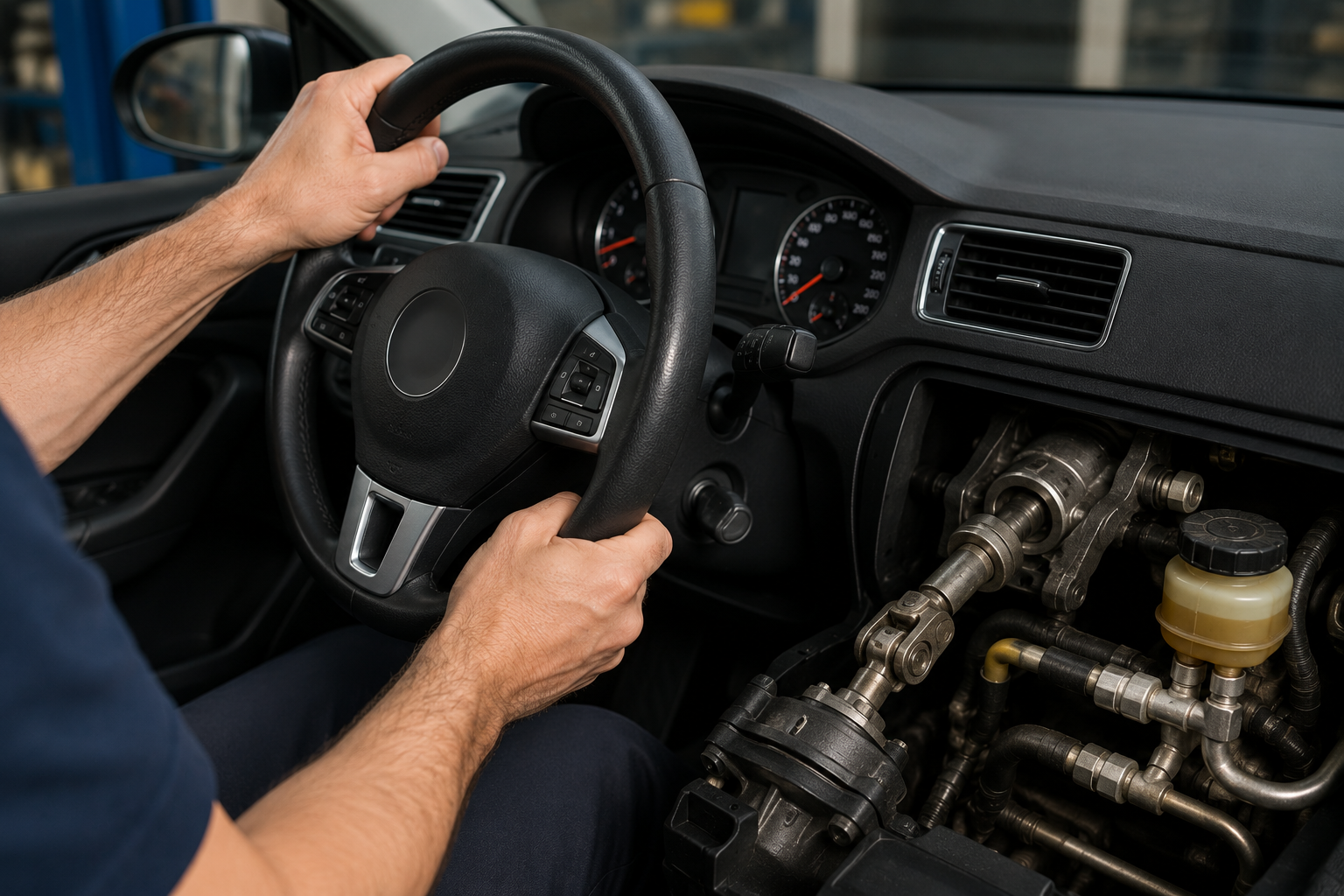
A steering wheel that is hard to turn has seven possible causes, and the most important diagnostic question is not what is wrong — it is when it is hard to turn. Hard steering only when cold that eases after a few minutes of driving points to power steering fluid viscosity or a cold-specific pump condition. Hard steering all the time, both cold and warm, points to a failing pump, low fluid, or a seized component. Hard steering that appeared suddenly after a specific event — hitting a pothole, a parking incident, or after a recent repair — points to a mechanical failure. Each pattern eliminates most causes before any testing begins.
Here is what the steering actually does when it feels heavy: either the power assist that amplifies your input at the steering wheel is failing or absent, or there is mechanical resistance somewhere in the steering linkage itself that your muscle power and the assist system together cannot easily overcome. Getting to which one it is — and which specific component within that group — takes a systematic approach based on when the problem occurs and whether the vehicle has hydraulic or electric power steering.
First: Identify Your Steering System
This determines which half of the cause list applies to your vehicle. Hydraulic power steering (HPS) uses a pump driven by the engine to pressurize fluid that assists steering. Electric power steering (EPS) uses an electric motor on or near the steering column. These systems fail in completely different ways.
| System | How to Identify | Hard Steering Causes |
|---|---|---|
| Hydraulic (HPS) | Fluid reservoir under hood with steering wheel symbol cap | Low fluid, failing pump, belt slip, hose leak, rack internal wear |
| Electric (EPS) | No reservoir under hood — EPS warning light on dash when fails | EPS motor fault, steering angle sensor, EPS fuse, mechanical binding |
| Electro-hydraulic (EHPS) | Small reservoir + electric pump — no engine-driven belt | Electric pump failure, fluid level, fuse |
The When-Does-It-Happen Diagnostic
| When Steering Is Hard | Primary Suspect | Secondary Suspect |
|---|---|---|
| Hard only when cold — eases after 5–10 min driving | Thick cold PS fluid, cold pump output, EPS motor cold stiffness | Inner rack stiffness on cold morning |
| Hard all the time — no improvement when warm | Low PS fluid, failing PS pump, EPS motor fault | Rack and pinion internal binding, tie rod damage |
| Hard only when parking / at very low speed | Normal limitation of system under maximum load, early PS pump wear | Low PS fluid or pressure loss at idle |
| Hard when turning one direction only | Asymmetric rack wear, damaged tie rod one side | PS pump pressure valve issue |
| Became hard suddenly — one specific moment | PS belt broke, PS pump seized, rack failure, EPS fuse blown | Steering column damage from impact |
| Hard + grinding noise when turning | Rack internal wear, dry steering components | Wheel bearing or CV joint — not PS related |
| Hard + EPS warning light on dash | EPS motor fault, steering angle sensor, EPS ECU issue | EPS fuse blown — check fuse box first |
| Hard + whining sound (HPS only) | Low PS fluid, failing PS pump | PS belt slipping |
7 Causes of Hard Steering
1. Low Power Steering Fluid — Check This First on HPS Vehicles
Low power steering fluid is the most common cause of heavy steering on hydraulic systems and the fastest to confirm. The power steering pump requires adequate fluid to generate hydraulic pressure. When level drops — from a slow leak at a hose connection, the pump shaft seal, or the steering rack — hydraulic pressure drops proportionally. The steering becomes heavier as fluid level falls and assist pressure reduces.
Check the reservoir level before anything else — with the engine off, locate the power steering reservoir and read the level against the MIN and MAX markings. A low reading while the steering is heavy is the most direct cause-and-effect relationship in the entire diagnostic list. Top up with the correct fluid specification for your vehicle and retest. If steering improves and stays improved — the level was low and the root cause is a leak that must be found and repaired. If the level drops again within weeks — the leak is active and must be traced. For the complete power steering fluid check procedure including what fluid your specific vehicle requires, see our power steering fluid guide.
The important follow-up: topping up fluid does not fix a leak. It restores steering function while the leak continues. Find and address the leak source — typically a hose fitting, pump shaft seal, or rack seal — within a reasonable timeframe. Driving on a leaking power steering system means the level will drop again, and running the pump with critically low fluid causes pump damage from heat and cavitation.
2. Failing Power Steering Pump
The power steering pump is a vane pump — rotating vanes sweep fluid through the pump body, generating pressure. As the pump wears internally — vane edges erode, the pump body develops wear surfaces — it generates progressively less pressure at the same rotational speed. The first symptom is usually heavy steering at low engine RPM and idle speed (where the pump turns slowest and generates least pressure), while steering at higher RPM feels more normal. This idle-specific heaviness is a reliable early indicator of pump wear.
Progressive pump failure produces heavy steering at all speeds, whining or groaning noises when the wheel is turned (the pump is struggling to generate pressure and the fluid is cavitating), and eventually complete loss of power assist if the pump seizes. A pressure test at the pump output — a gauge connected to the high-pressure line with a shutoff valve — quantifies how much pressure the pump is generating versus its specification. A pump generating significantly below specification pressure needs replacement. Power steering pump replacement: $350 to $800 at a shop.
3. Power Steering Belt Slipping or Broken (HPS)
On hydraulic power steering systems, the pump is driven by the engine’s serpentine belt or a dedicated power steering belt. If this belt slips — from tension loss, glazing, or contamination with oil — the pump spins slower than the engine and generates inadequate pressure, particularly under high steering demand. If the belt breaks completely, the pump stops turning entirely and all power assist is immediately lost. Steering becomes very heavy but remains functional — the steering system works without assist, it simply requires significantly more physical effort.
A sudden complete loss of power assist accompanied by heavy steering and no whining (the pump is not running at all) points to belt failure. Open the hood and look at the front of the engine — if the serpentine belt is missing or you can see it hanging loose, this is the cause. Belt failure also stops the alternator, so the battery warning light will come on alongside the steering complaint. See our battery light guide — a sudden appearance of both heavy steering and a battery warning light is almost always a broken serpentine belt. Belt replacement: $100 to $250 at a shop.
4. Electric Power Steering Motor or Sensor Fault (EPS)
Electric power steering systems assist the driver through a torque sensor that detects steering wheel input force and commands an electric motor to provide proportional assistance. When the EPS system develops a fault — motor overheating, torque sensor failure, EPS ECU fault, or steering angle sensor calibration loss — the system typically does one of three things: reduces assist to a lower level (partial assist), disables assist completely, or displays an EPS warning light on the dashboard while operating in reduced-assist mode.
EPS faults almost always store a fault code and illuminate the EPS warning light — a steering wheel icon with an exclamation mark on most vehicles. Reading these codes is the most productive diagnostic step available for an EPS-equipped vehicle with heavy steering. Check the fuse for the EPS system first — on some vehicles, a single blown fuse disables the entire EPS assist and takes 30 seconds to check and replace. The fuse location is in the owner’s manual under the fuse box diagram. EPS motor replacement or ECU repair: $400 to $1,500 depending on vehicle and fault location.
5. Rack and Pinion Wear or Damage
The steering rack translates the rotational input from the steering column into the lateral movement that turns the wheels. Internal rack wear — from age, inadequate lubrication from degraded fluid on HPS systems, or impact damage — creates internal friction that the steering assist must work against. Severe rack binding can exceed the assist system’s capability and make steering feel heavy regardless of power assist function.
Rack damage from impact — hitting a curb hard, a significant pothole at speed, or a low-speed parking collision — can bend the rack housing, damage internal rack teeth, or cause the rack to bind at specific steering positions. If heavy steering appeared immediately after a specific impact event, rack damage is the primary suspect. The diagnostic sign: steering that is fine through most of its range but suddenly stiffens or binds at a specific steering angle. Steering rack replacement: $800 to $1,800 including alignment, which is mandatory after any rack replacement.
6. Swollen or Kinked Power Steering Hose
Power steering hoses carry high-pressure fluid between the pump and rack. The inner lining of a high-pressure PS hose can degrade from age and heat cycling — the inner wall softens and can collapse partially under high pressure, restricting fluid flow. This internal collapse is not visible externally — the hose appears intact but is functionally restricted. A partially collapsed hose reduces the pressure that reaches the rack, causing heavy steering that may be intermittent or load-dependent.
A kinked hose — from improper routing after any underhood work — produces the same restriction. Heavy steering that appeared specifically after engine work, belt replacement, or any service that required moving hoses is worth investigating with a careful visual inspection of hose routing before any expensive component testing. PS hose replacement: $80 to $300 per hose depending on vehicle.
7. Incorrect Tire Pressure or Tire Type
Significantly underinflated tires increase rolling resistance and handling effort across the board — including steering effort. A tire that is 10 PSI or more below specification has more sidewall flex and a larger contact patch, both of which increase the effort required to turn the wheel, particularly at low speeds and parking. This is not a steering system problem — but it is sometimes the complete explanation for steering that feels heavier than expected on an otherwise functioning system.
Check all four tire pressures before any other steering diagnosis. If pressures are significantly low, inflate to the door placard specification and retest. On some vehicles, the difference in steering feel between properly inflated and 10 PSI low tires is significant enough that drivers report “heavy steering” that resolves completely with correct inflation. See our complete tire pressure check guide for the correct method. Additionally, upgrading to significantly wider or higher-performance tires than OEM spec increases steering effort — this is a normal consequence of increased contact patch and grip, not a malfunction.
Is It Safe to Drive with Hard Steering?
| Condition | Safe to Drive? | Action |
|---|---|---|
| Slightly heavier than normal — no sudden change | ⚠️ Monitor — diagnose soon | Check fluid, check tire pressure |
| Suddenly very heavy — appeared immediately | 🔴 Drive to shop only | Check belt, check EPS fuse, check fluid |
| Heavy only when parking — normal at speed | ✅ Yes — careful maneuvering | Diagnose within 2 weeks |
| Heavy + EPS warning light on | ⚠️ Drive carefully to shop | EPS diagnostic — read codes |
| Heavy + whining noise when turning | ⚠️ Drive to shop this week | Check PS fluid level immediately |
| Heavy + grinding or clunking when turning | 🔴 Inspect before driving further | Mechanical failure — rack or joint damage |
| Complete loss of assist — turns but requires significant force | ⚠️ Drive to shop only | Likely belt failure or pump seizure |
Frequently Asked Questions
Why is my steering wheel hard to turn?
A steering wheel that is hard to turn has seven main causes: low power steering fluid (most common on hydraulic systems — check level immediately), failing power steering pump, a broken or slipping serpentine belt that drives the pump, electric power steering motor or sensor fault (on EPS vehicles), worn or damaged rack and pinion, a collapsed or kinked power steering hose, or significantly underinflated tires increasing rolling resistance. When the heaviness occurs — cold only, all the time, or suddenly — identifies which cause is most likely.
Why is my steering wheel hard to turn in cold weather?
Steering that is hard when cold and eases after warming up typically indicates power steering fluid that is thick at cold temperatures — fluid viscosity increases significantly in cold weather and the pump generates less pressure until the fluid warms and thins. This is more pronounced when the fluid is old and degraded. Changing to fresh power steering fluid often resolves or significantly reduces cold-weather steering stiffness. On electric power steering systems, cold-weather stiffness can come from the EPS motor being stiffer when cold — usually minor and self-resolving within a few minutes of driving.
Can low power steering fluid cause hard steering?
Yes — low power steering fluid is the most common cause of heavy steering on hydraulic systems. The pump requires adequate fluid to generate hydraulic pressure for steering assist. As fluid level drops from a leak, pressure drops proportionally and steering becomes progressively heavier. Check the reservoir level before any other diagnosis. If the level is low, topping up immediately restores function — but the underlying leak must be found and repaired or the level will drop again.
Why is my steering wheel hard to turn when parked?
Steering that is heavy specifically when parking — moving very slowly or stationary with the wheel at full lock — can be a normal characteristic of the power steering system near its load limits, especially in vehicles with slightly worn but otherwise functional pumps. It can also indicate low power steering fluid pressure at idle speed (when the pump generates least pressure), an early-stage pump wearing out, or simply underinflated tires increasing the force required to turn the wheels against the road surface. Check tire pressure and fluid level first before assuming a mechanical failure.
Related Guides
If heavy steering is accompanied by noises during turning, our car making noise when turning guide covers the full diagnostic for CV joints, wheel bearings, and rack noises that sometimes combine with steering heaviness. For the complete power steering fluid check and what fluid your specific vehicle requires, see our power steering fluid guide. And if the battery warning light appeared alongside heavy steering — pointing to a broken serpentine belt — our battery light guide covers that combination and what to do immediately.