How Long Does a Car Battery Last? (By Type, Climate & Usage)
How long does a car battery last? Standard batteries last 3–5 years, AGM batteries 4–7 years — but climate, driving habits, and battery type change everything. Get the exact lifespan data for your situation plus 7 warning signs it’s already dying.
Your car battery will fail. Not maybe — definitely. The only question is whether it catches you off guard at 6 AM in a parking lot, or whether you see it coming and replace it on your own terms. How long does a car battery last? The textbook answer is 3 to 5 years. But that range is nearly useless without understanding what actually determines where YOUR battery lands on that spectrum — and whether yours is already silently dying right now.
This guide gives you the complete picture: exact lifespan data by battery type and climate zone, the 9 factors that shorten battery life, a 7-sign checklist to diagnose a dying battery before it dies on you, and a precise decision framework for when to replace rather than recharge.
How Long Does a Car Battery Last? — Direct Answer
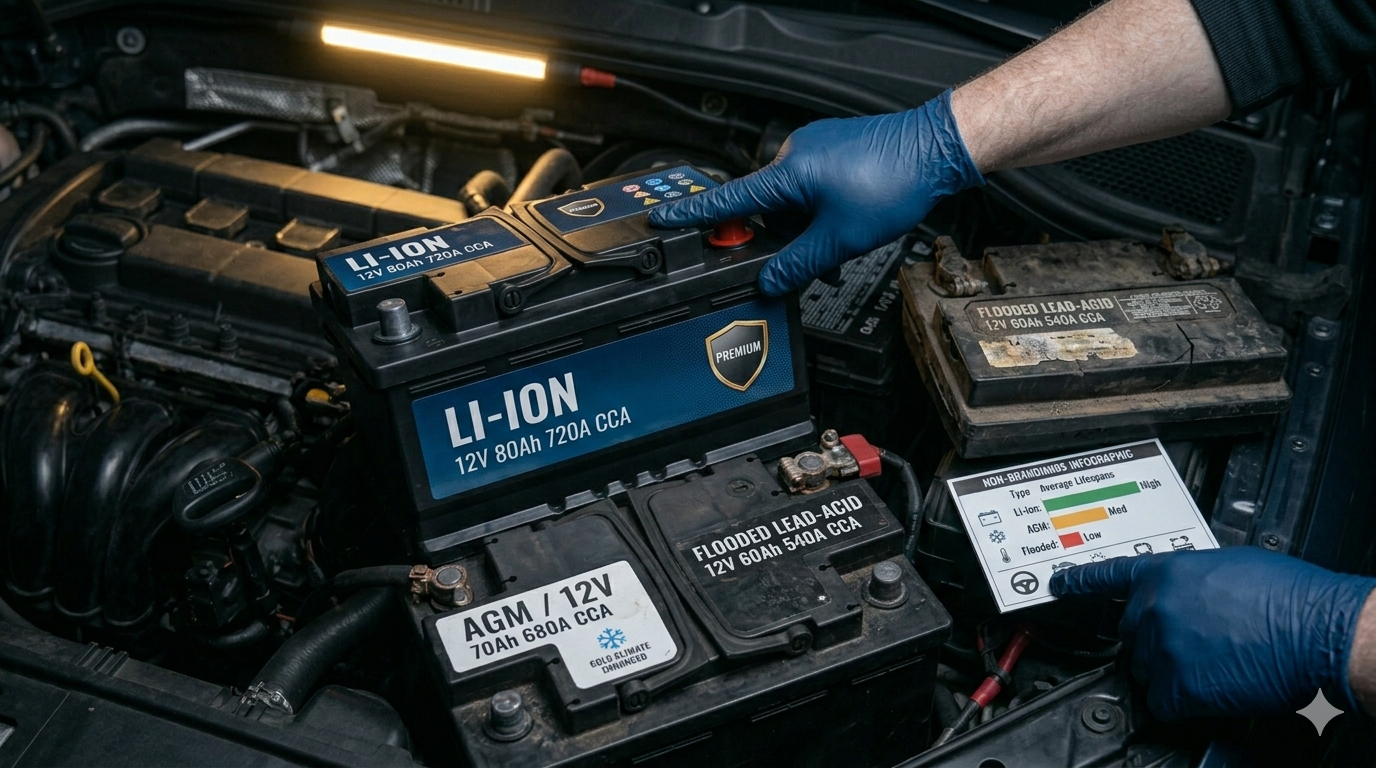
A standard lead-acid car battery lasts 3 to 5 years under average driving conditions. AGM (Absorbent Glass Mat) batteries last 4 to 7 years. Premium lithium-ion 12V batteries can last 8 to 12 years. However, batteries in hot climates routinely fail in under 3 years, while batteries in moderate climates with careful maintenance regularly exceed 7 years. The average is not a guarantee — it is a midpoint in a very wide range.
| Battery Type | Average Lifespan | Best Case | Worst Case | Common In |
|---|---|---|---|---|
| Standard Flooded Lead-Acid | 3–5 years | 7 years | 18 months | Most older vehicles |
| AGM (Absorbent Glass Mat) | 4–7 years | 10 years | 2 years | Start-stop systems, luxury cars |
| EFB (Enhanced Flooded Battery) | 4–6 years | 8 years | 2 years | Modern mid-range vehicles |
| Lithium-Ion 12V | 8–12 years | 15+ years | 4 years | High-end vehicles, EVs |
| Gel Cell | 5–8 years | 12 years | 3 years | Specialty/marine applications |
Car Battery Lifespan by Climate — The Number One Factor Most Drivers Miss
Where you live matters more than almost any other factor. Heat is the primary enemy of car battery longevity — not cold. Cold weather makes a failing battery visible (because low temperatures reduce capacity), but heat is what causes the irreversible chemical damage that kills the battery in the first place.
Batteries in the engine bay regularly experience temperatures exceeding 200°F in hot weather. This extreme heat accelerates a process called positive grid corrosion — the gradual breakdown of the lead plates inside the battery. Once those plates corrode beyond a threshold, the battery cannot be saved by any maintenance technique.
| Climate Zone | Average Battery Life | Primary Cause of Failure | Replacement Strategy |
|---|---|---|---|
| Hot (Arizona, Texas, Florida, Gulf Coast) | 2–3 years | Heat-accelerated plate corrosion | Replace at 2.5 years proactively |
| Moderate (Pacific Northwest, Midwest, Northeast) | 4–5 years | Normal wear + vibration | Test annually after year 3 |
| Cool/Cold (Minnesota, Montana, Canada) | 5–7 years | Cold stress on aging battery | Test every 6 months after year 4 |
| High Altitude (Colorado, Utah, Nevada) | 3–5 years | Temperature swings + thin air | Test annually after year 3 |
AAA research confirms this climate difference directly — in hot southern locales, a car battery will typically last approximately three years, while in cooler northern climates, a battery may last five years or longer. If you live in a hot climate and your battery is approaching 2.5 years, do not wait for symptoms — get it tested now.
9 Factors That Determine How Long Your Specific Battery Lasts
1. Extreme Heat — The Silent Battery Killer
Heat does two things to a car battery: it accelerates the evaporation of electrolyte fluid from inside the battery cells, and it speeds up the chemical reaction that causes internal corrosion. A battery that might last 5 years in Seattle may only last 2.5 years in Phoenix — not because it was used differently, but simply because of the ambient temperature it lived in.
Automakers in hot-climate markets often address this by relocating batteries to the trunk or under the rear seat — away from engine bay heat. If your battery is in the engine bay and you live in a hot climate, consider installing a battery heat shield, which can meaningfully extend battery life by reducing the peak temperatures the battery experiences.
2. Frequent Short Trips — The Undercharging Problem
Every cold engine start depletes a significant burst of energy from the battery. Your alternator needs a sustained period of engine operation — typically 20 to 30 minutes of actual driving — to fully recover that energy. A driver making ten 5-minute trips per day is repeatedly hammering the battery with full discharge cycles while never giving it enough time to fully recharge.
This creates a condition called chronic undercharge, which leads to sulfation — the buildup of lead sulfate crystals on the battery plates. Once significant sulfation occurs, it permanently reduces battery capacity. Frequent short trips (under 15 minutes) can shorten battery lifespan by preventing a full recharge. Rideshare drivers, delivery drivers, and urban commuters with short daily drives are especially vulnerable to this pattern.
3. Extended Parking — Self-Discharge and Sulfation
Modern cars are never truly “off.” Keyless entry receivers, alarm systems, ECU memory, and telematics modules draw small amounts of current continuously — anywhere from 15 to 85 milliamps depending on the vehicle. A car parked for three to four weeks without driving can fully discharge the battery. A deeply discharged lead-acid battery suffers permanent damage from the resulting sulfation.
Three or four weeks of not driving could kill your car battery — less than that if your car has a lot of onboard technology including keyless entry or remote starting. If you park a vehicle for extended periods, connect a smart battery maintainer (trickle charger) that monitors and maintains charge without overcharging.
4. Vibration — The Physical Destroyer
Vibration physically breaks down the battery’s internal structure. The lead plates inside the battery are relatively fragile — repeated vibration causes active material to shed from the plate surfaces, permanently reducing battery capacity. Rough roads, off-road driving, and driving with a loose battery hold-down bracket all accelerate this process.
Check that your battery is secured tightly in its tray with the hold-down bracket every time you inspect it. A battery that can wobble even slightly during driving is experiencing harmful vibration. This is an especially important check after any suspension work or if you regularly drive on rough or unpaved roads.
5. Parasitic Electrical Drain
Any electrical component that stays active after the car is parked — a stuck relay, a module that never enters sleep mode, an aftermarket accessory wired directly to a constant power source — continuously drains the battery. Even a 50-milliamp parasitic drain will fully discharge a battery over 1 to 2 weeks. Repeated deep discharge events dramatically shorten battery lifespan.
If you are replacing batteries every 12 to 18 months, parasitic drain is almost certainly the cause. Diagnose it with a multimeter before buying another battery. Learn the full diagnostic process in our guide to car battery draining overnight.
6. Charging System Issues — Overcharging and Undercharging
A malfunctioning alternator voltage regulator that allows overcharging (above 14.8 volts) literally boils the battery from the inside. The excessive voltage generates heat and gas inside the battery cells, destroying the internal structure rapidly. Undercharging (below 13.5 volts) causes chronic sulfation. Both conditions can destroy a new battery in months.
Always test your alternator output voltage after installing a new battery. A simple multimeter check takes 60 seconds and prevents you from destroying a $150 battery because of a failing $400 alternator. The correct range is 13.7 to 14.7 volts at idle with minimal electrical loads.
7. Battery Quality and Brand
Not all car batteries are equal. The quality of the lead alloy used in the plates, the purity of the electrolyte, the thickness of the plate grids, and the quality of the case all directly affect lifespan. Batteries from reputable manufacturers — Interstate, Optima, Odyssey, Bosch, DieHard, AC Delco — consistently outperform generic or unknown brands in both capacity retention and cycle life.
The warranty is a useful proxy for quality. A battery with a 3-year free replacement warranty reflects the manufacturer’s confidence in its product. A battery with only a 1-year free replacement period and a long prorated warranty period is telling you something about its expected longevity.
8. How the Battery Was Stored Before Sale
A car battery begins discharging from the moment it is manufactured. Batteries that sat in a warehouse or on a store shelf for 6 to 12 months before being sold have already experienced significant self-discharge — and potentially sulfation. A new or 6-month-old battery might start your car on a warm day, but it also might have degraded so far that it could not pass a battery test. When buying a battery, check the manufacturing date stamped on the label. Do not buy a battery manufactured more than 6 months ago.
9. Deep Discharge Events
A standard lead-acid battery is designed as a surface charge device — it should rarely discharge below 50% capacity under normal use. Every time the battery is fully discharged (lights left on, long parking period, severe parasitic drain), the resulting chemical reaction permanently reduces capacity. A single deep discharge can remove 20 to 30% of a battery’s total capacity. Multiple deep discharges can effectively destroy a battery within a year.
7 Warning Signs Your Car Battery Is Dying
A dying battery rarely fails without warning. These are the signals to watch for — in rough order of severity from early warning to imminent failure:
Sign 1 — Slow, Sluggish Engine Cranking
The engine takes noticeably longer to crank when you start the car — a groaning, labored sound instead of the quick, confident spin of a healthy battery. This is the most common early warning. Especially watch for this symptom worsening progressively over weeks. Cold mornings amplify it because low temperatures reduce battery capacity by 20 to 40%.
Sign 2 — Battery Warning Light
The battery or charging system warning light on your dashboard means the charging system is operating outside normal parameters. While this often indicates an alternator issue, a battery with very low voltage can also trigger it. In either case, have both the battery and alternator tested immediately — do not wait.
Sign 3 — Frequent Need for Jump Starts
Needing a jump start once after leaving lights on is normal. Needing jump starts regularly — even when you have not left anything on — means the battery cannot hold a sufficient charge between drives. This is a battery in the final stage of its life. Replace it before it strands you completely.
Sign 4 — Bloated or Swollen Battery Case
A battery case should have flat, rectangular sides. Any swelling, bulging, or distortion of the case means internal gases are building up — a result of severe overcharging or heat damage. A swollen battery is a safety hazard that can leak sulfuric acid or vent hydrogen gas. Replace it immediately and do not attempt to jump-start or recharge it.
Sign 5 — Visible Corrosion on Terminals
White, blue, or green powdery deposits on battery terminals indicate electrolyte leakage, which accelerates as batteries age. Heavy terminal corrosion is both a symptom of battery aging and a cause of further problems — it reduces current flow, preventing proper charging. Clean corrosion off immediately and have the battery tested if it is over 3 years old.
Sign 6 — Sulfur (Rotten Egg) Smell
A rotten egg smell near the battery means hydrogen sulfide gas is venting from the battery — a sign of severe overcharging or internal failure. This is an emergency situation. The battery is failing and potentially dangerous. Replace it immediately. Have the charging system checked simultaneously, as overcharging from a faulty voltage regulator is a common cause.
Sign 7 — Battery Age Over 4 Years
Age alone is a warning sign. Even without any other symptoms, a battery over 4 years old should be professionally load-tested every 6 months. A battery can test at perfect voltage (12.6V resting) and still fail a load test — meaning it cannot deliver sufficient current to start the engine under real-world conditions. Never rely on voltage alone to assess an older battery.
How to Test Your Car Battery — 3 Methods
Method 1: Multimeter Voltage Test (Free — 2 Minutes)
- Turn off the car and all accessories. Wait 2 hours after last drive for accurate resting voltage.
- Set multimeter to DC volts (20V range).
- Touch red probe to positive terminal (+), black probe to negative terminal (–).
- Read the voltage and interpret using the table below.
| Resting Voltage | State of Charge | Action |
|---|---|---|
| 12.65V or higher | 100% — Fully charged | Battery is healthy |
| 12.45–12.65V | 75–100% | Good — test load capacity |
| 12.24–12.45V | 50–75% | Low — charge and retest |
| 12.06–12.24V | 25–50% | Weak — likely needs replacement |
| Below 12.06V | Under 25% | Replace immediately |
Critical limitation: Voltage alone cannot tell you if a battery will start your car under load. A battery at 12.6V can still fail a load test. Use this as a screening test only — not a final verdict.
Method 2: Free Load Test at Auto Parts Store
AutoZone, O’Reilly Auto Parts, NAPA, and Advance Auto Parts all offer free professional battery testing. Their testers apply a real electrical load to the battery — simulating the current draw of starting an engine — and measure how well the battery holds voltage under that stress. This is the most accurate test available without specialized shop equipment. It takes 5 minutes and gives you a printed result.
Have this done every year after your battery turns 3 years old. Have it done immediately if you notice any of the warning signs described above. Any battery that fails a professional load test should be replaced regardless of age or resting voltage.
Method 3: Cold Cranking Amp (CCA) Test
Advanced battery testers measure Cold Cranking Amps — the current the battery can deliver at 0°F for 30 seconds while maintaining at least 7.2 volts. Your battery has a CCA rating stamped on its label (for example, “CCA: 600”). A professional load tester can measure the actual CCA your battery currently delivers and compare it to that rated value. A battery delivering less than 80% of its rated CCA should be replaced.
Replace vs Recharge — The Exact Decision Framework
| Situation | Decision | Reason |
|---|---|---|
| Battery under 3 years, died from leaving lights on | Recharge | Single discharge event, healthy battery |
| Battery under 3 years, died without obvious cause | Test and diagnose | Could be parasitic drain or early failure |
| Battery 3–4 years, slow cranking | Load test first | May have life left or may need replacement |
| Battery 4+ years, any symptoms | Replace | Past average lifespan, risk not worth it |
| Battery fails load test at any age | Replace immediately | Cannot reliably start engine — safety issue |
| Battery keeps dying after replacement | Test alternator first | Charging system issue destroying new batteries |
| Battery is swollen or smells like sulfur | Replace immediately | Safety hazard — do not jump or charge |
Car Battery Replacement Cost — Complete Breakdown
| Battery Type | DIY Part Cost | Shop Installed Cost | Lifespan Trade-off |
|---|---|---|---|
| Standard Flooded Lead-Acid | $80–$150 | $150–$250 | 3–5 years |
| AGM Battery | $150–$280 | $250–$400 | 4–7 years — better value long-term |
| Premium AGM (Optima, Odyssey) | $200–$350 | $300–$500 | 5–8 years — best for harsh conditions |
| OEM Replacement (dealer) | N/A | $200–$450 | Varies — warranty aligned |
Money-saving tip: Many vehicles (especially European makes — BMW, Mercedes, Audi, Volkswagen) require battery registration after replacement. The car’s ECU must be told a new battery has been installed so it can recalibrate its charging strategy. Skipping this step causes the charging system to apply the old battery’s charging profile to the new battery, potentially overcharging it and significantly shortening its life. Always ask the shop if your vehicle requires battery registration.
How to Extend Your Car Battery Life — 8 Proven Techniques
- Drive at least 20–30 minutes continuously once a week — allows alternator to fully recharge the battery rather than just partially recovering from startup draws
- Use a smart battery maintainer for storage — maintains optimal charge without overcharging; essential for any vehicle parked more than 2 weeks
- Keep terminals clean and corrosion-free — inspect every 6 months; clean with baking soda and water if corrosion is present
- Ensure battery hold-down bracket is tight — reduces vibration damage to internal plate structure
- Turn off all accessories before shutting the engine off — reduces initial load the battery must handle at next cold start
- Park in a garage when possible — reduces temperature extremes the battery experiences in both summer heat and winter cold
- Install a battery heat shield if you live in a hot climate — significantly reduces peak battery temperatures in engine bay
- Get annual battery testing after year 3 — catching a weak battery before it fails completely allows a planned replacement rather than an emergency one
Frequently Asked Questions
How long does a car battery last on average?
The average car battery lasts 3 to 5 years for standard lead-acid batteries and 4 to 7 years for AGM batteries. However, climate is the biggest variable — batteries in hot southern states (Arizona, Texas, Florida) routinely fail in 2 to 3 years, while batteries in cooler northern climates regularly last 5 to 7 years. Most automotive experts recommend testing any battery after its third year regardless of symptoms.
How do I know when my car battery needs to be replaced?
The clearest signs your car battery needs replacement are: slow or sluggish engine cranking on startup, the battery warning light on the dashboard, needing jump starts more than once, visible swelling of the battery case, heavy corrosion on terminals, and a battery over 4 years old that fails a professional load test. Do not wait for the battery to die completely — have it tested at any auto parts store for free after the 3-year mark.
Can a car battery last 10 years?
Yes — it is uncommon but entirely possible. The average car battery can last much longer than three to five years — battery experts hear quite often about car batteries lasting 10 years or longer. This typically requires a combination of favorable conditions: a moderate climate, consistent driving that keeps the battery fully charged, clean terminals, no deep discharge events, and a quality battery from the start. AGM and premium gel batteries are significantly more likely to achieve 7 to 10 year lifespans than standard flooded lead-acid batteries.
Does leaving a car unused shorten battery life?
Yes, significantly. A car battery naturally self-discharges at roughly 5 to 15% per month even when the vehicle is not being driven. Modern vehicles with multiple always-on modules discharge batteries even faster — some luxury vehicles can drain a battery in 2 to 3 weeks when parked. A fully discharged lead-acid battery suffers permanent chemical damage from sulfation. Use a smart battery maintainer whenever parking a vehicle for more than 2 weeks.
What kills a car battery fastest?
The three biggest car battery killers are: extreme heat (accelerates internal corrosion and electrolyte evaporation), repeated deep discharge events (leaving lights on, extended parking without a maintainer), and frequent short trips that prevent the alternator from fully recharging the battery. Of these, heat causes the most irreversible damage — it is the primary reason batteries in hot climate states fail significantly earlier than the national average.
Related Guides
Battery life and battery problems are connected — understanding one helps you prevent the other. If your battery keeps dying overnight, read our complete guide on car battery draining overnight to identify the specific cause. If you need to jumpstart your car while waiting for a replacement, follow our step-by-step jumpstart guide with the exact safe cable connection order. And if you are unsure whether your problem is the battery or the alternator, our bad alternator vs dead battery diagnostic guide gives you a definitive 5-step test to identify the culprit before spending money on parts.