Waking up to a dead car battery? Here are 9 real reasons your car battery drains overnight — and exactly how to find and fix each one yourself.
Why Is My Car Battery Draining Overnight? (9 Real Causes + Fixes)
You locked your car. Everything seemed fine. But the next morning — silence. No crank, no dashboard lights, just a completely dead battery. Sound familiar?
If your car battery keeps draining overnight, you are not alone, and the good news is: most causes are fixable without an expensive mechanic visit. This guide walks you through every likely reason your battery is dying overnight and shows you exactly how to diagnose and fix each one.
Let’s get into it.
What Actually Happens to Your Battery Overnight?
Your car battery does not fully shut off when you park. Even with the engine off, small amounts of power continue flowing to keep things like your clock, security alarm, keyless entry receiver, and ECU memory running. This is completely normal and is called standby current draw — usually between 20 to 85 milliamps (mA).
The problem starts when something in your car stays “awake” and silently pulls far more power than it should. When that happens, you wake up to a dead battery.
This hidden power theft has a name: parasitic drain. And it is the number one cause of overnight battery death in modern cars.
Here are all the reasons it happens — from the obvious to the ones most people never think to check.
9 Reasons Your Car Battery Is Draining Overnight
1. You Left a Light On (The Most Common Cause)
This is the number one reason for overnight battery drain — and the most embarrassing one. A headlight, dome light, glove box light, trunk light, or even a tiny vanity mirror light left on overnight will silently drain your battery completely flat.
How to check: Before going inside, walk around your car at night. Look for any glow from the windows, under the doors, or from the trunk area.
The fix: Turn off every light manually before leaving the car. Many newer cars alert you with a beep — but not all. Do not rely on the car to remind you.
2. Parasitic Drain From a Faulty Electrical Component
Even when everything looks off, a broken relay switch, a stuck module, or a faulty fuse can keep drawing power continuously. Some common culprits include:
- A trunk light whose switch is broken (the light stays on even when the trunk is closed)
- A glove box light with a stuck hinge
- A body control module or infotainment system that never fully goes to sleep
- An alarm system that is constantly active
How to check: Sit in your car at night. Close all the doors. Reach through the window and check if any interior lights remain on after about 30 seconds.
The fix: A parasitic draw test with a multimeter (explained below) will identify the exact circuit. A mechanic can also do this test quickly and cheaply.
3. Your Alternator Is Not Charging the Battery Properly
The alternator is the component responsible for recharging your battery while the engine runs. If the alternator has a faulty diode — a small component inside it — it can actually let current flow backward. This means instead of charging your battery, it quietly drains it while the car is parked.
This is one of the sneakiest causes of overnight drain because the car drives fine, but the battery dies every night anyway.
Warning signs to look for:
- Dimming headlights, especially at idle
- Flickering dashboard lights
- Battery warning light appearing on your dashboard
How to check: With the car running, use a multimeter to check the voltage across the battery terminals. A healthy alternator should show 13.7V to 14.7V. Below 13V means the alternator is not charging properly.
The fix: A faulty alternator needs professional replacement. Costs vary but typically run between $300 and $600 including parts and labor.
4. Your Battery Is Old and Cannot Hold a Charge
Car batteries have a lifespan of roughly 3 to 5 years. As batteries age, their internal plates degrade and they lose their ability to hold a full charge. An old battery may charge up when you drive but discharge completely overnight because it simply cannot store enough energy anymore.
How to check: Most auto parts stores — including AutoZone and O’Reilly — will test your battery for free. They attach a load tester and tell you instantly if the battery has enough capacity left.
The fix: If your battery is over 4 years old and consistently going flat, replace it. Battery replacement is one of the easiest DIY car jobs and costs between $100 and $250 depending on your vehicle.
5. Extreme Temperatures Are Killing Your Battery
Both heat and cold affect battery performance in different ways.
Cold weather slows the chemical reactions inside the battery, reducing its ability to deliver enough power to start the engine. A battery that seems fine in summer may completely fail to start the car in winter.
Hot weather is actually worse for long-term battery health. High temperatures accelerate the evaporation of battery fluid and cause internal corrosion, permanently reducing battery capacity over time.
How to check: If your battery issues are seasonal and your battery is over 3 years old, temperature is likely a factor.
The fix: Park in a garage when possible. If you are in an extremely cold climate, a battery blanket (a heated insulating pad that wraps around the battery) can help during winter months. In hot climates, parking in shade extends battery life significantly.
6. Corroded or Loose Battery Terminals
Your battery connects to your car’s electrical system through two terminal cables. If these connections are corroded, loose, or dirty, the battery cannot charge properly and may lose power overnight.
You will usually see corrosion as a white, blue, or greenish powder around the terminal connections.
How to check: Pop the hood and visually inspect both battery terminals. Wiggle the cables gently — they should feel firm and secure.
The fix: Cleaning corroded terminals is simple and free. Mix one tablespoon of baking soda with one cup of water. Disconnect the negative terminal first, then the positive. Apply the mixture with an old toothbrush, scrub gently, rinse with water, and dry thoroughly. Reconnect positive first, then negative.
7. Aftermarket Accessories Wired Incorrectly
Did you recently add a dashcam, custom stereo, subwoofer, GPS tracker, or LED underglow lighting? Aftermarket accessories that are not wired to a switched power source will keep drawing power continuously — even with the engine off.
A subwoofer or amplifier that is always getting power can drain a battery overnight all by itself.
How to check: Disconnect or unplug any recently added accessories and see if the overnight drain stops.
The fix: Have aftermarket accessories professionally wired to an ignition-switched power source so they only receive power when the engine is running.
8. Frequent Short Trips Preventing the Battery From Recharging
Every time you start your car, the battery uses a large burst of energy to crank the engine. The alternator then spends the next 15 to 20 minutes recharging what was used. If you are only making short 5 to 10-minute trips, the alternator never fully recharges the battery.
Over time, a battery that never fully recharges will degrade faster and eventually be unable to hold an overnight charge.
How to check: Think about your driving patterns. Are most of your trips under 15 minutes?
The fix: Take your car for a longer 30-minute drive at least once a week. This gives the alternator enough time to fully replenish the battery. Alternatively, use a smart battery charger/maintainer to top up the battery regularly.
9. A Completely Dead or Failing Battery Cell
Car batteries contain multiple internal cells. If one cell fails internally, the battery may look fine from the outside but will not hold a charge overnight no matter what you do. This is a common failure mode in batteries that have been deeply discharged multiple times.
How to check: A professional battery load test will detect a failed cell. A basic voltage reading alone will not catch this.
The fix: Replace the battery. There is no repairing a failed cell.
How to Find What Is Draining Your Battery (Step-by-Step)
If you want to find the exact cause yourself, here is a simple process:
Step 1 — Basic visual check first: Turn everything off. Close all doors. Walk around the car in the dark. Look for any glowing lights anywhere — interior, trunk, under doors. Check the hood too.
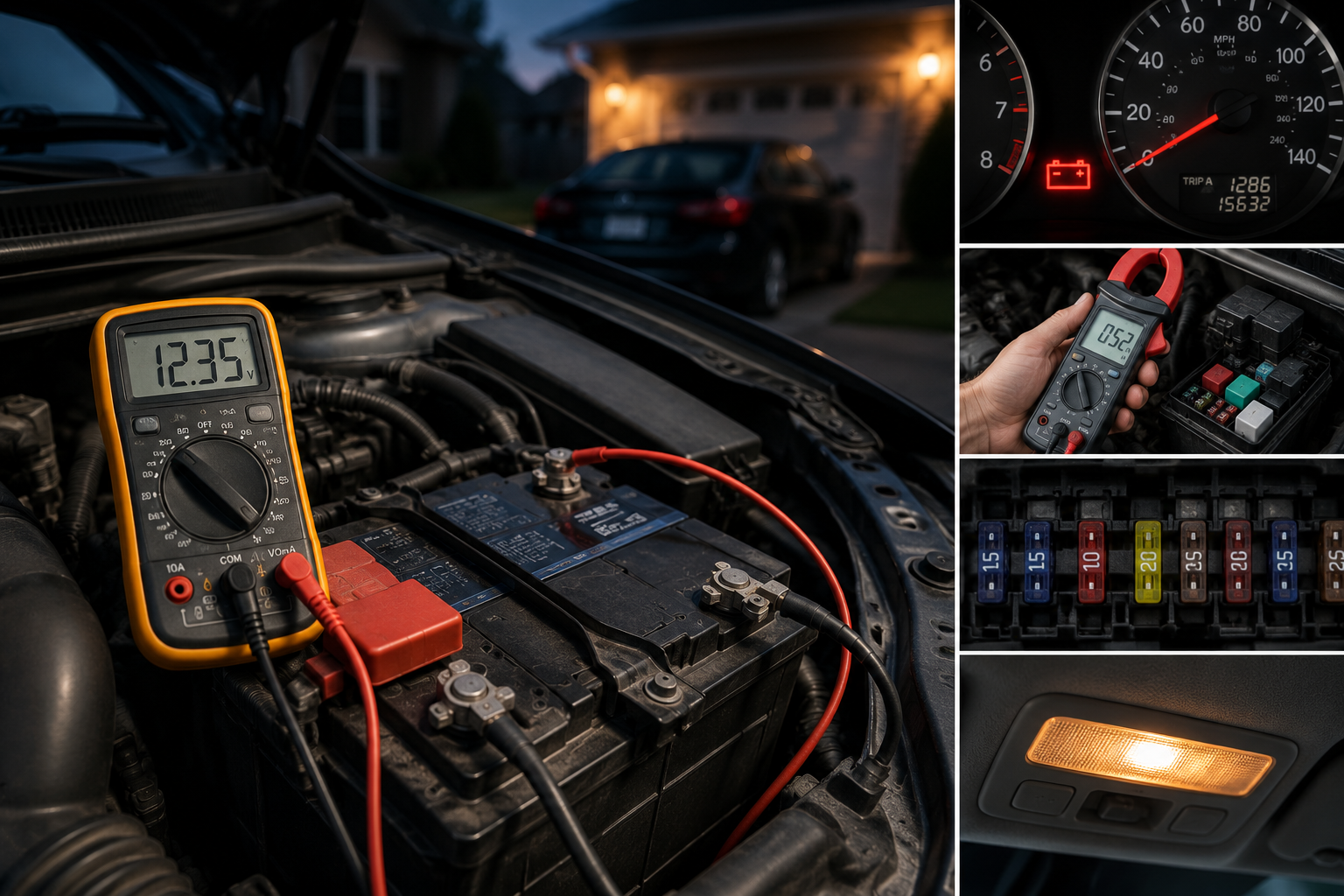
Step 2 — Check the voltage: With a multimeter set to DC voltage, touch the red probe to the positive terminal and black to the negative. A healthy battery at rest should read 12.4V to 12.7V. Below 12V means significant discharge.
Step 3 — The fuse pull test (for parasitic drain): With the car fully off and all doors closed, set your multimeter to measure DC amperage and connect it in series with the negative battery terminal. Wait 30 minutes for all modules to sleep. Your reading should be under 85mA. If it is higher, start pulling fuses one at a time from the fuse box. When the current drops suddenly, the culprit is on that fuse’s circuit.
Step 4 — When in doubt, go professional: If you cannot locate the drain yourself, a mechanic can perform a proper parasitic draw test in about 30 minutes. This is not expensive and will save you from replacing the wrong parts.
How Long Does It Take for a Car Battery to Drain Overnight?
A healthy battery in a modern car should not drain significantly overnight under normal conditions. However, a weak or aging battery can go completely flat within 8 to 12 hours if there is a significant parasitic drain pulling power. In extreme cold, even a moderately healthy battery can struggle after 10 to 12 hours.
How to Stop Your Car Battery From Draining Overnight — 6 Quick Habits
- Always double-check that all lights are off before leaving the car
- Unplug phone chargers and USB devices when not in use
- If your car sits unused for more than a week, use a trickle charger or battery maintainer
- Have your battery tested for free every year at an auto parts store
- Get your alternator checked if you notice dimming lights or slow cranking
- Take longer drives regularly if you mostly do short trips
Frequently Asked Questions
How do I know if my alternator or battery is draining my car? Start the car and check battery voltage with a multimeter. If it reads below 13V while running, the alternator is not charging properly. If the voltage is fine while running but drops overnight, the battery itself or a parasitic drain is the issue.
Can a bad fuse cause battery drain? Yes. A fuse protecting a circuit with a faulty component — like a light that does not turn off — can cause persistent battery drain. The fuse-pull method described above will help you identify which circuit is responsible.
Is it safe to drive a car with a draining battery? You can drive short distances, but do not ignore the problem. A failing battery can leave you stranded without warning, and a faulty alternator can damage other electrical components over time.
How much does it cost to fix overnight battery drain? It depends on the cause. Cleaning terminals: free. Replacing a battery: $100 to $250. Fixing a parasitic drain: $50 to $200 for diagnosis and repair. Replacing an alternator: $300 to $600.
Can cold weather alone drain a car battery overnight? Extreme cold reduces a battery’s capacity significantly. A battery that is borderline weak may not be able to start the engine after sitting overnight in freezing temperatures. The cold does not destroy the charge permanently — once warmed up, the battery may recover — but it exposes underlying weakness.
Final Thoughts
A car battery draining overnight is never a random problem. There is always a cause — and most causes are findable and fixable without spending a fortune at a shop.
Start with the simple checks first: lights, loose terminals, battery age. If those are all fine, move to alternator testing and parasitic drain diagnosis. Work through the list systematically and you will find the culprit.
If you found this guide helpful, check out our article on [how long a car battery actually lasts] and [how to tell if your alternator is failing] — both help you get ahead of battery problems before they leave you stranded.