How Long Do Tires Last? Mileage, Age, and 6 Factors That Decide It
How long do tires last? The honest answer is two numbers — mileage AND age — and whichever comes first wins. Most tires last 50,000 to 70,000 miles, but a tire sitting in a hot climate for 6 years may need replacement at 30,000 miles. This guide covers lifespan by tire type, the age rule manufacturers actually use, 6 factors that cut or extend life, and the 5 warning signs that mean replace now regardless of tread depth.
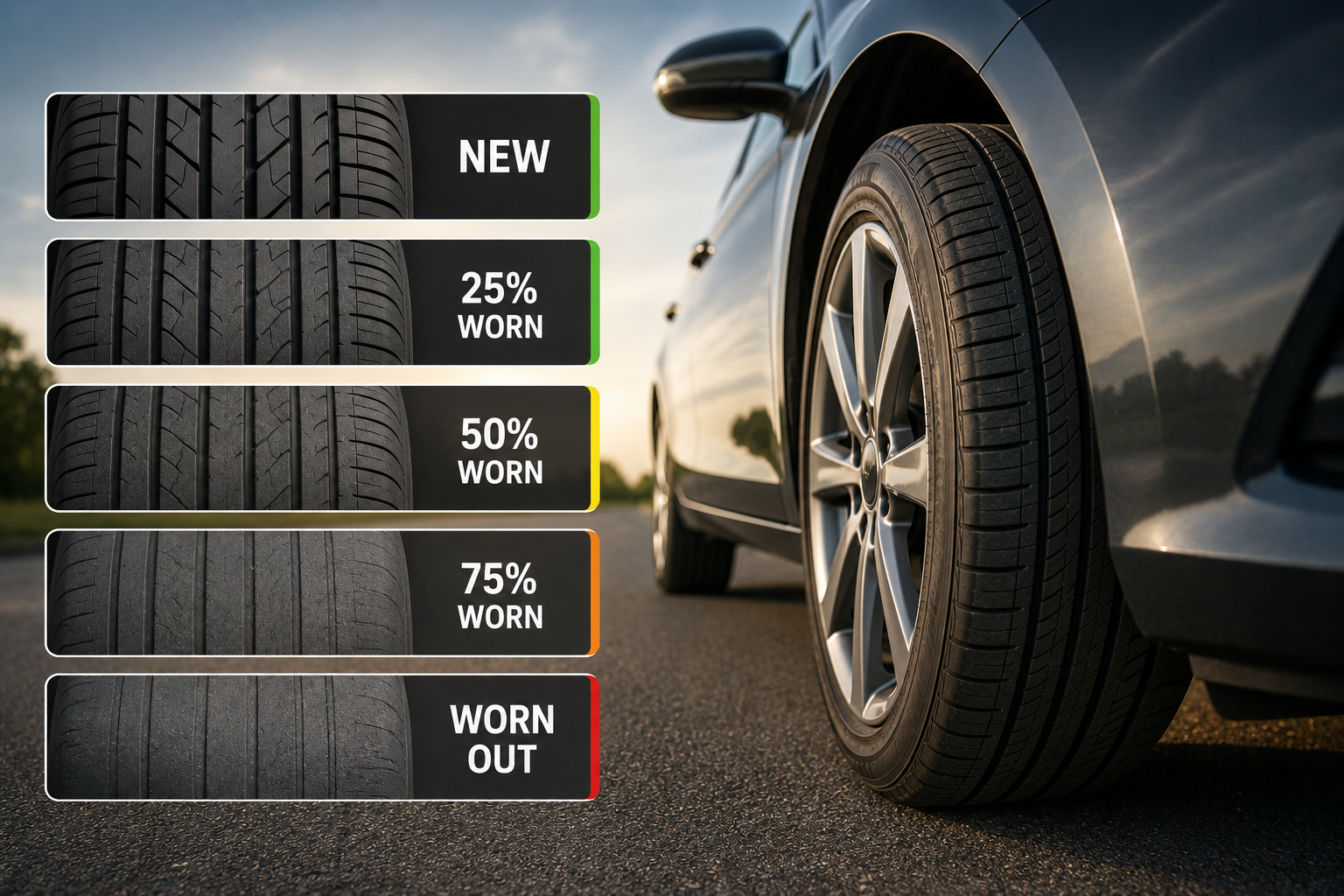
How long do tires last? Two numbers determine it — mileage and age — and whichever limit arrives first requires replacement. Most passenger tires last 50,000 to 70,000 miles. But every major tire manufacturer also specifies a maximum service age of 6 to 10 years from the manufacture date, regardless of remaining tread depth. A tire with 30,000 miles on it and 7/32 of tread remaining is still a replacement candidate if it was manufactured 7 years ago. The age rule is based on rubber compound oxidation that weakens the tire’s internal structure in ways that are invisible from the outside until the tire fails.
How long do tires last is one of those questions with a deceptively simple answer that hides significant complexity underneath. Ask a tire shop and they say 50,000 miles. Ask the tire manufacturer’s website and you find a maximum age specification that most drivers have never seen. Understanding both answers — and which one applies to your specific tires — is what separates a driver who replaces tires at the right time from one who either replaces them unnecessarily early or drives past the point of safety.
How Long Do Tires Last — Complete Answer by Tire Type
How long do tires last varies significantly by compound type and intended use. The rated mileage warranty is the manufacturer’s estimate under controlled testing conditions — real-world life depends on the additional factors covered below.
| Tire Type | Typical Mileage Life | Maximum Age | Best For |
|---|---|---|---|
| All-season touring | 60,000–80,000 miles | 6–10 years | Everyday passenger cars, balanced performance |
| All-season standard | 45,000–65,000 miles | 6–10 years | Budget-conscious replacement, light vehicles |
| Performance summer | 20,000–40,000 miles | 6 years | Sports cars, aggressive driving — wears fast intentionally |
| Ultra-high performance | 15,000–30,000 miles | 6 years | Performance vehicles — shortest lifespan on list |
| Winter / snow | 30,000–40,000 miles seasonal | 6 years | Cold climates — softer compound wears faster in warm temps |
| All-terrain truck | 40,000–60,000 miles | 6–10 years | Trucks and SUVs with mixed on/off road use |
| Highway truck | 60,000–80,000 miles | 6–10 years | Trucks used primarily on paved roads |
| Run-flat | 30,000–50,000 miles | 6 years | Vehicles without spare tire — stiffer sidewall reduces life |
A driver who asks how long do tires last and receives “50,000 miles” as the answer is receiving an average, not a guarantee. That same tire driven by two different people in two different climates may last anywhere from 30,000 to 75,000 miles. The six factors below explain that range.
Budget vs Premium — How Long Do Tires Last by Brand Tier
| Tier | Example Brands | Typical All-Season Life | Price per Tire | Cost per Mile |
|---|---|---|---|---|
| Premium / Tier 1 | Michelin, Bridgestone, Continental, Goodyear | 65,000–80,000 miles | $150–$250 | $0.002–$0.003 |
| Mid-range / Tier 2 | Cooper, Hankook, Firestone, Falken | 50,000–65,000 miles | $90–$150 | $0.0015–$0.003 |
| Budget / Tier 3 | Sentury, Westlake, Primewell | 30,000–45,000 miles | $50–$90 | $0.002–$0.003 |
The cost per mile calculation is the most honest way to compare tire tiers. A $200 Michelin that lasts 75,000 miles costs $0.0027 per mile. A $70 budget tire that lasts 35,000 miles costs $0.002 per mile — technically cheaper per mile, but with significantly worse wet braking performance and less predictable handling as it wears.
Mileage vs Age — Which Matters More When Asking How Long Do Tires Last?
This is the question most drivers never ask because they assume mileage is the only metric that matters when determining how long do tires last. The answer changes for many drivers — especially those in hot climates or with low-mileage vehicles.
Rubber is an organic compound that degrades continuously from the moment it is manufactured, regardless of whether it is being driven on or sitting in a garage. The degradation mechanisms are oxidation, ozone attack, UV exposure, and heat cycling. All four processes happen whether the tire is rolling at 70 mph or sitting unmoved on a parked vehicle.
| Tire Age | Condition | Action |
|---|---|---|
| Under 5 years — any mileage | Rubber compound within design parameters | Replace when tread reaches 2/32″ or below |
| 5–6 years — any mileage | Annual professional inspection recommended | Replace if cracking, stiffness, or tread below 4/32″ |
| 6–7 years — any mileage | Approaching manufacturer age limit | Plan replacement regardless of tread — inspect for cracking |
| 7–10 years — any mileage | At or past most manufacturer limits | Replace immediately — do not drive on 10-year-old tires |
| Over 10 years — any mileage | All manufacturers consider unsafe | Replace immediately regardless of appearance |
How long do tires last in hot climates is a critical distinction. A tire in Phoenix, Arizona ages approximately 1.5 to 2 times faster than the same tire in Seattle, Washington. The practical implication: drivers in Phoenix should use 6 years as their maximum age limit, not the 10-year maximum that applies in moderate climates.
How to Find Your Tire’s Manufacturing Date
Every tire sold in the United States carries a DOT (Department of Transportation) code on its sidewall. The last four digits are the manufacturing date: the first two digits are the week of manufacture, the last two are the year.
Example: DOT code ending in 2419 means the 24th week of 2019 — approximately June 2019. A tire checked in 2026 with this code is 7 years old regardless of its mileage.
Check the DOT date on all four tires — and on your spare. Spare tires are notorious for exceeding age limits because they are never used and drivers forget they exist. The National Highway Traffic Safety Administration (NHTSA) provides complete guidance on tire age limits and DOT code reading as part of its official tire safety resources.
6 Factors That Determine How Long Do Tires Last on Your Car
Factor 1: Driving Style — The Biggest Variable in Tire Lifespan
Aggressive acceleration, hard braking, and fast cornering generate heat that accelerates compound breakdown and removes tread material more quickly per mile. Driving style has more impact on how long do tires last than any other single variable including brand or quality tier.
| Driving Style | Effect on Tire Life | Example |
|---|---|---|
| Highway-focused, smooth driving | +20–40% longer than average | 60,000-mile tire can last 75,000+ miles |
| Normal mixed driving | Baseline average life | Rated mileage applies roughly |
| Heavy city driving — frequent stops | 15–25% shorter than average | 60,000-mile tire lasts 45,000–50,000 miles |
| Aggressive — hard acceleration and braking | 30–50% shorter than average | 60,000-mile tire lasts 30,000–40,000 miles |
Factor 2: Tire Pressure Maintenance
Underinflation is the single most damaging maintenance failure for tire longevity. An underinflated tire flexes more per revolution, generating more heat, wearing the outer edges of the tread faster than the center, and stressing the sidewall with each rotation.
The NHTSA estimates that tires underinflated by 25 percent wear out 25 percent faster than properly inflated tires. Check tire pressure monthly using the vehicle door jamb specification — not the tire sidewall maximum — always cold. See our complete tire pressure checking guide for the exact procedure and PSI chart by vehicle type.
Factor 3: Wheel Alignment and Balance
Misaligned wheels point in slightly different directions from the vehicle’s travel direction, causing tires to scrub laterally with every rotation rather than rolling cleanly forward. Even 0.5 degrees of toe-out misalignment creates feathering wear and can reduce how long tires last by 15 to 30 percent while also increasing fuel consumption.
Wheel imbalance concentrates wear in specific tread areas, producing the flat spot or cupping pattern visible on many worn tires. Balancing and alignment should be checked annually and after any significant impact.
Factor 4: Rotation Schedule
Front and rear tires wear at different rates. On a front-wheel-drive vehicle, front tires can wear 2 to 3 times faster than rear tires. Regular rotation — every 5,000 to 7,500 miles — equalizes wear across all four tires. A set of tires properly rotated typically lasts 20 to 30 percent longer than the same set never rotated.
The Car Care Council recommends rotation every 5,000 to 7,500 miles as standard maintenance to maximize how long do tires last. See our complete car maintenance schedule for rotation intervals alongside every other service interval.
Factor 5: Climate and Storage Conditions
Climate significantly affects how long do tires last beyond mileage. Hot climates accelerate rubber oxidation — tires in Phoenix age approximately twice as fast as tires in Seattle. UV exposure on vehicles parked outdoors accelerates surface oxidation of the sidewall.
For stored vehicles or seasonal tires: store in a cool, dry location away from direct sunlight, away from ozone-generating equipment such as electric motors or compressors, and ideally in airtight bags when not in use. The 6-year age guideline applies to stored tires equally.
Factor 6: Vehicle Weight and Load
Heavier vehicles put more load on tires per stop and per mile. A full-size pickup truck weighing 5,500 to 6,500 pounds generates significantly more heat and wear per tire per mile than a compact car weighing 2,800 pounds. Regular towing or hauling near maximum payload further accelerates wear — tires on a truck that regularly hauls heavy loads may wear 30 to 50 percent faster than the same tires without payload.
5 Warning Signs Your Tires Need Replacing Now
- Tread depth at or below 2/32″: Insert a penny upside down (Lincoln’s head pointing into the tread) into the deepest groove. If you see the top of Lincoln’s head — replace immediately. This is the legal minimum in most US states. The quarter test (Washington’s head) at 4/32″ is a more conservative and safety-oriented trigger for wet weather driving.
- Sidewall cracking or crazing: Visible cracks in the sidewall rubber indicate oxidation and compound degradation. A tire with 6/32″ tread and significant sidewall cracking is not a safe tire — tread depth alone does not determine how long do tires last safely.
- Bulge or bubble in the sidewall: A visible bulge indicates a broken internal cord. The inner air pressure is pushing through fractured structural elements. A bulged tire can fail catastrophically. Replace immediately — do not drive on a tire with a sidewall bulge.
- Persistent vibration that rotation and balancing do not resolve: Internal tire damage — belt separation or broken internal cords — causes the tire to run out-of-round. This is a structural failure indicator, not a balance issue.
- Tire age over 6 years in hot climates or over 10 years anywhere: Rubber degradation creates structural failure risk that tread depth measurement cannot detect. Any tire meeting these age criteria should be replaced regardless of visible condition or remaining tread depth.
TPMS Warning vs Actual Tire Condition
The Tire Pressure Monitoring System (TPMS) illuminates when one or more tires drops 25 percent or more below recommended pressure. What it does not tell you: whether the tire has a slow leak, whether pressure loss is temperature-related, or whether the tire has wear or age issues requiring replacement.
TPMS does not monitor tread depth. A tire can be perfectly inflated and still need immediate replacement due to 2/32″ tread, sidewall cracking, or a bulge from impact damage. Monthly manual pressure checks and visual inspection at every tire rotation both remain essential regardless of TPMS.
How Long Do Tires Last by Vehicle Type
| Vehicle Type | Typical Tire Life | Notes |
|---|---|---|
| Compact and mid-size sedan (Civic, Camry, Accord) | 50,000–70,000 miles | Light weight, often highway use — favorable conditions |
| Large sedan / full-size car | 45,000–65,000 miles | More weight than compact — moderate wear increase |
| Compact SUV / crossover (RAV4, CR-V, Equinox) | 45,000–65,000 miles | AWD variants may wear slightly faster |
| Mid-size SUV (Explorer, Highlander) | 40,000–60,000 miles | Higher weight — more wear per mile |
| Full-size SUV (Tahoe, Expedition) | 35,000–55,000 miles | Heavy vehicle — tires work harder per mile |
| Half-ton pickup truck (F-150, Silverado) | 40,000–60,000 miles unloaded | Regular payload/towing: reduce 20–35% |
| Sports car (Mustang, Camaro) | 20,000–40,000 miles | Performance tires, performance driving — fastest wear |
Frequently Asked Questions — How Long Do Tires Last
How long do tires last on average?
How long do tires last on average is 50,000 to 70,000 miles for standard all-season passenger tires — but mileage is only half the answer. Every tire also has a maximum service age of 6 to 10 years from its manufacture date, regardless of remaining tread. Whichever limit arrives first — mileage or age — determines replacement time. A low-mileage tire that is 8 years old needs replacement even with 7/32″ of tread remaining.
How do I know when my tires need replacing?
Check five things at every tire rotation: tread depth using the penny test, visible sidewall cracking, any bulge in the sidewall, tire age from the DOT code on the sidewall, and overall condition. Tires that pass the tread test but show sidewall cracking or are over 6 years old in hot climates still need replacement — tread depth alone does not fully determine how long do tires last safely.
Do tires expire even if they have tread left?
Yes. Rubber degrades from oxidation, ozone, UV light, and heat cycling continuously from manufacture — regardless of whether the tire is being driven on. Every major manufacturer specifies a maximum service age of 6 to 10 years. Find your tire’s manufacture date in the last four digits of the DOT code on the sidewall. The 6-year limit in hot climates and 10-year limit in moderate climates applies regardless of how long do tires last in terms of mileage on your specific vehicle.
How long do all-season tires last?
All-season tires last 50,000 to 80,000 miles depending on quality tier, driving style, and maintenance. Premium brands like Michelin and Bridgestone rate for 60,000 to 80,000 miles. Mid-range brands rate for 50,000 to 65,000 miles. Budget all-season tires typically last 30,000 to 45,000 miles. These estimates assume proper inflation, rotation every 5,000 to 7,500 miles, and correct alignment.
How long do winter tires last?
Winter tires last 30,000 to 40,000 miles of seasonal use. Because they use a softer rubber compound designed for cold temperatures, they wear faster than all-season tires and should never be driven year-round. Used only for winter months in northern climates, a set can last 4 to 6 winter seasons. How long do winter tires last is also governed by the 6-year age rule — a 7-year-old set needs replacement regardless of remaining tread depth.
Related Guides
Tire maintenance connects directly to several other guides on this site. For checking and maintaining tire pressure — the single biggest maintenance factor in how long do tires last — see our complete tire pressure guide with PSI chart by vehicle type. For incorporating tire rotation into a complete vehicle maintenance plan, our car maintenance schedule lists every service interval. And if your tires are causing steering wheel vibration — sometimes the first sign of internal damage before visible wear appears — our car shaking diagnosis guide covers the wheel balance and bearing causes that commonly coincide with tire wear patterns.