Why Is My Car Shaking? 10 Causes Diagnosed by Speed, Location & When It Happens
Why is your car shaking? The answer depends on WHEN and WHERE you feel it. Our dual diagnostic matrix identifies your exact cause in 60 seconds — 10 real causes, repair costs, and urgency scale included.
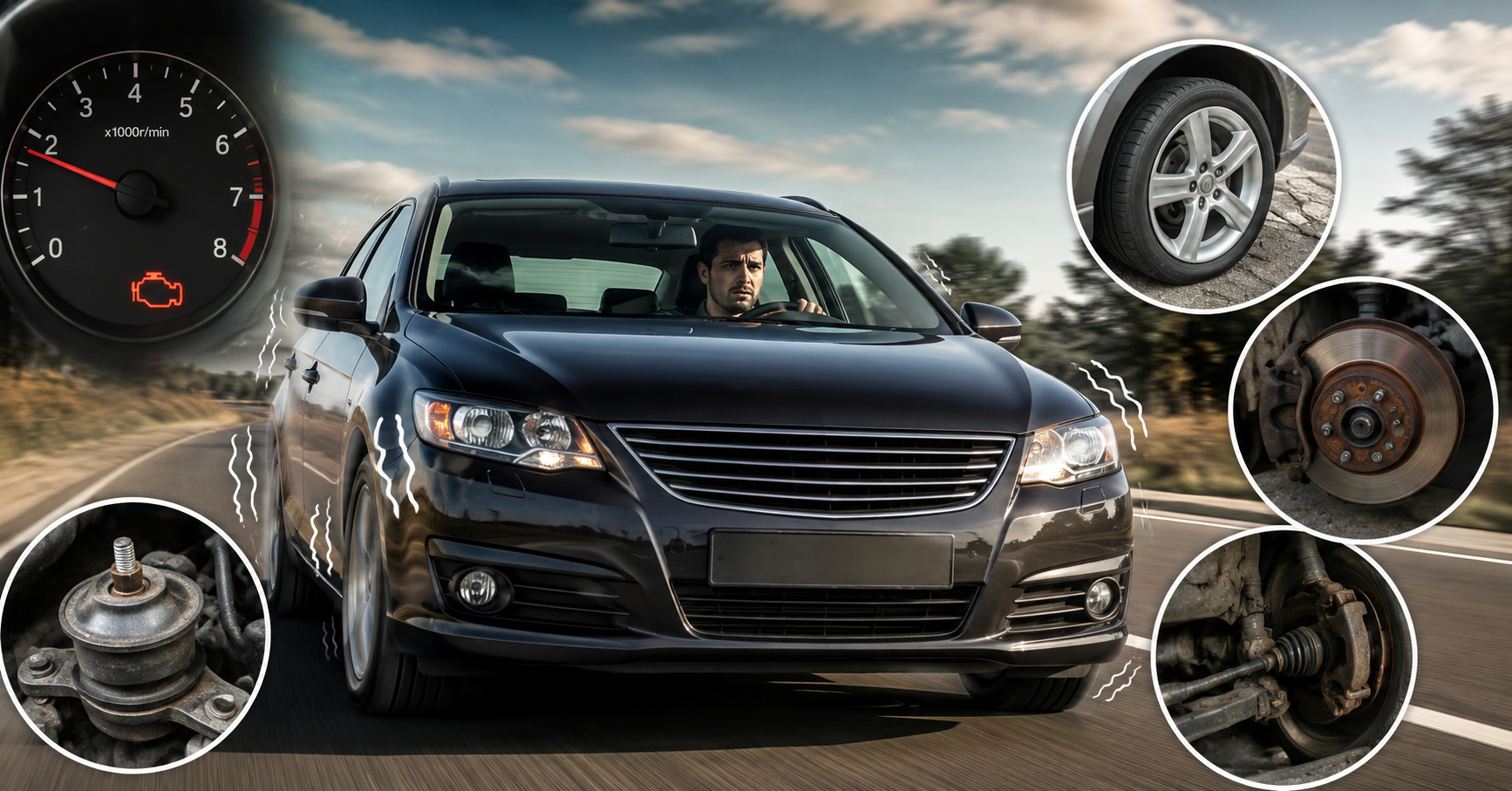
Is It Safe to Drive? — Urgency Scale for Every Cause
| Shaking Situation | Safe to Drive? | Distance Limit | Action |
|---|---|---|---|
| Mild vibration at 50–60 mph, improves above/below — tire imbalance | ✅ Yes | Normal driving | Schedule balancing within a week |
| Vibration when braking only, brakes still effective | ⚠️ Short term | Drive to shop | Inspect rotors within days |
| Steering wheel shake that worsens with speed | ⚠️ Caution | Avoid highway speeds | Balance and alignment check |
| Whole car shaking at idle — check engine light on | ⚠️ Limited | Drive to shop | Read codes — likely misfire |
| Clicking or shaking during turns | ⚠️ Monitor | Drive carefully | CV axle inspection this week |
| Growling + vibration that changes with sway test | ❌ Not recommended | Drive to shop only | Wheel bearing failing — safety risk |
| Visible tire bulge or blowout feel | 🚨 Stop now | Zero — pull over | Replace tire immediately |
| Violent shaking at any speed — new and sudden | 🚨 Stop now | Pull over safely | Emergency — tow to shop |
Complete Repair Cost Guide
| Repair | DIY Cost | Shop Cost | Difficulty |
|---|---|---|---|
| Tire balancing (all four) | N/A | $60–$100 | Shop only |
| Road force balancing (all four) | N/A | $120–$200 | Shop only |
| Four-wheel alignment | N/A | $80–$150 | Shop only |
| Tire replacement per tire | N/A | $100–$350 | Shop recommended |
| Wheel straightening per wheel | N/A | $75–$150 | Specialist |
| Brake rotor replacement per axle | $100–$300 parts | $250–$600 | Moderate |
| Spark plug replacement | $30–$80 parts | $100–$300 | Easy–Moderate |
| Motor mount replacement | $50–$150 parts | $200–$600 | Moderate |
| CV axle replacement per axle | $80–$200 parts | $300–$600 | Moderate |
| Wheel bearing replacement per wheel | $60–$150 parts | $250–$500 | Moderate–Hard |
| Shock/strut replacement per axle | $100–$300 parts | $300–$700 | Moderate |
| Ball joint replacement per joint | $50–$150 parts | $200–$500 | Moderate–Hard |
Free DIY Checks You Can Do Right Now
- Visual tire inspection: Look for bulges, uneven wear patterns, or objects embedded in the tread. Run your hand across the tread — cupping feels like a washboard surface across the width of the tire.
- Tire pressure check: Under or overinflated tires cause handling issues that feel like vibration. Check all four tires including the spare. See our complete guide on how to check tire pressure.
- Wheel lug nut check: With the car parked and wheels on the ground, attempt to hand-tighten each lug nut. Any that turn indicate a loose wheel — a serious safety issue. Torque all lug nuts to spec immediately.
- Sway test for wheel bearings: At 50–60 mph on a safe, clear road, gently sway the car left and right. If growling changes — louder in one direction — a wheel bearing is suspect on the side where the noise decreases.
- Engine mount visual check: With the hood open and engine running (from outside the car), have an assistant shift briefly into Drive while you watch the engine. Excessive lurching or rocking indicates a failed mount.
- CV boot inspection: Look at each front axle from underneath. The accordion-shaped rubber boots should be intact. Grease splattered on surrounding components means a boot has torn and the CV joint is failing.
Frequently Asked Questions
Why is my car shaking?
Car shaking has 10 main causes — but the specific cause depends entirely on when and where you feel the vibration. Shaking only between 45–65 mph that improves above that speed almost always means tire imbalance. Shaking only when braking means warped rotors. Shaking at idle or during acceleration suggests an engine issue — misfire or bad motor mount. Shaking during turns points to a CV axle or wheel bearing. Use the dual diagnostic matrix at the top of this guide to identify your exact cause before spending money on repairs.
Is it safe to drive a car that is shaking?
It depends entirely on the cause. Mild tire imbalance vibration at highway speed is not immediately dangerous but should be corrected within a week. Brake shaking while braking still effectively is manageable for a few days. A growling wheel bearing, visible tire bulge, or sudden violent shaking at any speed requires immediate attention — these are active safety risks. When in doubt, drive directly to a shop rather than continuing normal driving.
Why does my car shake at highway speeds but not at low speeds?
Shaking that appears or worsens at highway speed most commonly indicates tire imbalance, wheel alignment issues, a bent wheel, or worn suspension components that cannot handle the forces at higher speeds. If the shaking is worst at a specific speed — say 55 mph — and improves both above and below that speed, tire imbalance is almost certainly the cause. A standard tire balancing appointment resolves this in most cases.
Why does my car shake when idle?
Shaking at idle — when the car is stopped and in park or drive — points to the engine rather than wheels or tires. The most common causes are an engine misfire from worn spark plugs or a bad ignition coil, a failed or deteriorating motor mount that no longer absorbs engine vibration, or a vacuum leak disrupting the air-fuel mixture. A check engine light accompanying idle shake almost always stores a relevant fault code — read it with a free OBD2 scanner before attempting any repairs.
How much does it cost to fix a shaking car?
Tire balancing costs $60–$100 for all four tires and resolves the most common shaking cause. Wheel alignment runs $80–$150. Brake rotor replacement costs $250–$600 per axle. Motor mount replacement runs $200–$600. CV axle replacement is $300–$600 per axle. Wheel bearing replacement costs $250–$500 per wheel. Always diagnose the specific cause first — replacing components without proper diagnosis wastes money and often does not solve the problem.
Related Guides
If your shaking happens specifically when braking, our detailed guide on car shakes when braking covers every brake-related cause with a complete diagnostic system. If grinding accompanies the shake, see our grinding noise when braking guide. For tire-related vibration, our tire pressure guide shows how improper inflation causes handling and vibration issues — and how to fix it yourself in minutes.