Bad Fuel Pump Symptoms: 8 Signs Diagnosed by When and How They Happen
Bad fuel pump symptoms are easy to confuse with ignition problems, clogged injectors, and failing sensors — because all of them affect fuel delivery and produce similar drivability complaints. The difference is the pattern: fuel pump symptoms follow fuel demand logic. They worsen under high load, improve under light throttle, and correlate with fuel tank level. This guide diagnoses all 8 symptoms using those patterns to distinguish a dying pump from everything else it mimics.
The most reliable diagnostic pattern for bad fuel pump symptoms is this: they follow fuel demand. Symptoms are worst during hard acceleration from stops, during sustained highway driving under load, and when the fuel tank is below a quarter full. They improve or disappear at light throttle, during gentle city driving, and immediately after filling the tank. A car that stumbles under hard acceleration but idles fine, or runs well in the morning and stumbles after a long highway run, is telling you the pump can meet low demand but cannot sustain high demand — the classic signature of a pump that is wearing out but has not yet failed completely.
Bad fuel pump symptoms send more drivers to replace the wrong parts than almost any other drivetrain diagnosis. The pump shares symptoms with worn spark plugs, dirty injectors, a clogged fuel filter, a failing MAF sensor, and a blocked catalytic converter — all of which affect how much usable fuel reaches the combustion chamber. What separates a fuel pump diagnosis from these alternatives is not the symptom itself but when it happens, under what conditions, and whether a specific set of pattern tests points to the pump specifically. This guide works through each failing fuel pump symptom using that diagnostic logic.
The Fuel Demand Logic — How to Recognize Bad Fuel Pump Symptoms
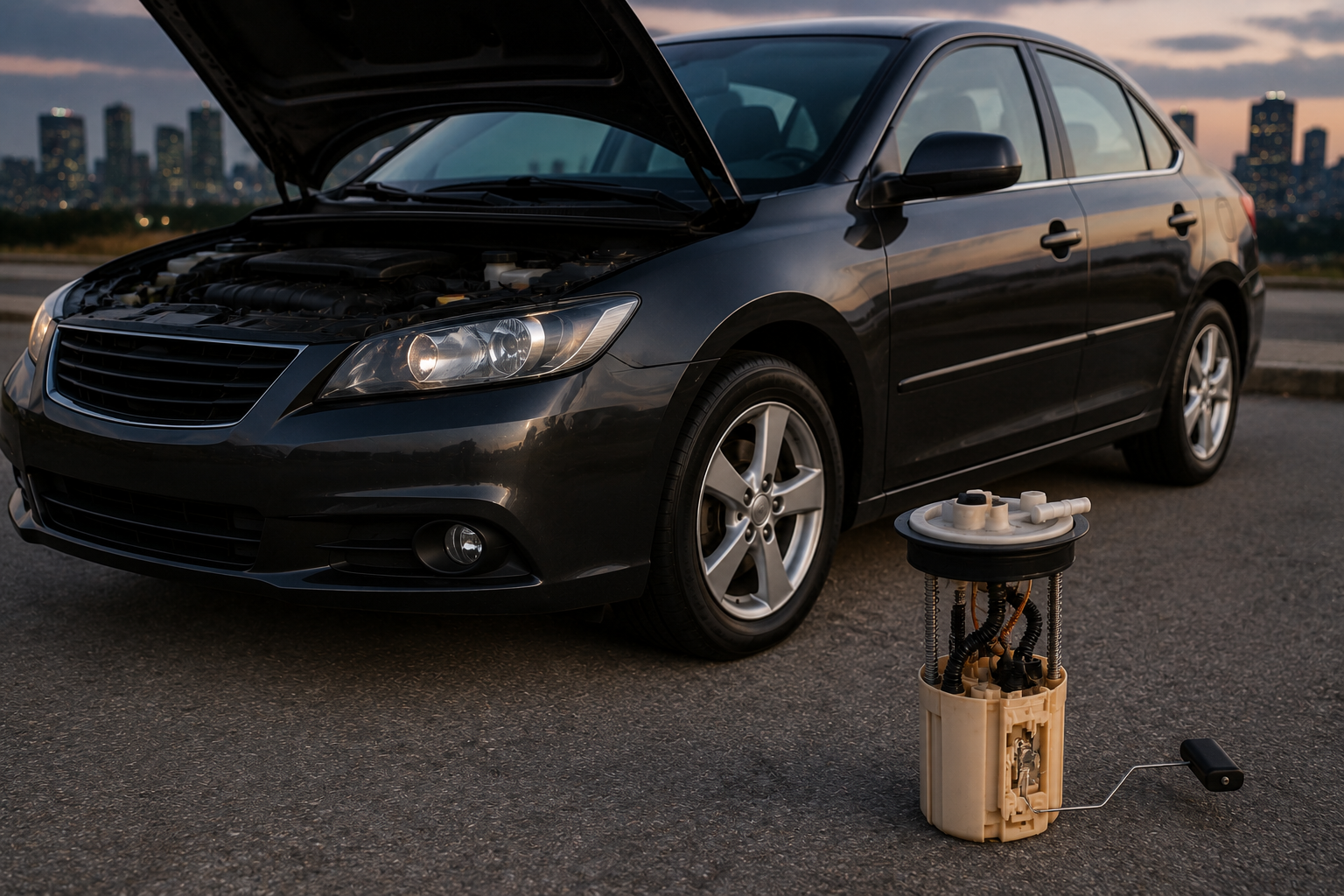
An electric fuel pump sits inside the fuel tank, submerged in fuel that both cools and lubricates the pump motor. As the pump wears internally — brushes erode, windings weaken, the impeller wears — it loses the ability to maintain high flow rates and high pressure under sustained demand. Early in failure, the pump meets light demand adequately but cannot sustain peak output. Late in failure, it cannot meet even light demand. The transition between these stages produces the pattern that distinguishes bad fuel pump symptoms from other fuel system problems.
| Failure Stage | What the Pump Can Do | Symptoms Present | Urgency |
|---|---|---|---|
| Early failure | Meets light/moderate demand — fails under hard acceleration or sustained high load | Stumble under hard acceleration, occasional hesitation on highway, symptom-free at idle and city driving | 🟡 Schedule diagnosis soon |
| Mid failure | Meets idle and light driving — fails under moderate load or hot conditions | Regular hesitation and stumbling, hard starts when hot, gets worse as tank drops below half | 🟠 Diagnose this week |
| Late failure | Meets idle only — fails intermittently even at low demand | Extended cranking to start, stalling while driving, no-start after hot soak, very poor performance | 🔴 Replace before stranded |
| Complete failure | Cannot maintain any pressure | Engine cranks but will not start — no fuel delivery | 🚨 Stranded — tow to shop |
8 Bad Fuel Pump Symptoms — Diagnosed by Pattern
Symptom 1: Engine Sputtering at High Speed — Classic Bad Fuel Pump Symptom
A car that runs normally at city speeds but sputters, stumbles, or briefly loses power during highway driving — particularly during sustained cruising at 65 to 75 mph or during uphill grades at speed — is showing the most characteristic early bad fuel pump symptom. At highway speed under moderate load, fuel demand is higher and more sustained than in stop-and-go city driving. A pump that is wearing out but not yet failed cannot maintain adequate pressure under this sustained demand. The engine momentarily runs lean, sputters, then recovers as the pump catches up briefly — then sputters again.
The distinguishing pattern: the stumble is most pronounced during sustained cruising, not during initial acceleration. It tends to worsen as the drive continues and the pump heats up. A road test that includes 15 to 20 minutes of sustained highway driving is the most reliable way to reproduce bad fuel pump symptoms — many failing pumps will not show symptoms at all during short city driving that never taxes output capacity.
What it mimics and how to distinguish: A clogged fuel filter produces a nearly identical symptom. A failing pump shows a pressure drop during snap acceleration when tested with a gauge at the fuel rail. A clogged filter shows restricted steady-state pressure that improves minimally during snap acceleration. Replace the filter before concluding the pump is failing — the filter is $30 to $100, the pump is $400 to $900. According to RepairPal’s fuel pump replacement cost estimator, most fuel pump replacements fall between $400 and $1,500 depending on vehicle type and whether the fuel tank must be dropped for access.
Symptom 2: Difficulty Starting — Long Crank Before Engine Fires
The fuel pump runs for approximately 2 seconds before you turn the key to start, pressurizing the fuel rail in preparation for the initial injection events. A healthy pump brings rail pressure to specification during this 2-second prime cycle. A pump showing bad fuel pump symptoms either does not build adequate pressure during the prime cycle, or pressure bleeds down slowly between start attempts because the pump’s check valve is also failing.
The symptom: the engine cranks normally but takes 3 to 6 seconds of cranking to fire, where previously it started within 1 to 2 seconds. Sometimes it fires immediately if you turn the key to the run position twice in a row before cranking — this manually runs the pump twice to build more fuel pressure before the starter engages. If this key-cycle trick improves starting, the pump is not building adequate pressure on a single prime cycle.
Long crank is more pronounced after the car has sat for several hours and may be less noticeable when restarting a warm engine within minutes of shutting off. The distinction from a failing starter: a failing starter produces a slow or weak crank. A failing fuel pump produces a normal-speed crank that takes longer to result in the engine firing.
Symptom 3: Engine Hesitation Under Hard Acceleration
Hard acceleration represents the highest instantaneous fuel demand the pump ever faces. At wide-open throttle, the injectors open to their maximum duty cycle and the fuel rail must supply a surge of fuel. A weakening pump that manages normal driving adequately may fail to maintain adequate pressure during this demand spike — producing one of the most common bad fuel pump symptoms: hesitation or stumbling specifically during hard acceleration that clears at light throttle.
This bad fuel pump symptom differs from ignition-related hesitation: fuel pump hesitation is throttle-depth-dependent — the harder you press the gas, the more pronounced the stumble. Light to moderate throttle from the same speed may produce no stumble at all. See our guide on car hesitates when accelerating for the complete comparison of all acceleration hesitation causes including MAF sensor, throttle body, and injector faults that produce similar but distinguishable patterns.
Symptom 4: Engine Stalls Under Load or When Hot
A fuel pump that has progressed past early failure may cause the engine to stall under load. The stall occurs when fuel demand exceeds what the weakening pump can deliver — the engine runs increasingly lean until combustion cannot be sustained. Hot conditions accelerate this because the pump motor generates its own heat during operation, and a pump already at the edge of its performance capacity becomes more likely to fail when the motor overheats.
Two specific stalling patterns point to bad fuel pump symptoms over other causes. First: stalling specifically during heavy load events but not during light driving. Second: stalling after extended hot driving but not immediately after a cold start. See our car stalls while driving guide for the complete condition-based matrix that separates fuel pump stalls from ignition and sensor-related causes.
Symptom 5: Whining or Humming Noise from the Fuel Tank
A functioning fuel pump produces a soft, barely audible hum from the rear of the vehicle when the ignition is first turned on. One of the clearest bad fuel pump symptoms is a noticeably louder whining, humming, or high-pitched noise from the fuel tank area that is audible during normal driving and persists throughout the drive — not just during the brief startup prime cycle.
Pump bearing wear causes the motor to run less smoothly and generate more noise. Cavitation — the formation and collapse of vapor bubbles in fuel around the pump inlet — also produces characteristic noise that is louder when the tank is low and during high-demand operation. A distinct whining from behind the rear seat that changes pitch or intensity with engine load is a reliable indicator of pump mechanical distress. The Car Care Council’s vehicle systems resources list abnormal pump noise alongside fuel system pressure loss as primary indicators of a failing fuel pump requiring professional diagnosis.
Symptom 6: Engine Surging Under Light Throttle
While most bad fuel pump symptoms involve insufficient fuel delivery, a pump with a failing internal check valve can produce intermittent over-delivery — the pump surges momentarily, delivering more fuel than the injectors are asking for. The brief surge produces a subtle lurching sensation at steady-state light throttle — the car seems to accelerate slightly without the driver pressing the gas harder.
Fuel pressure surges are the least common bad fuel pump symptom and the easiest to misattribute to other causes. Fuel pressure testing during the surge — confirming that pressure spikes during the surge event — is necessary to attribute it to the pump rather than a control system fault like a throttle position sensor or IAC valve issue.
Symptom 7: No Start After Hot Soak
Hot soak no-start is a particularly frustrating bad fuel pump symptom because it can seem completely random. The sequence: the car runs normally, you stop for 20 to 45 minutes, return to the car, and the engine cranks normally but will not start. After waiting 30 to 60 minutes, it starts again.
The mechanism: some pump failures are thermal — the pump motor windings fail under heat stress. During normal driving, airflow and fuel circulation cool the pump adequately. After shutdown, the pump sits in a hot engine bay without cooling airflow and the already-weakened motor components reach a thermal threshold where they fail to operate. After 30 to 60 minutes of cooling, they recover enough to function again. Hot soak no-start that resolves after extended cooling is strongly associated with a pump at or near complete failure.
Symptom 8: Symptoms Worsen Below a Quarter Tank — Most Specific Bad Fuel Pump Symptom
This is the most specific pattern for distinguishing bad fuel pump symptoms from all other causes. The pump sits at the bottom of the fuel tank. Fuel serves as a coolant and lubricant for the pump motor. As fuel level drops below a quarter tank, the pump may no longer be fully submerged — the motor runs hotter and with less lubrication, further reducing output from an already-weakened pump.
A driver who notices that all their bad fuel pump symptoms — stumbling, hesitation, difficult starting — are noticeably worse in the last quarter of each tank and improve immediately after filling up has described the strongest diagnostic indicator available without specialized equipment. No other fuel system fault correlates specifically with tank level in this way. This pattern also reveals a bad habit that accelerates pump wear: consistently running the tank to near-empty shortens pump life by running the motor hot and under-lubricated.
The 5-Minute DIY Test for Bad Fuel Pump Symptoms
Test 1: Listen for Pump Prime Cycle
Turn the ignition key to the ON position without cranking the engine. Listen for a soft 2-second hum from the rear of the vehicle. Perform this test 2 to 3 times consecutively. Bad fuel pump symptoms at this stage include a weaker hum than normal, a whining or grinding noise, or no sound at all from a pump that previously made audible prime noise.
Test 2: Tank Level Correlation Test
Over your next 2 to 3 fill-ups, note whether bad fuel pump symptoms — stumbling, hesitation, difficult starting — are more pronounced below a quarter tank and less pronounced after filling. A consistent correlation is one of the strongest diagnostic indicators available without specialized equipment and is unique to bad fuel pump symptoms.
Test 3: Key-Cycle Start Test
If the car is slow to start, turn the ignition to ON, wait 3 seconds, turn to OFF. Repeat twice more, then attempt normal start. If starting improves significantly — the pump is not building adequate pressure on a single prime cycle, confirming bad fuel pump symptoms related to pressure bleed-down or weak check valve.
Test 4: Fuel Pressure Test at the Rail — Definitive
A fuel pressure gauge connected to the Schrader valve on the fuel rail reads actual pump output pressure. Most port injection vehicles specify 45 to 60 PSI. Test at key-on prime, at idle, and during snap acceleration.
| Pressure Reading | Interpretation |
|---|---|
| At or above specification — key on, engine off | Pump output adequate at rest — may still fail under running load |
| Below specification at key-on prime | Bad fuel pump symptom confirmed — pump cannot build adequate static pressure |
| Pressure drops quickly after ignition off | Check valve failed — explains long crank after sitting |
| At spec at idle, drops during snap acceleration | Bad fuel pump symptom confirmed — pump cannot sustain high-demand flow |
| At spec at all conditions | Not the pump — investigate injectors, sensors, or ignition |
Bad Fuel Pump Symptoms vs Other Causes — Comparison
| Symptom Pattern | Points to Bad Fuel Pump | Points Elsewhere |
|---|---|---|
| Stumble worst under hard acceleration, fine at light throttle | ✅ Strong — demand-dependent | Spark plugs: stumble at any throttle |
| Worse at low fuel level, better after fill-up | ✅ Very strong — pump-specific | No other cause correlates with tank level |
| Worsens with engine heat — better when cold | ✅ Strong — thermal failure pattern | Crank sensor also fails hot — test both |
| Long crank, improves with multiple key cycles | ✅ Strong — check valve or pressure bleed | Injector leak-down also causes this |
| Whining noise from tank area | ✅ Direct — mechanical pump noise | No other component in that location |
| Stumble at all throttle levels equally | ❌ Less likely | Spark plugs, coils, injectors more likely |
| Check engine light with specific misfire codes | ❌ Less likely for pump | Ignition coil, injector, spark plug |
| Rough idle that clears at speed | ❌ Not a pump pattern | IAC valve, throttle body, vacuum leak |
Fuel Pump Replacement Cost
| Vehicle Type | DIY Cost | Shop Cost | Labor Hours |
|---|---|---|---|
| Most front-wheel drive sedans and cars | $80–$200 parts | $400–$700 | 2–4 hours |
| Trucks and SUVs with high tank | $100–$250 parts | $500–$800 | 2–3 hours |
| Vehicles requiring fuel tank drop | $80–$200 parts | $500–$900 | 3–5 hours |
| Vehicles with in-tank module assembly | $150–$350 parts | $600–$1,000 | 3–5 hours |
| Diesel vehicles | $200–$500 parts | $700–$1,500 | 4–6 hours |
Always replace the fuel filter simultaneously with the pump if your vehicle has an accessible external filter — the old filter may have contributed to pump stress. Replace the fuel strainer at the same time — it is included with most pump assemblies and takes no additional labor to install.
Frequently Asked Questions About Bad Fuel Pump Symptoms
What are the signs of a bad fuel pump?
The eight most reliable bad fuel pump symptoms are: engine sputtering at high speed under sustained load, difficulty starting with extended cranking, hesitation specifically during hard acceleration, engine stalling under load or after hot soak, a whining or humming noise from the fuel tank area, engine surging at light throttle, no-start after the car has been off for 20 to 45 minutes in warm conditions, and symptoms that noticeably worsen when the fuel tank drops below a quarter full. The key diagnostic pattern: bad fuel pump symptoms follow fuel demand — worst under high load, better at light throttle, and correlated with tank level.
How do I know if my fuel pump is failing or something else?
Three patterns distinguish bad fuel pump symptoms from similar complaints. First: symptoms that are demand-dependent — worst under hard acceleration, absent at idle. Second: symptoms that worsen as the fuel tank drops below a quarter full and improve after filling. Third: long crank that improves when you cycle the ignition to ON twice before starting. A fuel pressure test confirming pressure drops during snap acceleration definitively confirms bad fuel pump symptoms versus other causes.
Can I drive with bad fuel pump symptoms?
For a limited distance in early failure — yes. A pump causing occasional stumbling under hard acceleration but allowing normal driving can be driven carefully to a shop. Avoid hard acceleration, keep the fuel tank above a quarter full, and do not take long highway trips. A pump showing late-stage bad fuel pump symptoms — frequent stalling or hot-soak no-start — should be replaced before any long drive. Complete pump failure requires towing.
What does a failing fuel pump sound like?
A failing fuel pump produces a whining or humming noise from the fuel tank area — louder than normal, continuous during driving rather than limited to the 2-second prime cycle. Normal pump noise is a very soft hum when the ignition is first turned on. Bad fuel pump symptoms that are audible include noise louder than normal, continuous while driving, or with a grinding quality. The noise often worsens when the fuel tank is below half full.
Related Guides
If you are experiencing bad fuel pump symptoms alongside acceleration hesitation, our car hesitates when accelerating guide covers the MAF sensor, throttle body, and injector causes that produce similar symptoms. For stalling that may be fuel-pump related, see our car stalls while driving guide. And if the check engine light is on alongside bad fuel pump symptoms, reading the stored codes per our check engine light guide before any repair prevents replacing parts that the codes would have pointed away from.