Car Hesitates When Accelerating: 8 Causes + Diagnostic Checklist
Car hesitates when accelerating — that brief pause before power arrives. Different from jerking, different causes. Our symptom-based diagnostic checklist identifies the exact cause in minutes with repair costs for all 8 problems.
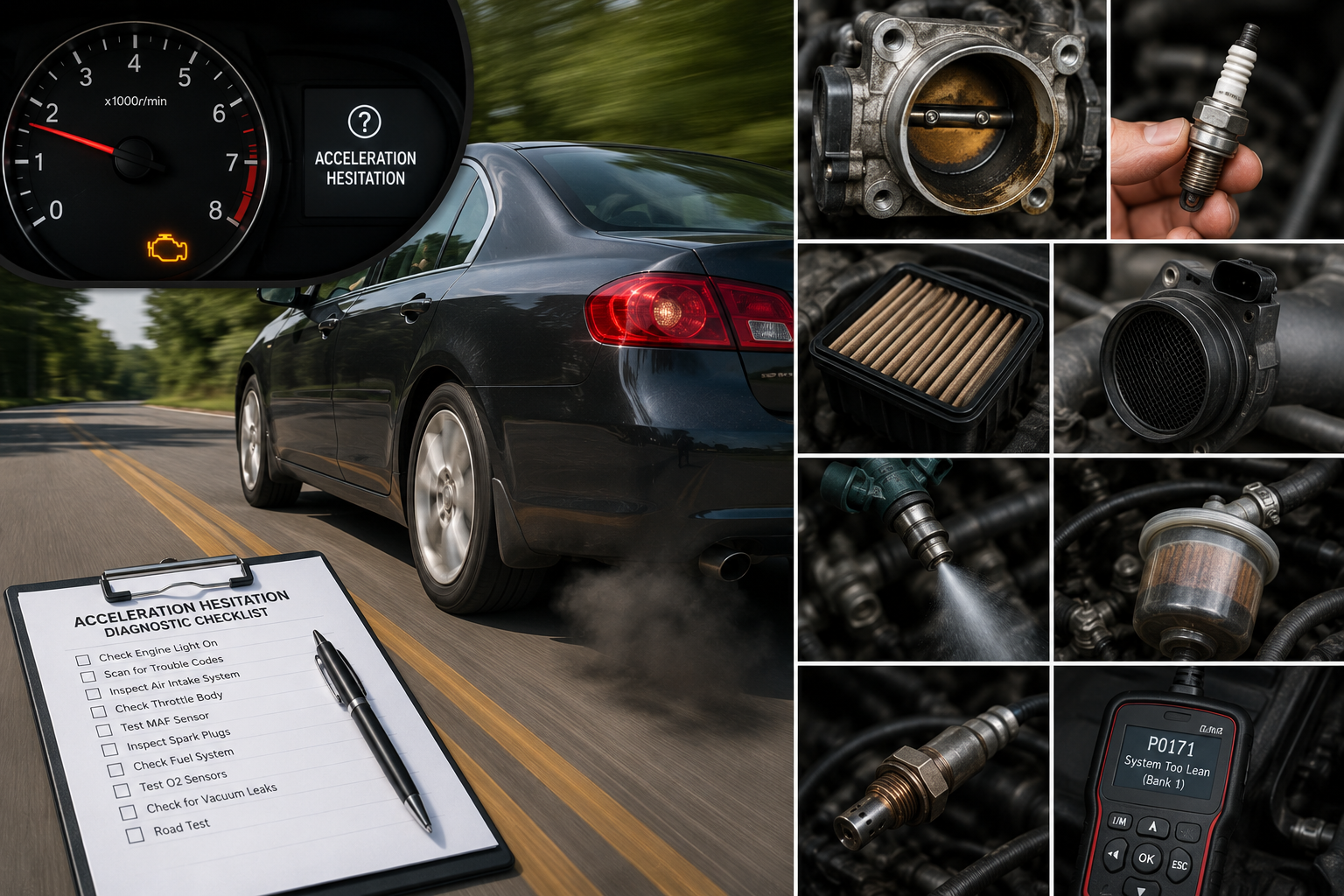
A car that hesitates when accelerating is different from one that jerks. Hesitation is a delay — you press the gas, there is a brief pause before power arrives, then the car accelerates normally. Jerking is a repeated grab-and-release during acceleration. That distinction matters because hesitation and jerking share some causes but not all. Hesitation specifically points to fuel delivery timing problems, vacuum leaks, sensor failures that affect the air-fuel ratio calculation, or throttle response issues — not primarily transmission problems. The hesitation duration and when it happens narrows it further.
You press the accelerator and nothing happens for a half-second. Then the car moves. Sometimes the hesitation is barely noticeable — a slight flat spot before power builds. Other times it is severe enough that the car feels like it is going to stall before lurching forward. The engine is telling you something specific with this symptom, and understanding what it is saying saves you from the most common expensive mistake: replacing expensive components based on guesswork when the actual cause costs $15 to fix.
Hesitation vs Jerking — Why the Distinction Matters
| Symptom | Description | Primary Cause Category |
|---|---|---|
| Hesitation | Delay before power — pause then go | Fuel timing, sensors, vacuum leaks, throttle |
| Jerking | Repeated surge-and-drop during acceleration | Misfires, injectors, transmission engagement |
| Stumbling | Rough, uneven power delivery throughout acceleration | Misfires, ignition weakness, fuel pressure drops |
| Surge | Unexpected power increase without pressing gas harder | IAC valve, vacuum leaks, TPS fault |
Diagnostic Checklist — When Does the Hesitation Occur?
| When It Happens | Primary Suspect | Secondary Suspect |
|---|---|---|
| Cold start only — fine when warm | Dirty throttle body / IAC valve | Cold start injector / coolant temp sensor |
| Warm engine only — fine when cold | Lean mixture from vacuum leak | Failing oxygen sensor (reads rich when hot) |
| First acceleration from stop — every time | Dirty throttle body / TPS fault | Low fuel pressure at startup |
| Only during light throttle transition | MAF sensor / TPS calibration | Accelerator pump (carbureted engines) |
| Only under hard acceleration | Fuel pump delivery limit | Clogged fuel filter |
| After the car sits for days | Fuel pressure bleed-down (check valve) | Injector leak-down |
| Worse in hot weather | Vapor lock / fuel system heat soak | Fuel pump overheating |
| With check engine light on | Read the fault code first — diagnosis in the code | Oxygen sensor / MAF fault most common |
8 Causes of Car Hesitation When Accelerating
1. Dirty Throttle Body — Most Common Cold-Start Hesitation
The throttle body controls air flow into the engine. Carbon deposits accumulate on the throttle plate and bore from crankcase vapors recirculated through the PCV system. When these deposits build up, two problems occur. First, the throttle plate does not open as smoothly — there is a physical resistance to initial opening that creates a hesitation as you begin to press the accelerator. Second, the idle air control passages get partially blocked, causing the ECU to hunt for the correct idle mixture during transitions from idle to acceleration.
Cold-start hesitation is the signature symptom of a dirty throttle body — the engine idles fine, but the first press of the gas pedal produces a momentary flat spot before power arrives. As the engine warms and the throttle opens wider, the deposits have less relative effect and the hesitation reduces or disappears entirely.
Throttle body cleaning costs $5–$15 in cleaner spray and 15–20 minutes of DIY time. On drive-by-wire vehicles (no mechanical throttle cable), spray cleaner on a rag and wipe — never spray directly into the throttle body while the car is running. After cleaning, many drive-by-wire vehicles require a throttle body relearn procedure — turn ignition on without starting, wait 10 seconds, turn off, wait 10 seconds, start. This allows the ECU to recalibrate the throttle position to the now-clean bore.
2. Mass Airflow Sensor Fault
The MAF sensor measures incoming airflow. The ECU uses this reading to calculate fuel injection quantity. A contaminated or failing MAF sensor sends incorrect data — the ECU under-fuels during acceleration transitions because it reads less air than is actually entering. The result: a lean stumble or hesitation precisely when you push the gas pedal and airflow increases rapidly.
MAF contamination is particularly common on vehicles using oiled aftermarket filters that were over-oiled at installation. The oil deposits on the MAF sensing element cause it to read consistently low. Cleaning the MAF with dedicated cleaner (not carburetor cleaner or brake cleaner — these damage the sensing element) resolves most contamination cases. If the hesitation persists after cleaning, the MAF may have failed electrically and needs replacement at $100–$300.
A diagnostic shortcut: disconnect the MAF sensor and drive the car carefully. Most modern ECUs enter a failsafe mode using a default map that bypasses the MAF reading. If the hesitation disappears with the MAF disconnected, the MAF is providing bad data and needs cleaning or replacement. If the hesitation remains, the MAF is not the cause.
3. Faulty Throttle Position Sensor
The throttle position sensor tells the ECU the exact angle of the throttle plate at every moment. When you press the accelerator, the ECU sees the throttle opening and begins increasing fuel injection and ignition advance to match. A TPS that sends incorrect position data creates hesitation in a specific way: the delay between pressing the gas pedal and fuel delivery increasing — because the ECU does not know the throttle is opening until a moment after it actually does.
TPS faults are almost always accompanied by a check engine light with codes P0120–P0124. The hesitation from a TPS fault tends to be consistent — every time you accelerate from the same throttle position — rather than intermittent. TPS replacement costs $50–$200 for the part. On many modern vehicles, the TPS is integrated into the throttle body assembly and the entire unit requires replacement.
4. Vacuum Leak
The intake manifold operates under vacuum when the engine is running. Air enters the engine only through the throttle body and metered by the MAF sensor. A vacuum leak — a crack in an intake hose, a failed intake manifold gasket, a disconnected vacuum line — allows unmetered air to enter the engine that the ECU does not know about. The ECU calculates fuel injection based on the air it measured through the MAF, but more air is actually entering through the leak. The mixture runs lean.
Lean conditions produce hesitation because the combustion cycle receives insufficient fuel relative to the air. The ECU’s long-term fuel trims compensate gradually, but during acceleration transitions the compensation cannot keep up with the rapidly changing airflow, creating a stumble. Vacuum leak hesitation is typically worse at idle and light throttle — where the vacuum differential is highest — and may improve at wide-open throttle where the leak is proportionally smaller relative to total airflow.
Vacuum leak diagnosis: spray carburetor cleaner briefly around intake hose connections, manifold gaskets, and vacuum line connections with the engine running. If the idle changes when you spray a specific location — the engine RPM briefly rises as it runs on the cleaner — you have found the leak. Professional smoke testing (pressurizing the intake with smoke to find leaks visually) costs $50–$100 at a shop and finds leaks spray testing misses.
5. Failing Oxygen Sensor
Oxygen sensors measure exhaust oxygen content and feed this data to the ECU for fuel trim adjustment. A failing oxygen sensor that reads consistently rich or consistently lean causes the ECU to over-correct fuel delivery in the opposite direction. A sensor reading lean (too much oxygen) causes the ECU to add extra fuel. When you accelerate, the transition disrupts this compensation and the mixture briefly runs too rich or too lean until the feedback loop stabilizes — producing the hesitation.
Oxygen sensor hesitation typically worsens as the engine and sensor heat up — symptoms that appear after 10–15 minutes of driving rather than on cold start. Most oxygen sensor failures store fault codes (P0130–P0167 range). Oxygen sensor replacement costs $50–$200 for the part; $100–$300 at a shop including labor.
6. Fuel Pressure Issues — Fuel Pump or Filter
The fuel system must maintain consistent rail pressure at all times — especially during the sudden demand increase of hard acceleration. A fuel pump that cannot maintain pressure under load creates a lean stumble precisely when the accelerator is pressed hard. A clogged fuel filter restricts flow, producing the same effect — the pump can maintain pressure at light throttle but cannot flow enough fuel when demand spikes.
Fuel pressure hesitation has a specific pattern: fine at light throttle, noticeable hesitation during moderate to hard acceleration, and often gets worse as the fuel tank drops below a quarter full (pump draws air when low). A fuel pressure gauge test while replicating the symptom shows the root cause directly — pressure that drops during acceleration snap indicates pump or filter, pressure that holds indicates the problem is elsewhere.
Fuel filter replacement (where external filters exist): $30–$100 DIY, $100–$200 at a shop. Fuel pump replacement: $400–$900 depending on whether the tank requires dropping.
7. Worn Spark Plugs or Ignition Coil Weakness
Spark plugs that have worn beyond their service interval require more voltage to fire. During the rapid throttle transitions of acceleration — when intake charge is densest and combustion pressure highest — the weakened spark from worn plugs fails to consistently ignite the mixture. The result is a stumble or hesitation during the acceleration transition that clears once the throttle stabilizes.
Unlike a fully failed ignition coil that produces a constant misfire (felt as continuous rough running), an ignition coil that is weakening but not failed produces hesitation specifically during the high-demand condition of acceleration — the coil can maintain idle and light throttle spark but struggles when the load increases. Replacing spark plugs at or before the manufacturer’s interval prevents this entirely. See our guide on the car maintenance schedule for correct spark plug replacement intervals.
8. Carbon Deposits on Intake Valves (Direct Injection Engines)
Direct injection engines — which include virtually all modern turbocharged engines and many naturally aspirated engines — inject fuel directly into the cylinder rather than into the intake port. This means fuel never washes the intake valves. Over time, oil vapors from the PCV system deposit carbon on the back of the intake valves. Heavy deposits restrict airflow into the cylinder, particularly at low valve lift during light throttle, creating hesitation and a flat spot during the low-to-mid throttle transition.
Carbon buildup hesitation is progressive — it develops gradually over 60,000–80,000 miles and the driver adapts to the gradually worsening response without noticing the change until it becomes significant. The fix is walnut blasting — media blasting the intake ports with walnut shell media through the intake manifold with the valves closed. Cost: $400–$800 at a shop specializing in GDI engine service. Preventive treatment every 50,000 miles on direct injection engines is recommended maintenance — far cheaper than the fuel injector cleaning and other parts replacement drivers pursue before correctly identifying this as the cause.
Quick Diagnostic Sequence — Do These in Order
- Check for check engine light fault codes first. Even a hesitation without a visible CEL may have stored pending codes. Read with a free OBD2 scanner at AutoZone or O’Reilly. A code present changes the entire diagnostic approach — follow the code before spending any money. Our check engine light guide covers free code reading.
- Check and replace the air filter. A severely clogged air filter restricts intake airflow and causes lean conditions at higher throttle. $15–$30, 5 minutes. Eliminate this before anything else.
- Clean the throttle body. $5–$15, 20 minutes. If hesitation is worse on cold start and improves when warm, this is the most likely cause and the cheapest fix.
- Clean the MAF sensor. $10 in MAF cleaner, 10 minutes. High probability fix if hesitation appeared after an air filter change or oil service.
- Try fuel injector cleaner. One bottle of Techron or BG 44K in a full tank, driven aggressively. If hesitation improves — injector deposits contributing.
- Inspect vacuum hoses. Look for cracked, disconnected, or collapsed hoses around the throttle body and intake manifold. A $3 hose replaces a $500 diagnostic.
- Replace spark plugs if near interval. If mileage is within 10,000 miles of the replacement interval, replace them — the cost is certain, the improvement is likely, and it is maintenance that is due anyway.
- Fuel pressure test. If all above are clear and hesitation remains, a fuel pressure test definitively confirms or eliminates the fuel pump and filter.
Repair Cost Summary
| Repair | DIY Cost | Shop Cost | Fix Probability |
|---|---|---|---|
| Air filter replacement | $15–$30 | $30–$80 | Low — but check first |
| Throttle body cleaning | $5–$15 | $80–$150 | High for cold-start hesitation |
| MAF sensor cleaning | $10 | $50–$100 | High after filter change |
| Fuel injector cleaner | $10–$25 | N/A | Moderate |
| Vacuum hose replacement | $3–$20 | $50–$150 | High if leak confirmed |
| Spark plug replacement | $20–$100 | $100–$400 | High if near interval |
| Throttle position sensor | $50–$200 | $150–$400 | High if P012x code stored |
| MAF sensor replacement | $100–$300 | $200–$450 | High if cleaning fails |
| Oxygen sensor replacement | $50–$200 | $150–$350 | Moderate with O2 codes |
| Fuel filter replacement | $20–$80 | $100–$200 | Moderate |
| Fuel pump replacement | $80–$200 | $400–$900 | Confirmed by pressure test |
| Intake valve cleaning (walnut blast) | N/A | $400–$800 | High on GDI engines 60K+ |
Frequently Asked Questions
Why does my car hesitate when I accelerate?
A car hesitates when accelerating because of a brief mismatch between the air entering the engine and the fuel being delivered — the combustion cycle momentarily receives the wrong mixture during the transition from idle to acceleration. The most common causes are a dirty throttle body restricting smooth air flow transition, a contaminated MAF sensor providing incorrect air measurement, a vacuum leak allowing unmetered air, worn spark plugs providing insufficient ignition energy during the high-load acceleration moment, or a fuel delivery problem limiting the fuel spike needed when demand increases suddenly.
What is the difference between hesitation and jerking when accelerating?
Hesitation is a delay — you press the gas, there is a brief pause before power arrives, then the car accelerates normally. It is a single transition problem. Jerking is a repeated grab-and-release pattern during acceleration — the car surges, drops, surges, drops rhythmically as you maintain the throttle. Hesitation primarily indicates sensor, vacuum, or throttle issues. Jerking more often indicates misfires, fuel injector inconsistency, or transmission engagement problems. Both can share some causes like worn spark plugs and fuel delivery issues, but the diagnostic approach differs.
Can a dirty air filter cause hesitation?
Yes, though it is rarely the sole cause of noticeable hesitation unless severely clogged. A moderately dirty air filter reduces overall airflow and causes the engine to run slightly richer — the opposite of the lean condition that typically causes hesitation. A severely clogged filter restricts airflow enough to cause lean stumble at higher throttle openings. Always replace the air filter as part of hesitation diagnosis — it is cheap, it is due maintenance, and it eliminates one variable before spending money on more expensive parts.
Can low fuel cause hesitation when accelerating?
A low fuel level does not cause hesitation by itself — but a failing fuel pump becomes more likely to cause hesitation when the tank is low. The pump sits at the bottom of the tank and draws air when fuel level is very low. Additionally, at low fuel levels the pump may not stay submerged in fuel that normally helps cool and lubricate it, accelerating wear. If hesitation is noticeably worse below a quarter tank and improves after filling up, the fuel pump is approaching failure and should be tested and replaced proactively.
Related Guides
If your car hesitates and then jerks rather than smoothly accelerating, see our related guide on car jerks when accelerating — the speed-based diagnostic matrix there covers the jerking pattern specifically. If a check engine light is present alongside the hesitation, read our check engine light guide for free code reading before any repairs. And if the hesitation is accompanied by engine knocking or ticking sounds, our engine knocking diagnosis guide covers the combined symptom scenario that often indicates a more serious underlying issue.