Check Engine Light Flashing: What It Means, How Long You Have, and What to Do
A flashing check engine light is not the same as a solid one. Solid means a problem exists. Flashing means active engine misfiring is destroying your catalytic converter right now — every mile you drive is potentially hundreds of dollars in additional damage. Here is exactly what is happening, how long you can safely drive, and what to do in the next 10 minutes.
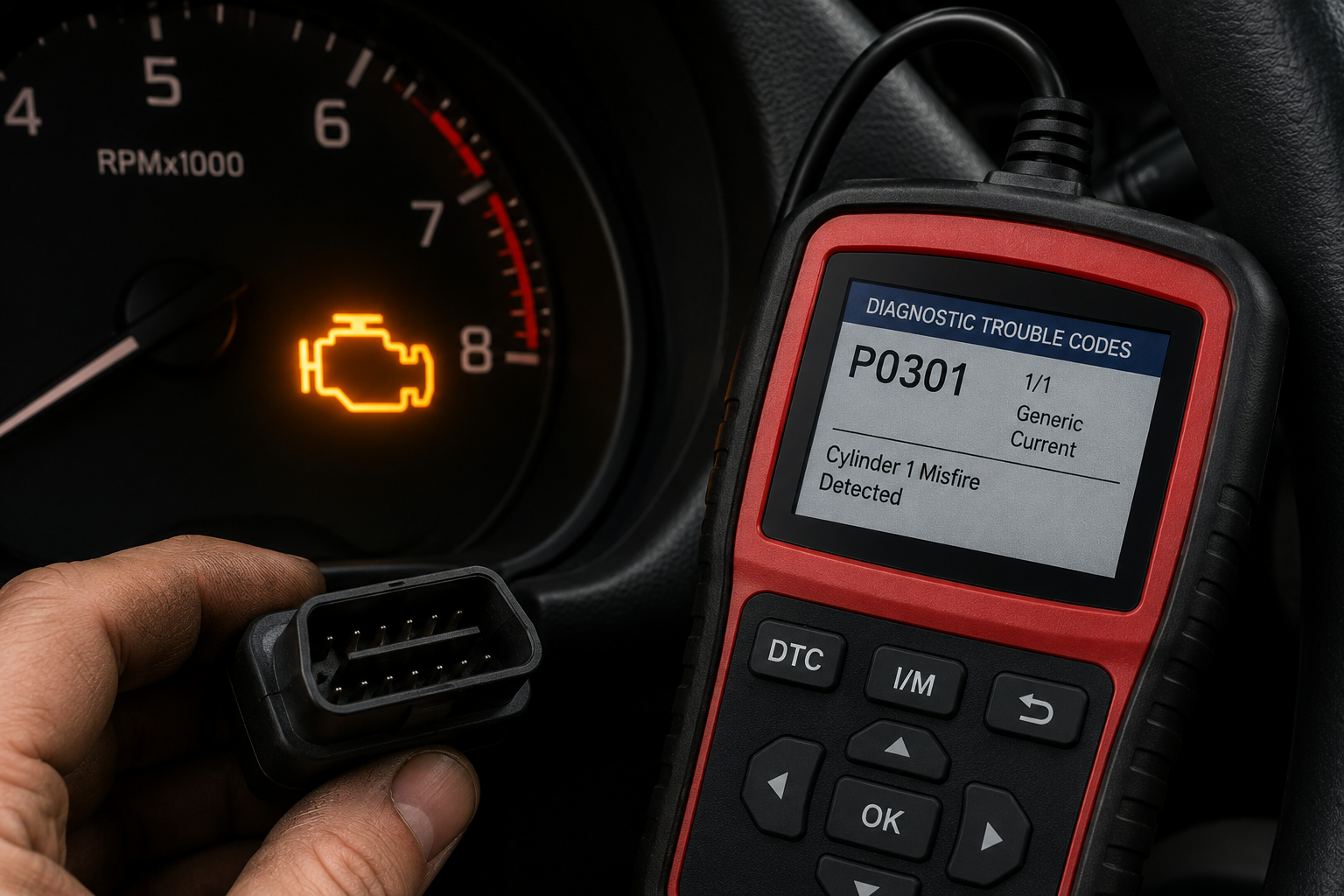
A flashing check engine light means the engine is misfiring right now — unburned fuel is passing through the exhaust system and into the catalytic converter, where it is burning at temperatures the converter was never designed to handle. Every minute of continued driving with a flashing CEL deposits more heat into the catalytic converter. At a certain point — which varies by vehicle but often comes within 50 to 100 miles of sustained misfiring — the converter’s internal ceramic substrate melts, fuses, or fractures. A catalytic converter costs $800 to $2,500 to replace. The misfire that caused the flashing light often costs $50 to $300 to fix. Drive on a flashing CEL and you can convert a minor repair into a major one in a single commute.
Pull over when it is safe to do so. That is the correct response to a flashing check engine light. Not “I’ll check it when I get home.” Not “it’ll probably sort itself out.” A solid amber check engine light — which most drivers have seen — is a stored fault code indicating something needs attention. A flashing or blinking amber check engine light is an active emergency signal with a specific meaning: the engine is currently misfiring and the catalytic converter is at risk of damage with every additional mile. This guide tells you exactly what is happening, what caused it, and the correct sequence of actions from the moment the light starts flashing.
Flashing vs Solid — Two Completely Different Situations
| Light Behavior | Meaning | Urgency | Correct Action |
|---|---|---|---|
| Solid amber — steady on | Stored fault code — problem detected | 🟡 Address within days to weeks | Read codes at auto parts store, diagnose and repair |
| Flashing / blinking amber | Active misfire — catalytic converter at risk | 🔴 Stop driving — within next few miles | Reduce speed, avoid hard acceleration, reach a safe stop |
| Flashing amber + rough running | Severe active misfire — multiple cylinders | 🚨 Pull over immediately | Stop engine, do not continue driving, call for service |
| Red CEL (rare — some vehicles) | Critical fault — immediate action required | 🚨 Stop immediately | Same as flashing — stop the vehicle |
| CEL flashed briefly then went solid | Misfire occurred, engine management caught it | 🟠 Address this week | Read codes — catalytic damage may have already begun |
The critical distinction most guides fail to explain clearly: the flashing CEL is not a more severe version of the solid CEL. It is a different signal with a different cause. The solid CEL illuminates when a sensor reading falls outside acceptable parameters — an oxygen sensor, MAF sensor, EVAP system leak, loose gas cap, dozens of possible causes, most of which allow continued driving while arrangements are made for diagnosis. The flashing CEL is triggered specifically by the misfire monitoring system detecting that combustion is failing in one or more cylinders at a rate that poses a risk to the catalytic converter. The ECU flashes the light as an active warning to stop driving, not a passive note to get service eventually.
What Is Actually Happening Inside the Engine
A misfire means one or more cylinders is failing to combust the air-fuel mixture on their firing stroke. The piston compresses the mixture, the spark plug fires — but the mixture does not ignite, or ignites incompletely. The result: that cylinder produces no power contribution, and — more critically — the unburned or partially burned air-fuel mixture exits the cylinder through the exhaust valve and passes into the exhaust system.
The catalytic converter normally receives exhaust gases that have already been through combustion. Its job is to process trace amounts of unburned hydrocarbons, carbon monoxide, and nitrogen oxides. It is not designed to receive raw unburned fuel. When a misfiring cylinder sends unburned fuel directly into the converter, that fuel ignites inside the converter itself — at temperatures that can reach 1,600°F to 2,000°F. The converter’s honeycomb ceramic substrate is engineered to operate at 800°F to 1,200°F under normal conditions. The excess heat from burning fuel inside the converter melts and fuses the ceramic substrate, reducing or eliminating exhaust flow, and ultimately destroying the converter’s catalytic function.
This is why the flashing CEL was specifically designed — the engineers who wrote the OBD2 standard in the 1990s understood that misfire damage to catalytic converters was both common and preventable, and created a distinct visual warning (flashing vs solid) to communicate exactly this risk to drivers. The system is working as intended when your CEL flashes. The intended response is to stop driving.
How Long Can You Drive with a Flashing Check Engine Light?
| Situation | Safe Distance | Reason |
|---|---|---|
| Light just started flashing, car running normally | 2–3 miles maximum to reach a safe stop | Converter damage begins immediately with active misfire |
| Flashing + rough idle or shaking | Pull over within 1 mile | Multiple cylinder misfire — severe converter risk |
| Flashing + strong burning smell | Pull over immediately | Converter may already be overheating — fire risk possible |
| Flashing + loss of power | Pull over safely — within 1 mile | Significant misfire affecting drivability and safety |
| Light flashed briefly, now solid | Drive to shop directly | Misfire event occurred — codes stored, diagnose today |
| Flashing only at certain RPM, normal otherwise | Drive gently to shop only | Intermittent misfire — avoid load conditions that trigger it |
The answer most people want is “how many miles before I damage something.” The honest answer: there is no safe number of miles to drive on a flashing CEL. Some catalytic converters begin showing damage signatures within a few miles of sustained misfiring. Others withstand longer. The variables include misfire severity, how many cylinders are affected, the vehicle’s speed (highway speed means more exhaust flow and more unburned fuel reaching the converter), and the converter’s age and condition. The conservative, correct answer is: zero additional miles beyond what is needed to reach a safe stop.
4 Causes of a Flashing Check Engine Light
1. Worn or Failed Spark Plugs — Most Common Cause
Spark plugs that have exceeded their service interval have eroded electrodes with a wider-than-specification gap. When the gap becomes too wide, the coil must produce more voltage to jump the gap — and under certain conditions (high load, cold temperature, high cylinder pressure) it cannot produce enough voltage. The plug fails to fire on that stroke. The cylinder misfires. The unburned charge exits through the exhaust.
A spark plug misfire that causes a flashing CEL is typically more severe than the mild hesitation caused by a slightly worn plug — by the time the ECU is flashing the light, the misfire rate has crossed the threshold where converter damage is considered imminent. Copper plugs have a replacement interval of 30,000 to 50,000 miles. Iridium or platinum plugs last 60,000 to 100,000 miles. If your vehicle is within 15,000 miles of its plug replacement interval and the CEL starts flashing — spark plugs are the first place to look and often the complete fix. Replacement costs $100 to $300 at a shop for most 4-cylinder engines. For the full maintenance interval, see our car maintenance schedule guide.
2. Failed Ignition Coil
Modern engines use individual ignition coils — one per cylinder — in the coil-on-plug configuration. When a coil fails, the cylinder it serves loses spark completely. Unlike a worn spark plug that may occasionally fire weakly, a completely failed coil produces a consistent, every-cycle misfire in its cylinder. The ECU detects this immediately and flashes the CEL within a few engine cycles of the failure.
The fault code stored will be P0301 through P0308, identifying the specific misfiring cylinder number. Knowing the cylinder number allows a quick diagnostic swap test: move the suspected coil to an adjacent cylinder and clear the codes. If the misfire code follows the coil to the new cylinder — the coil is faulty. If the misfire stays on the original cylinder — the spark plug or fuel injector for that cylinder is the cause. Individual coil replacement costs $50 to $150 for the part and is straightforward DIY on most coil-on-plug engines.
3. Fuel Injector Failure
A fuel injector that has failed open — stuck in the open position — floods its cylinder with excess fuel. The rich mixture may not ignite reliably, causing misfires. More commonly, a failed-open injector causes a misfire because the fuel washes the oil film off the cylinder walls, reduces compression, and fouls the spark plug in that cylinder with wet fuel deposits. The misfire from a failed injector can be particularly damaging to the catalytic converter because it delivers not just a missed combustion event but an excessive fuel charge directly to the exhaust.
A fuel injector that has failed closed — stuck shut — delivers no fuel to its cylinder. The cylinder fires air only, producing a lean misfire. Lean misfires are less damaging to catalytic converters than rich misfires but still trigger the flashing CEL. Fuel injector faults store codes that identify the affected cylinder and in some cases identify the injector circuit specifically. Injector replacement costs $300 to $600 per injector at a shop.
4. Low Compression — Mechanical Misfire
If spark plugs, coils, and injectors all test normal and a misfire persists, the cause may be mechanical — the cylinder cannot build adequate compression to allow combustion regardless of how well the ignition and fuel systems function. Low compression comes from worn piston rings that allow combustion pressure to escape into the crankcase, a burned or bent exhaust valve that does not seal completely, or a head gasket breach between the combustion chamber and coolant passage that allows compression to escape.
A compression test — performed with a compression gauge inserted into the spark plug hole and the engine cranked — identifies low-compression cylinders definitively. Normal compression on a modern gasoline engine is 150 to 200 PSI. A cylinder reading below 100 PSI, or more than 15 to 20 PSI lower than the other cylinders, has a mechanical issue. Mechanical misfire repairs are significantly more expensive — head gasket replacement runs $1,500 to $3,500, valve jobs run $800 to $2,000. Identifying this cause early by reading codes, performing the coil swap test, and then a compression test avoids replacing ignition and fuel components unnecessarily on an engine with a mechanical fault. For head gasket symptoms see our white smoke from exhaust guide.
What to Do Right Now — Step by Step
- Reduce speed immediately. Higher speed means more misfire events per minute and more unburned fuel reaching the catalytic converter. Slow down and avoid hard acceleration.
- Turn off non-essential electrical loads. AC, rear defroster, heated seats — not because they affect the misfire, but because reducing electrical load allows you to focus on getting safely stopped without additional distractions.
- Reach a safe stop within 2 to 3 miles. A parking lot, gas station, or road shoulder. Do not continue driving to your destination.
- Turn the engine off and wait 5 minutes. This allows the catalytic converter to cool and stops the ongoing damage accumulation.
- Read the fault codes. If you have a Bluetooth OBD2 scanner or can reach an auto parts store, read the codes before any repairs. The code P0301 through P0308 identifies the specific misfiring cylinder. P0300 means random multi-cylinder misfire. This code narrows the diagnosis from eight possible causes to one specific cylinder, saving significant diagnostic time and money.
- Do not clear the codes and keep driving. Clearing codes without fixing the underlying cause removes the diagnostic information and does nothing to stop the physical damage to the converter. See our check engine light reset guide for when clearing codes is and is not appropriate.
- Arrange repair before driving further. If the car is at a safe location and not at a shop, call for a tow or have the vehicle inspected on-site. Do not drive it further with the light actively flashing.
What Happens If You Ignore a Flashing CEL
| Miles Driven on Flashing CEL | Likely Result | Estimated Cost |
|---|---|---|
| 0–5 miles (stop immediately) | Misfire repair only — converter may be undamaged | $100–$400 misfire repair |
| 5–50 miles (drove home or to shop) | Possible converter damage beginning — may need replacement | $100–$400 misfire + possible $800–$1,500 converter |
| 50–200 miles (drove over multiple days) | Converter likely significantly damaged | $800–$2,500 converter + misfire repair |
| 200+ miles (ignored for weeks) | Converter destroyed — possible engine damage from back pressure | $1,500–$4,000+ total repair |
Catalytic Converter Damage — How to Know If It Already Happened
After addressing the misfire that caused the flashing CEL, two symptoms suggest the catalytic converter sustained damage during the period of misfiring.
- New check engine light with P0420 or P0430 code: These codes mean “catalyst efficiency below threshold” — the converter is no longer processing exhaust gases adequately. These codes appear after the misfire codes are resolved, indicating the converter was damaged during the misfiring period.
- Sulfuric or rotten egg smell from exhaust after misfire repair: A converter that was overheated loses its ability to convert hydrogen sulfide in the exhaust — the rotten egg smell indicates the converter is no longer catalyzing the exhaust properly.
- Reduced power after misfire repair: A severely damaged converter creates back pressure — the partially melted substrate restricts exhaust flow and reduces engine power measurably.
Frequently Asked Questions
What does a flashing check engine light mean?
A flashing or blinking check engine light means the engine is actively misfiring — one or more cylinders is failing to combust the air-fuel mixture. Unburned fuel is passing through the exhaust system into the catalytic converter, where it burns at temperatures that can destroy the converter’s internal structure. The flashing light is specifically designed to communicate this risk and prompt the driver to stop driving immediately, not drive to a shop at their convenience.
How long can I drive with a flashing check engine light?
The correct answer is zero additional miles beyond what is needed to safely stop the vehicle. Catalytic converter damage can begin within a few miles of sustained misfiring, and the damage cost — $800 to $2,500 for converter replacement — far exceeds the misfire repair that caused the flashing light in the first place. Drive 2 to 3 miles to reach a safe stop, turn off the engine, and arrange for the vehicle to be inspected before driving further.
What is the difference between a flashing and solid check engine light?
A solid check engine light indicates a stored fault code — a problem detected by the ECU that warrants service but typically does not require stopping immediately. A flashing check engine light indicates an active misfire event that is causing damage to the catalytic converter in real time. A solid light means schedule service soon. A flashing light means stop driving now. These are two entirely different signals with different causes and different correct responses.
Can I drive to the mechanic with a flashing check engine light?
Only if the mechanic is within 2 to 3 miles. Drive slowly, avoid hard acceleration, and turn off the AC and other electrical loads to reduce distraction. If the mechanic is farther away, call them and ask whether the vehicle can be driven safely or should be towed. In most cases, a shop will advise towing to prevent catalytic converter damage that would add significant cost to the repair. A tow costs $75 to $200. A catalytic converter costs $800 to $2,500.
What causes a check engine light to flash?
A flashing check engine light is caused specifically by engine misfires severe enough to risk catalytic converter damage. The four main causes are worn or failed spark plugs (the most common — check service interval), a failed ignition coil (often identifiable by a cylinder-specific P030X code), a failed fuel injector delivering too much or no fuel, and low compression from mechanical engine wear such as worn piston rings or a damaged valve. The OBD2 fault code stored alongside the flashing light usually identifies which cylinder is affected and narrows the cause significantly.
Related Guides
Once the flashing CEL is resolved and the vehicle is safe to drive, read the stored codes using our complete check engine light guide to understand what was stored and whether codes should be cleared. If the misfire was accompanied by engine knocking or unusual sounds, our engine knocking diagnosis guide covers the mechanical causes that can contribute to both symptoms simultaneously. For maintaining the components most likely to cause misfires — spark plugs and ignition coils — our car maintenance schedule includes the correct replacement intervals for every ignition system component.