Car Making Clicking Noise: 9 Causes Diagnosed by Sound Location and Speed
Car making clicking noise? The location and speed-correlation of the click identifies the cause more reliably than almost any other observation. Clicking that gets faster as the car speeds up is wheel-rotation related — CV joint, wheel bearing, or loose hubcap. Clicking only when turning points specifically to the CV joint. Clicking at startup only is the battery or starter system. This guide diagnoses all 9 causes using those patterns.
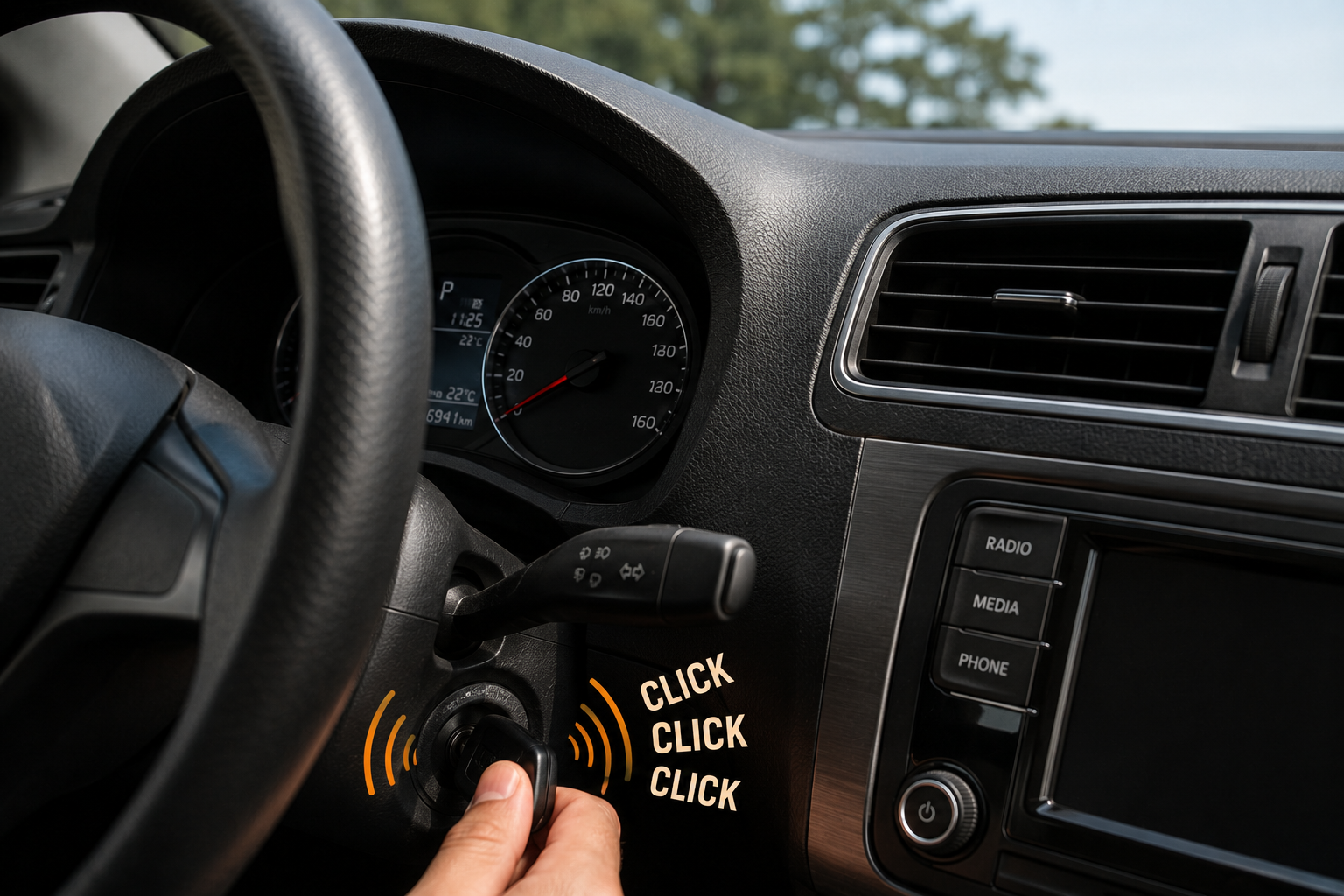
When a car is making clicking noise, two observations identify the cause faster than any other diagnostic approach: where the sound comes from and whether its speed changes with vehicle speed. A clicking noise that gets faster as the car accelerates is synchronized with wheel rotation — the most likely causes are a CV joint, a loose hubcap, or a stone caught in the brake shield. A clicking noise at a fixed rate regardless of speed is engine or accessory-related. A clicking noise only when turning is almost exclusively the CV joint. A clicking noise only at startup without starting points to the battery or starter system. Each pattern narrows the field from nine possible causes to one or two before anything is inspected.
A car making clicking noise gets most drivers’ attention immediately — and for good reason. Some clicking noises are urgent warnings of imminent mechanical failure. Others are completely normal and require no action at all. The challenge is distinguishing between them, because the same basic description covers everything from a free fix (a stone stuck in a brake shield) to a $900 CV axle replacement, to a $0 normal GDI fuel injector tick that came with the car from the factory. This guide provides the diagnostic framework to identify your specific car making clicking noise before spending money on any diagnosis or repair.
Car Making Clicking Noise — The Primary Diagnostic Matrix
When your car is making clicking noise, answer these three questions first. The combination of answers pinpoints your cause from the table below.
| When Does the Click Happen? | Does Click Speed Change with Vehicle Speed? | Location | Primary Suspect |
|---|---|---|---|
| Only when turning — not going straight | Yes — faster in tighter turns | Front wheel area | CV joint (outer) — most likely cause |
| While driving straight — steady rhythm | ✅ Yes — click rate matches wheel speed | Wheel area | Loose hubcap, stone in brake shield, wheel bearing |
| While driving — rhythm matches wheel speed | ✅ Yes | Front wheel | CV joint (inner), wheel bearing, brake hardware |
| Only at startup — engine won’t start | N/A — car not moving | Engine area | Dead battery (rapid clicking) or failed starter (single click) |
| Idling and while driving — fixed rate | ❌ No — same rate at all speeds | Under hood | Low oil lifter tick, GDI injector noise (normal), valve train |
| Only when cold — disappears when warm | ❌ No | Engine | Normal thermal expansion or low oil pressure at cold start |
| After parking — car is off | N/A | Exhaust or engine | Normal cooling contraction — not a fault |
| Only when braking | Varies | Wheel area | Loose brake hardware, worn caliper slide pins |
| Random — no consistent pattern | Inconsistent | Various | Loose trim piece, stone in wheel, suspension component |
The Speed Correlation Test — First Step for Car Making Clicking Noise
Before any visual inspection or shop visit, perform this test when your car is making clicking noise. In a safe area with no traffic, accelerate from 15 mph to 40 mph and pay close attention to the click frequency.
- Click rate increases proportionally with speed: The clicking is synchronized with wheel rotation. This points to anything rotating with the wheels — CV joint, wheel bearing, brake hardware, loose hubcap, or stone debris. This group accounts for the majority of car making clicking noise complaints.
- Click rate stays constant regardless of speed: The clicking is engine or accessory related and not connected to wheel rotation. This points to valve train issues, fuel injector ticking, or cooling system components.
- Click disappears at certain speeds: A click present at 20 to 40 mph but absent below 15 mph and above 55 mph is often a resonance issue — a loose component vibrating at a specific frequency range, not wheel rotation specifically.
9 Causes of Car Making Clicking Noise
Cause 1: Worn CV Joint — Most Common Car Making Clicking Noise Cause
The CV (Constant Velocity) joint is the most common cause of a car making clicking noise during turns and has one of the most reliable diagnostic signatures in automotive repair. Outer CV joint failure produces a rhythmic clicking specifically when turning — the click appears when you turn the steering wheel and disappears when driving straight. It is most pronounced during sharp turns at low speeds, such as pulling into or out of a parking space or making a U-turn.
The mechanism: outer CV joints allow the axle to flex as the wheel turns. Inside the joint, steel balls run in grooved races packed with grease. When the CV boot tears, grease escapes and contamination enters. The steel balls run on dirty, dry surfaces and produce the characteristic click at the high angles reached during turning.
Confirm the diagnosis: In a safe area, turn the wheel to full lock in one direction and drive slowly in a circle. Clicking that appears or intensifies confirms an outer CV joint on the opposite side — turning left loads the right CV joint, turning right loads the left. This test is the most reliable DIY confirmation available for a car making clicking noise during turns. According to RepairPal’s CV axle replacement cost guide, CV axle replacement costs $300 to $600 per side at a shop depending on vehicle — catching it at the boot stage costs $150 to $300.
See our detailed guide on car making noise when turning for the complete CV joint diagnosis including the full-lock circle test.
Cause 2: Loose Hubcap or Wheel Cover
A hubcap or wheel cover that has become partially detached can produce a rhythmic clicking or tapping that perfectly mimics a more serious wheel component issue. The click is synchronized with wheel rotation, gets faster with speed, and may change character when turning as centrifugal force shifts the loose cover.
Test: Park and firmly press on the center of each hubcap. Push around the outer edges. Any that flex noticeably or show visible gaps at the edge are loose. Remove and refit or replace. A replacement hubcap costs $15 to $60 — if this resolves your car making clicking noise, it is the best-case outcome of this diagnostic.
Cause 3: Stone or Debris Caught in Brake Shield
The brake dust shield — a thin metal plate behind each rotor — sits very close to the rotor surface. A small stone that wedges between the shield and the rotor produces a loud, rhythmic clicking or tapping perfectly synchronized with wheel rotation. This is one of the most common causes of a car making clicking noise that appears suddenly after driving on gravel or through road debris.
Shine a flashlight between the rotor and the shield — a stone is usually visible. Remove with needle-nose pliers. If not visible, a shop can bend the shield slightly to allow debris to fall out — typically free or minimal cost and takes about 10 minutes.
Cause 4: Rapid Clicking at Startup — Dead Battery
A car making rapid clicking noise when you turn the key — a fast series of clicks with no engine cranking — almost always indicates insufficient electrical current to operate the starter motor. The rapid clicking is the starter solenoid cycling rapidly as it tries to engage but cannot maintain the current needed.
The primary cause is a dead or severely discharged battery. Secondary causes include corroded battery terminals that restrict current flow — see our battery terminal cleaning guide — or a failed battery that passes a resting voltage test but cannot sustain the high current draw of cranking.
Single loud click at startup: One solid click rather than rapid multiple clicks when turning the key indicates a failed starter motor solenoid or seized starter. A jump start will not fix a failed starter. See our car won’t start clicking noise guide for the definitive single vs rapid click diagnostic.
Cause 5: Low Engine Oil — Lifter or Valve Train Tick
When oil level is low or oil pressure is inadequate, hydraulic lifters partially collapse and produce a rapid ticking or clicking sound from the top of the engine. This tick is not synchronized with wheel speed, is consistent at all driving speeds, and is typically louder when the engine is cold.
Check the oil level immediately — see our engine oil level guide. Persistent lifter tick after bringing oil to the correct level may indicate oil that is overdue for a change — degraded oil loses viscosity stability and provides less consistent pressure to the lifters. See our signs your car needs an oil change for the complete condition guide.
Cause 6: Normal GDI Fuel Injector Noise — Not a Problem
GDI (Gasoline Direct Injection) engines inject fuel at extremely high pressure (200 to 2,000+ PSI), and the injectors produce an audible ticking or clicking at the injection frequency — clearly audible from outside the car and sometimes from inside. This is a car making clicking noise scenario that requires no repair at all.
GM issued a technical service bulletin for certain models acknowledging GDI injector noise as a normal characteristic, stating no repair is needed. Identify normal GDI noise: the tick is consistent and rhythmic, present at idle and while driving, not synchronized with wheel speed, originates from the top of the engine, and has been present since the car was new rather than appearing recently.
Cause 7: Worn Ball Joints or Tie Rod Ends
Worn ball joints and tie rod ends produce clicking and clunking sounds during turns and over bumps — but their click pattern differs from CV joint clicking. CV joint clicking is smooth and rhythmic during a sustained turn. Ball joint clicking tends to be irregular, more of a clunk, and most pronounced during the initial direction change rather than sustained through a full turn.
Ball joints and tie rod ends are safety-critical. A failed ball joint can separate and cause wheel collapse. Any clicking from the steering and suspension area accompanied by vague steering, uneven tire wear, or visible play in the steering wheel should be inspected professionally before further driving. See our car making noise when turning guide for the complete at-home ball joint play test.
Cause 8: Loose Brake Hardware or Worn Caliper Pins
When brake hardware wears out or is not replaced during brake service, the pad develops slight movement within the caliper bracket and produces a clicking or tapping sound — typically most prominent at low speeds. A car making clicking noise from loose brake hardware can be confirmed by applying light brake pressure during the noise: if clicking stops when braking, the pad is being clamped firmly and can no longer move — loose hardware is the cause.
Brake hardware replacement kits cost $15 to $30. The Car Care Council recommends inspecting brake hardware and pad clearances at every brake service interval — hardware should be replaced with every pad change.
Cause 9: Normal Thermal Contraction After Shutdown
A car making clicking noise after you have parked and turned off the engine is almost always normal thermal contraction. The exhaust system — reaching 800°F to 1,200°F during operation — cools rapidly after shutdown and contracts as it cools. Metal components contracting at different rates produce ticking and clicking sounds that can continue for 15 to 30 minutes after parking. This is completely normal and requires no action.
The only exception: if clicking after shutdown is accompanied by a burning smell or visible smoke from the engine bay, that indicates oil or fluid contacting hot exhaust components — see our car smells like burning oil guide.
Is It Safe to Drive? — Urgency Scale
| Car Making Clicking Noise Cause | Safe to Drive? | Urgency |
|---|---|---|
| CV joint clicking during turns | ⚠️ Weeks — avoid full lock | Schedule replacement this month |
| Loose hubcap | ✅ Yes — fix soon | Hubcap could detach at speed |
| Stone in brake shield | ✅ Yes | Remove when convenient |
| Rapid clicking — won’t start | N/A — not running | Charge or replace battery now |
| Low oil lifter tick | 🔴 Check oil immediately | Add oil before driving further |
| Normal GDI injector noise | ✅ Yes — not a fault | No action needed |
| Ball joint or tie rod clicking | 🔴 Inspect this week | Safety-critical — inspect before long drives |
| Loose brake hardware | ✅ Short term | Replace hardware at next brake service |
| Thermal contraction after shutdown | ✅ Normal | No action needed |
Car Making Clicking Noise — Repair Cost Guide
| Repair | DIY Cost | Shop Cost |
|---|---|---|
| Loose hubcap — refit or replace | Free–$60 | Free–$80 |
| Stone removal from brake shield | Free | Free–$30 |
| Battery terminal cleaning | Free | $20–$50 |
| Battery replacement | $80–$200 | $150–$300 |
| CV boot replacement (early catch) | $30–$80 parts | $150–$300 |
| CV axle replacement (one side) | $80–$200 parts | $300–$600 |
| Brake hardware kit | $15–$30 parts | $50–$120 |
| Tie rod end + alignment | $20–$60 parts | $200–$400 |
| Ball joint replacement | Not recommended DIY | $200–$500 per joint |
| Starter motor replacement | $80–$200 parts | $300–$700 |
Frequently Asked Questions — Car Making Clicking Noise
Why is my car making a clicking noise?
A car making clicking noise has 9 main causes identified by location and speed pattern. Clicking that gets faster with vehicle speed is wheel-rotation related — CV joint, loose hubcap, stone in brake shield, or wheel bearing. Clicking only when turning is almost exclusively a worn CV joint. Rapid clicking at startup without the engine starting means a dead battery. A single click at startup means a failed starter. Clicking at idle that does not change with speed is likely normal GDI injector noise, low oil lifter tick, or thermal contraction after shutdown.
What causes a clicking noise when driving?
A car making clicking noise while driving is most commonly caused by a worn CV joint (clicking only when turning at low speeds), a stone or debris in the brake dust shield (rhythmic clicking matching wheel speed), loose brake hardware (clicking at low speed that stops when braking), or a worn wheel bearing. The speed correlation test — noting whether click frequency increases with vehicle speed — is the fastest way to narrow the cause before any inspection.
Is clicking noise while driving dangerous?
Depends on the cause. CV joint clicking is not immediately dangerous but will worsen — the joint can eventually fail causing loss of drive to that wheel. Ball joint clicking is more urgent — a ball joint that separates can cause wheel collapse and loss of vehicle control. Clicking from low oil is potentially serious if oil level is actually low. A stone in the brake shield and a loose hubcap are not safety-critical but should be addressed — a loose hubcap can detach at speed.
Why does my car click when I turn?
A car making clicking noise specifically when turning is almost always a worn outer CV joint. The joint operates at its highest angle during turns — when worn surfaces contact each other and produce the click. The sound appears during turns and disappears when driving straight. Most pronounced during sharp turns at low speeds. Confirm by turning to full lock in each direction and driving in a slow circle — the clicking is loudest when the affected joint is most loaded.
Why does my car make clicking noises when starting?
A car making rapid clicking noise when starting but not turning over almost always indicates a dead or severely discharged battery. The rapid clicking is the starter solenoid cycling as it tries to engage without sufficient current to hold the engagement. A single loud click instead of rapid clicking indicates a failed starter motor. Check battery terminals for corrosion first — even on a charged battery, heavy corrosion can restrict current enough to cause rapid clicking on startup.
Related Guides
For clicking specifically during turns with the full diagnostic and full-lock circle test, our car making noise when turning guide covers all 9 steering and suspension noise causes. For clicking at startup that won’t start, see our car won’t start clicking noise guide for the definitive single vs rapid click diagnostic. For engine ticking from the valve train, our engine knocking and ticking sounds guide covers all engine noise types. And for battery-related clicking on startup, see our battery terminal guide — corrosion is a frequently overlooked cause of startup clicking.