Battery Light On in Car? Here’s Exactly What It Means (And What to Do)
Battery light on in your car? It almost never means just a dead battery. It means your charging system has stopped working — and your car is running on battery reserve only. Here’s exactly what caused it, how long you have before the car dies, and what to do right now.
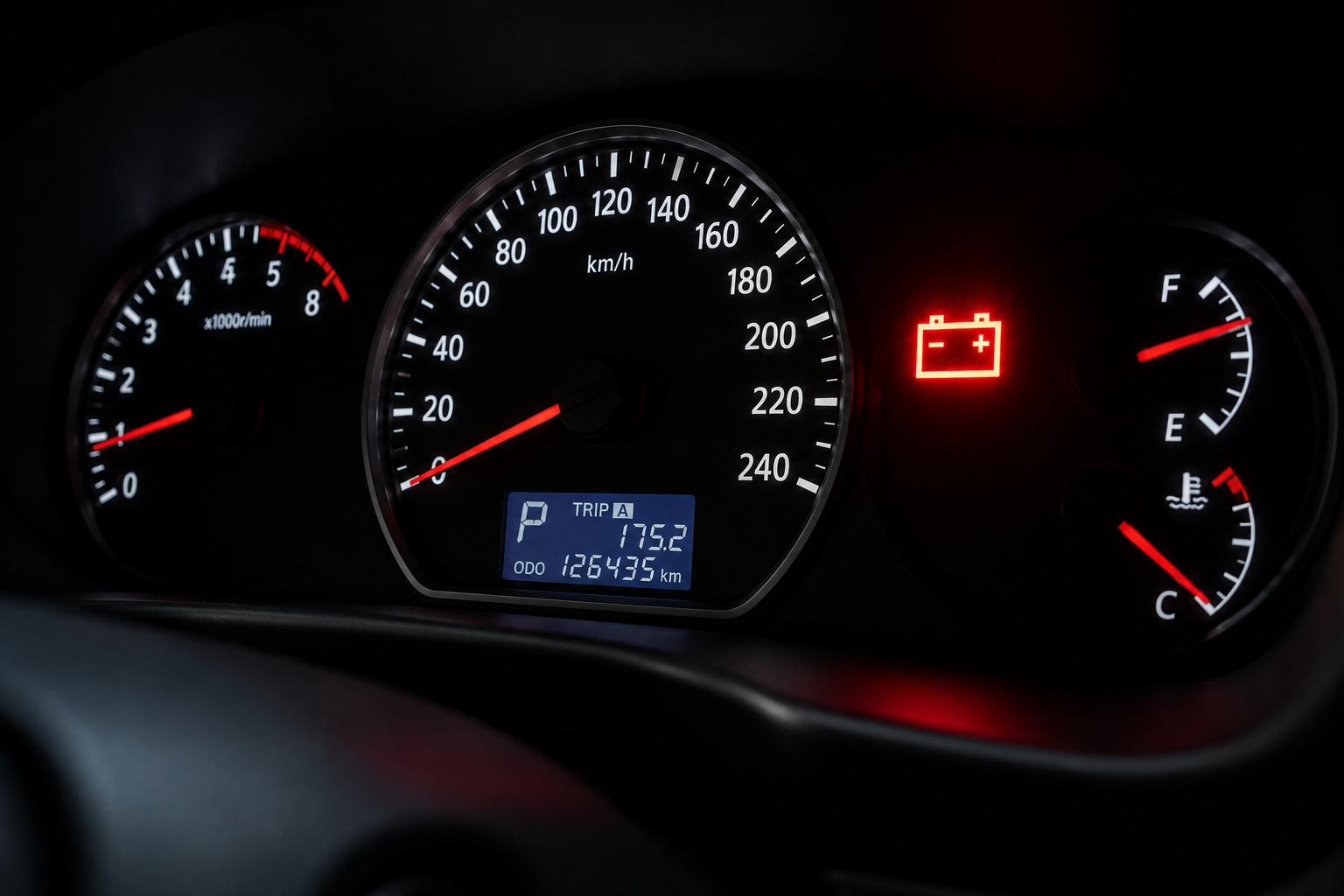
When the battery light comes on while driving, your car is no longer charging its own battery. The alternator — the component that keeps the battery topped up while the engine runs — has either failed or stopped receiving the power it needs to work. Your car is now running entirely on whatever charge remains in the battery. Depending on electrical load, that gives you roughly 20–60 minutes of driving before the car shuts off. Turn off everything you do not need — AC, heated seats, rear defrost, stereo — and drive directly to a shop or safe location. Do not ignore this light and continue driving normally.
Most people see the battery warning light and think the battery is dead. That assumption sends them to buy a new battery — and two days later the light is back because the actual problem, a failing alternator, was never fixed. The battery light is not a battery diagnostic. It is a charging system diagnostic. It tells you the electrical circuit responsible for keeping your battery charged is no longer functioning. Understanding that one distinction saves most drivers from replacing perfectly good parts.
What the Battery Light Actually Means
Your car’s charging system works like this: the engine drives the alternator through the serpentine belt. The alternator generates electricity — typically 13.7 to 14.7 volts — which does two things simultaneously. It powers the car’s electrical systems while the engine is running, and it recharges the battery to replace what was used during starting.
The battery warning light monitors system voltage. When voltage drops below approximately 12 volts with the engine running, the light illuminates. That voltage drop means the alternator is either not producing electricity at all, producing it at inadequate levels, or there is a fault in the circuit between the alternator and the battery that prevents the current from getting through.
Here is the critical point: the battery light does not mean your battery is currently dead. It means the system that keeps your battery alive has stopped working. Your battery may be perfectly healthy — but it is now being drained with no source of replenishment. Every electrical load you run draws from that finite reserve. Every minute you drive with the battery light on, that reserve shrinks.
The 5 Causes — What Actually Triggered Your Battery Light
1. Failed Alternator — Most Common Cause
The alternator is the most frequent cause of the battery warning light on a car that was running normally up until the light appeared. Alternators fail from bearing wear, internal winding failure, voltage regulator failure, or diode bridge failure. The diode bridge converts the alternator’s alternating current output to the direct current your car’s electrical system uses — when diodes fail, the alternator may still spin but produces inadequate or no output.
An alternator typically gives some warning before complete failure: the battery light might flicker briefly at idle and disappear at higher RPM as the alternator spins faster, headlights might dim slightly at idle, or the battery light might appear intermittently before becoming permanent. Many drivers miss these early signs and first notice the issue when the light stays on.
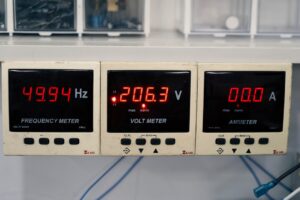
Testing this yourself requires a multimeter. With the engine running, check voltage at the battery terminals. A working alternator reads 13.7 to 14.7 volts. Below 13.5 volts means the alternator is undercharging. At or below 12 volts, the alternator is effectively not charging at all — you are running on battery reserve only. See our complete comparison in the bad alternator vs dead battery guide for the definitive 5-step test.
Alternator replacement at a shop costs $350 to $800 depending on the vehicle. The alternator on most modern front-wheel-drive cars sits near the bottom front of the engine and is accessible, though access varies widely. A remanufactured alternator from an auto parts store costs $120 to $250 with a core charge refund, and is a legitimate DIY repair on many vehicles if you are comfortable with basic mechanical work.
2. Broken or Slipping Serpentine Belt
The serpentine belt physically drives the alternator. If this belt breaks, stretches significantly, or slips on the alternator pulley, the alternator stops spinning — and stops producing electricity. A broken serpentine belt is immediately obvious: power steering suddenly becomes very heavy, the AC stops working, and often other warning lights appear alongside the battery light simultaneously. The belt may also produce a loud squealing noise before failing completely as it begins to slip.
If your battery light appeared suddenly alongside heavy steering and multiple warning lights, do not continue driving. A broken serpentine belt also stops the water pump on most engines, which means the engine will overheat within minutes. Pull over immediately. This is not a drive-to-the-shop situation — call a tow or at minimum check that the belt is intact before restarting. Open the hood: the belt should be a continuous loop around the front of the engine. If it is missing, hanging loose, or clearly broken, do not start the car again without replacing it.
Serpentine belt replacement costs $100 to $250 at a shop. The part itself is $30 to $80. DIY replacement is very accessible on most vehicles — the belt routing diagram is printed on a sticker under the hood on most cars, and the tension is released with a belt tensioner tool or a breaker bar.
3. Battery Itself Is Failing
A battery that has failed internally — shorted cells, sulfated plates, broken internal connections — cannot hold voltage even when the alternator charges it. The alternator may be working perfectly, but voltage drops because the battery is acting as a load rather than a storage device. The battery light illuminates because system voltage is low despite adequate alternator output.
This cause is more common than most drivers realize, especially on batteries over four years old. A battery that fails under load — not just at rest — will cause the battery light to appear under heavy electrical demand even if a simple voltage test with a multimeter shows it apparently charged. This is why load testing matters: AutoZone, O’Reilly, and NAPA all perform battery load tests for free that put the battery under realistic current demands and reveal failures that voltage-only tests miss.
The distinction between a battery failure causing the light versus an alternator failure: if the battery light appeared after a period of gradual decline — the car has been slow to crank recently, battery has been jump-started more than once this year, battery is over 4 years old — the battery is the primary suspect. If the light appeared suddenly with no prior warning in a car that was starting normally, the alternator or belt is more likely. For a deeper look at battery lifespan by type and climate, see our guide on how long car batteries last.
4. Loose, Corroded, or Damaged Battery Cables
The alternator charges the battery through the positive battery cable. The circuit returns through the negative cable and the chassis ground. Any significant resistance in this circuit — from corrosion at the battery terminal posts, a loose cable clamp, a damaged cable with broken internal strands, or a poor chassis ground connection — prevents adequate current from reaching the battery even when the alternator is producing normal voltage.
This is often the most overlooked cause because drivers see their battery terminals and think they look fine. A terminal with moderate white or green corrosion that appears structurally intact can still have enough resistance to partially block charging current. The test: with the engine running, use a multimeter to measure voltage drop across each battery cable. More than 0.2 volts drop across the positive cable, or more than 0.1 volts across the negative cable or chassis ground, indicates excessive resistance that needs addressing.
Cleaning corroded terminals costs nothing and takes 10 minutes — baking soda, water, an old toothbrush, and reconnecting the cables firmly. For badly corroded or damaged cables, replacement costs $20 to $60 for the parts and is a straightforward DIY task. Do not underestimate this cause: corroded battery terminals are responsible for a significant number of charging system warning lights that drivers attribute to the alternator and spend hundreds replacing unnecessarily.
5. Electrical Fault in the Charging Circuit — Fuse, Wiring, or Voltage Regulator
The charging circuit includes the alternator exciter circuit — a small current that activates the alternator’s voltage regulation — and the main output circuit. A blown fuse in the exciter circuit prevents the alternator from receiving its activation signal and it produces zero output despite being mechanically sound. Some vehicles have a dedicated alternator fuse in the engine bay fuse box, while others route this circuit through the main fuse block. A $5 fuse is occasionally the entire cause of a battery warning light that diagnostics might otherwise blame on the alternator.
Modern vehicles with smart alternators — controlled by the ECU rather than a simple internal voltage regulator — can also trigger the battery light through software faults, ECU communication errors with the alternator, or a failed battery monitoring sensor. These require dealer-level diagnostic scanning to identify and cannot be diagnosed with a simple multimeter test. If a shop has tested both the battery and alternator and found them functioning normally, a wiring or ECU-related charging fault is the next investigation path.
How Long Can You Drive with the Battery Light On?
This is the question every driver with the battery light on needs answered immediately. The honest answer: it depends on battery state of charge and electrical load, but the general guideline is 20 to 60 minutes under average conditions.
| Condition | Estimated Time Remaining | Action |
|---|---|---|
| Battery light just came on, battery recently charged, daytime driving | 45–60 minutes | Drive directly to nearest shop without detours |
| Battery light on, nighttime driving (headlights required) | 20–35 minutes | Headlights draw 15–25 amps — dramatically reduces reserve |
| Battery light on + AC running + headlights | 15–25 minutes | Turn off everything except ignition — drive immediately |
| Battery light on + battery over 3 years old | Unpredictable — 10–40 minutes | Do not push it — pull over at first available safe location |
| Battery light on + other warning lights appearing | Under 10 minutes | Pull over now — car is losing electrical systems |
| Battery light flickers at idle, goes off at higher RPM | Hours to days (intermittent) | Drive to shop — early alternator failure |
The fastest way to extend driving time: turn off the AC compressor, rear window defroster, seat heaters, and the stereo. These collectively draw 20 to 40 amps. Reducing electrical load slows the battery drain rate and can double or triple your remaining driving time. Your headlights — if it is dark — should stay on for safety despite the drain. Do not turn headlights off while driving to save battery.
The Voltage Quick Test — Do This Right Now
If you have a multimeter — or can get one from a nearby auto parts store where they are usually available for loan — this test takes 90 seconds and tells you definitively what is happening.
- With the engine OFF, measure voltage at the battery terminals. A healthy battery at rest reads 12.4 to 12.8 volts. Below 12.0 volts means the battery is significantly discharged.
- Start the engine. Measure voltage at the battery terminals again with the engine running at idle. A working alternator reads 13.7 to 14.7 volts. If you are reading 12 to 13.5 volts, the alternator is undercharging. If you are reading 12 volts or below, the alternator is not charging at all.
- With the engine running, turn on the AC, headlights, and rear defroster simultaneously. Voltage may drop 0.2 to 0.5 volts under this load on a healthy system. If voltage drops below 13 volts under load, the alternator cannot maintain the system under demand.
| Reading (Engine Running) | Conclusion | Next Step |
|---|---|---|
| 13.7–14.7V | Alternator charging normally | Battery or circuit fault — load test the battery |
| 13.0–13.5V | Alternator undercharging | Check belt tension, alternator output — alternator likely failing |
| 12.5–13.0V | Marginal charging — borderline failure | Alternator or high-resistance cable — professional diagnosis |
| Below 12.5V | Alternator not charging | Check belt first — then alternator replacement |
| Above 15V | Alternator overcharging | Voltage regulator failure — replace alternator |
Battery Light vs Other Dashboard Warning Lights — Know the Difference
Three dashboard lights are commonly confused when the charging system fails. Getting this right matters because the appropriate response differs.
- Battery light (red battery icon): Charging system fault — alternator, belt, cable, or battery issue. Car is running on battery reserve. Drive to shop immediately or pull over.
- Oil pressure light (red oil can icon): Engine oil pressure critically low. This has nothing to do with the electrical system. If the oil light comes on, stop the engine immediately — continuing to drive risks catastrophic engine damage within minutes. Do not confuse this with the battery light. See our guide on oil warning signs.
- Check engine light (amber engine icon): Engine management system detected a fault. May or may not be related to the charging system. If the check engine light appears alongside the battery light, read the stored fault codes — the code often identifies the exact charging system component that failed. See our check engine light guide for free code reading.
- Temperature warning light (red thermometer or temp gauge in red): Engine overheating. Unrelated to charging system unless a broken serpentine belt stopped both the alternator and water pump — in which case both the battery light and temperature light illuminate simultaneously. If that combination appears, pull over immediately.
After Fixing the Charging System — Does the Light Turn Off?
After repairing the alternator or replacing the battery and cables, the battery warning light should go off on its own once the system returns to normal voltage. On most vehicles, the light extinguishes within 30 to 60 seconds of the engine running at normal operating conditions after the repair.
If the light remains on after a verified repair, three things to check: the battery itself needs to be recharged — a battery that was significantly discharged during the charging system failure may read low voltage even after the alternator is fixed, because the battery needs time to accept a full charge. Drive for 20 to 30 minutes at highway speed to give the alternator time to recharge the battery fully.
On some modern vehicles — particularly those with battery monitoring systems (BMW, Mercedes, Volkswagen) — the battery warning light or a related fault code may persist after repair until the system is reset using a dealer scan tool or compatible OBD2 software. These systems track battery health and charge state, and a fault code stored during the failure may need to be cleared before the light extinguishes. If your battery light stays on despite a verified working alternator and charged battery, this is the most likely explanation.
Repair Cost Guide
| Repair | DIY Cost | Shop Cost | Time at Shop |
|---|---|---|---|
| Battery terminal cleaning | Free | $20–$50 | 15 minutes |
| Battery cable replacement | $20–$60 | $80–$200 | 30–60 minutes |
| Battery replacement | $80–$200 | $150–$300 | 20–30 minutes |
| Serpentine belt replacement | $30–$80 | $100–$250 | 30–60 minutes |
| Alternator replacement | $120–$250 (reman) | $350–$800 | 1–3 hours |
| Voltage regulator (if separate) | $20–$60 | $150–$300 | 1–2 hours |
| Charging system diagnostic | Free (AutoZone, O’Reilly) | $50–$100 | 30 minutes |
Preventing the Battery Light from Coming Back
Two maintenance habits prevent most charging system failures before they become roadside emergencies.
First: replace the battery proactively at 4 to 5 years. Most batteries last 3 to 5 years. A battery that has begun to fail internally loads the alternator harder as the alternator works to charge a battery that keeps accepting charge and then dropping voltage. This additional load accelerates alternator wear. Replacing a failing battery before it causes the battery light to come on prevents both the roadside inconvenience and the alternator strain. Have the battery load tested annually after it turns 3 years old — this is free at most auto parts stores.
Second: include the serpentine belt in your maintenance schedule. Most manufacturers recommend belt inspection every 60,000 miles and replacement every 80,000 to 100,000 miles. A belt that is cracked, glazed, or showing sidewall wear should be replaced before it slips or breaks. The cost of replacing a belt on schedule is $100 to $250. The cost of being stranded when it breaks — tow truck plus potential overheating damage — is significantly higher. See our complete car maintenance schedule for the full belt replacement interval guide.
Frequently Asked Questions
What does it mean when the battery light comes on in your car?
The battery warning light means your car’s charging system has stopped working properly. The alternator — which generates electricity to power the car and recharge the battery while driving — is either failing, the serpentine belt that drives it has broken, or there is a fault in the electrical circuit. Your car is now running on battery reserve only. With average electrical load, most cars have 20 to 60 minutes of driving time before the battery is too discharged to keep the engine running. Turn off non-essential electrical loads and drive directly to a shop.
Can I drive with the battery light on?
For a short distance — yes. The battery light means the charging system has failed, not that the car is about to stop immediately. You have 20 to 60 minutes of driving on battery reserve depending on battery charge level and electrical load. Turn off the AC, rear defroster, seat heaters, and stereo to reduce drain and extend that window. Do not continue driving normally to your destination if it is more than 30 minutes away. Head directly to the nearest auto parts store or mechanic. If additional warning lights appear alongside the battery light, pull over immediately — the car is losing electrical systems rapidly.
Does the battery light mean I need a new battery?
Not necessarily. The battery warning light most commonly indicates a failed alternator, not a dead battery. The battery may be perfectly healthy, but without the alternator charging it, the battery drains while driving. Replacing a good battery when the alternator is the actual problem results in the new battery draining and the light returning within days. Have both the battery and the alternator tested before replacing either — free at AutoZone, O’Reilly, or NAPA — to confirm which component is actually failing.
Why does my battery light come on and off?
An intermittent battery light that comes on at idle and goes off when RPM increases usually indicates a failing alternator that can still produce some output at higher speeds but struggles at idle. This behavior happens because the alternator spins faster at higher RPM and a partially failing unit can still meet output requirements at speed but not at idle. An intermittent light that appears briefly then clears can also indicate a loose belt that slips under load, or corroded battery cables that create intermittent resistance. Either way, an intermittent battery light is an early warning of a developing charging system fault — have it diagnosed before it becomes a roadside failure.
How long does a car battery last after the battery light comes on?
With a fully charged battery and average electrical load, most cars last 30 to 60 minutes after the battery light illuminates. With heavy loads — headlights, AC, rear defroster all running — that drops to 20 to 30 minutes. A battery that was already partially discharged before the light came on may last only 10 to 20 minutes. These are approximations — some batteries with higher capacity last longer, some older batteries fail faster. The safe approach is to treat it as a 20-minute window and act immediately rather than gauging how far you can push it.
Related Guides
If your battery warning light has been on and the battery is now dead, our step-by-step jumpstart guide covers the exact safe cable order. For diagnosing whether the alternator or battery is specifically at fault, our bad alternator vs dead battery guide gives you the complete multimeter test. And if your car is not starting at all after the battery drained, see our car won’t start clicking noise guide — the clicking pattern tells you whether it is the battery, starter, or connection causing the no-start.