Engine Knocking Sound: 9 Causes Diagnosed by Sound Type, RPM & Location
Engine knocking sound diagnosed by type — combustion knock vs mechanical knock vs rod knock sound completely different and need different fixes. Our RPM + sound + location matrix identifies your exact cause before you spend money on the wrong repair.
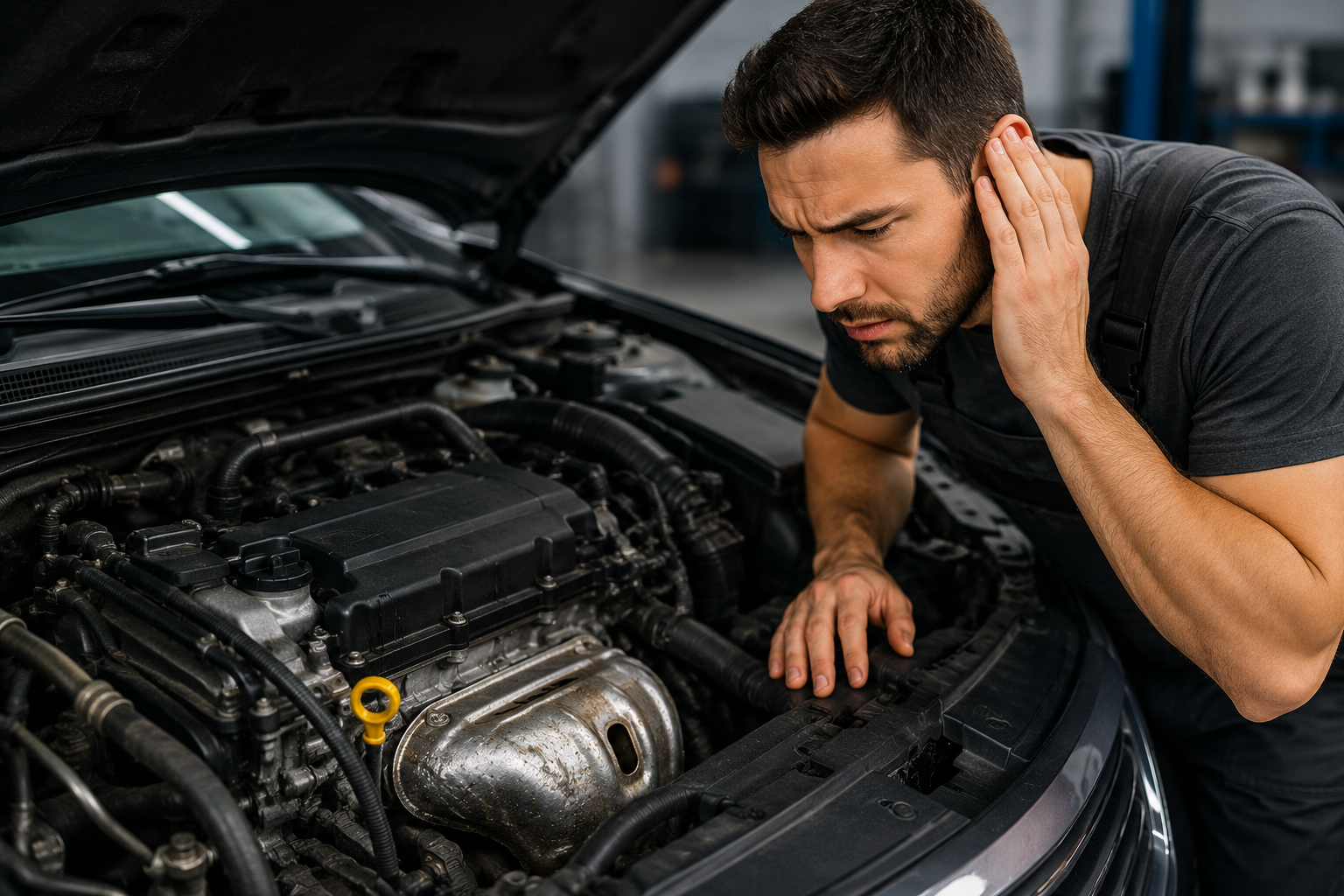
Engine knocking divides into two distinct categories with completely different causes and urgency levels. Combustion knock — pre-ignition, detonation, wrong fuel — is often fixable without disassembly. Mechanical knock — rod knock, piston slap, bearing wear — means metal is contacting metal inside the engine and every mile driven increases repair cost exponentially. The sound character, RPM behavior, and location of the knock tells you which category you are dealing with before a mechanic touches the car.
That knocking sound from your engine is not one problem. It is a family of nine different problems that happen to produce similar sounds — but for completely different reasons, with completely different urgency levels, and requiring completely different fixes. A knock caused by low-octane fuel costs $0 to fix and disappears the next time you fill up. A rod knock from worn bearings means your engine is destroying itself and every additional mile costs you more money in eventual repair. Knowing which one you have before calling a mechanic is the difference between a $50 fuel top-up and a $4,000 engine rebuild estimate.
The Critical First Distinction: Combustion Knock vs Mechanical Knock
Every engine knock falls into one of two fundamental categories. Identifying the category correctly determines everything that follows — the urgency, the diagnostic process, and the repair.
| Category | Sound Character | RPM Behavior | When It Occurs | Urgency |
|---|---|---|---|---|
| Combustion Knock (pre-ignition, detonation) | Sharp metallic ping or rap — hollow sound | Changes with engine load, not always with RPM | Under acceleration, climbing hills, high load | 🟡 Moderate — address soon |
| Mechanical Knock (rod, piston, bearing) | Deep, hollow thud — “rod knock” has a dull resonance | Increases directly with RPM — faster engine = faster knock | All RPM ranges — present at idle, worsens with speed | 🔴 Urgent — stop driving |
| Valve Train Tick (lifters, valves) | Light, rapid ticking — shallower than knock | Faster with RPM but localized to top of engine | Cold start especially — may quiet when warm | 🟡 Monitor — check oil first |
The most important diagnostic distinction: if the knock changes directly and immediately with RPM — faster RPM equals faster knock rate — the knock is mechanical. If the knock changes with engine load (throttle position, climbing a hill, carrying cargo) more than raw RPM, the knock is combustion-related. This single test performed while stationary with the engine running at different RPM tells you more in 60 seconds than most diagnostic tools.
Sound, RPM & Location Diagnostic Matrix
Use this matrix — which no competitor guide provides — to identify your exact cause before spending anything:
| What You Hear | When You Hear It | Where It Comes From | Most Likely Cause | Urgency |
|---|---|---|---|---|
| Sharp metallic ping or rap | Under hard acceleration or climbing hills only | General engine area — hard to pinpoint | Low-octane fuel or carbon deposits | 🟢 Low |
| Deep hollow thud — rhythmic | Present at all RPM, worsens with acceleration | Bottom of engine — crankshaft area | Rod knock — worn connecting rod bearings | 🚨 Stop driving |
| Dull slapping at cold start, quiets when warm | First 2–3 minutes after cold start only | Upper cylinder area — piston area | Cold piston slap — normal clearance at cold | 🟢 Monitor |
| Dull slapping present when warm AND cold | Always — does not quiet when engine warms | Upper cylinder area — piston area | Worn piston-to-cylinder clearance | 🟠 Professional diagnosis needed |
| Rapid light ticking — top of engine | Cold start especially, may reduce when warm | Top of engine — valve cover area | Low oil pressure to lifters or sticking lifter | 🟡 Check oil immediately |
| Knocking immediately after refueling | Under load — appeared right after filling up | General combustion area | Wrong octane fuel — below engine requirement | 🟢 Top off with correct grade |
| Knock that appeared after overheating episode | Any time — new knock after overheating event | General engine area | Heat-induced pre-ignition or bearing damage | 🔴 Professional inspection now |
| Knock plus check engine light | Any RPM — CEL illuminated simultaneously | Any area | Knock sensor failure or misfire causing knock | 🟠 Read codes first |
| Intermittent knock — not always present | Unpredictable — sometimes there, sometimes not | Varies | Failing knock sensor or early-stage detonation | 🟡 Professional diagnosis |
The 9 Causes of Engine Knocking — Complete Diagnostic Guide
Cause 1: Wrong Octane Fuel — Most Common, Cheapest Fix
Octane rating measures a fuel’s resistance to self-igniting under compression before the spark plug fires. Every engine has a compression ratio — the ratio of the cylinder’s total volume to its compressed volume. High-compression engines (ratio above 10:1, common in performance, turbocharged, and luxury vehicles) require higher-octane fuel because they compress the air-fuel mixture more aggressively, making it more prone to igniting before the spark fires.
When you put 87-octane regular fuel into an engine requiring 91 or 93 premium, the fuel ignites before the piston reaches top dead center. The resulting pressure spike fights the upward-moving piston — that collision is the sharp metallic ping you hear under acceleration. Modern vehicles have knock sensors that detect this and retard ignition timing to compensate, which is why the knock may not be immediately obvious. The engine is correcting itself — but at the cost of power output and fuel economy, both of which you can measurably feel.
Definitive identification: Did the knock appear immediately or shortly after your most recent fill-up? Does it specifically worsen under hard acceleration or climbing grades? Check your owner’s manual fuel specification — or look inside the fuel filler door on most modern vehicles. If your car requires premium and you have regular in the tank, this is your cause.
Fix: Fill up with the correct octane grade. If you have a nearly full tank of wrong fuel, top it off with the highest-octane fuel available to dilute the octane shortfall. The knock should reduce significantly within 20–50 miles as the correct-grade fuel replaces the wrong fuel through consumption. Cost: $0 beyond the correct fuel you should have purchased initially.
Cause 2: Carbon Deposits in Combustion Chamber
Every combustion cycle leaves traces of partially burned hydrocarbons on piston crowns, cylinder walls, and intake valves. Quality engine oil and fuel detergents slow this accumulation — but over thousands of miles, deposits build up regardless. The problem is physics: carbon deposits have a higher heat capacity than clean metal surfaces. They absorb and retain heat cycle after cycle, raising their surface temperature above the fuel’s auto-ignition point. The deposit itself becomes an ignition source, firing the air-fuel mixture before the spark plug does — a condition called hot-spot pre-ignition or surface ignition.
Carbon deposit knock shares characteristics with low-octane knock — hollow pinging under load — but it appears even when using the correct fuel grade. It typically develops gradually and worsens over time rather than appearing suddenly. High-mileage engines with inconsistent oil change history, engines that do mostly short-trip driving (which prevents oil from reaching operating temperature and burning off moisture), and direct-injection engines (which cannot wash valves with fuel because injectors spray directly into the cylinder) are most susceptible.
Fix options: Fuel system cleaner added to the fuel tank ($10–$25 for a quality product) addresses mild deposit buildup over several tankfuls. A professional intake cleaning service ($100–$200) uses chemical solutions to dissolve heavier deposits. Walnut blasting — a shop procedure using crushed walnut shells to abrade deposits from intake valves — is the gold standard for direct-injection engines at $300–$500. Oil change with a full-synthetic detergent oil removes deposits from internal engine surfaces over multiple changes.
Cause 3: Rod Knock — The Most Serious Mechanical Knock
This is the knock that mechanics dread finding and drivers most fear hearing confirmed. Rod knock occurs when the bearing that connects the connecting rod to the crankshaft journal wears to the point where there is excess clearance. Instead of the rod rotating smoothly on a pressurized oil film, it slaps against the crankshaft journal on each power stroke — creating a deep, resonant, rhythmic thud that increases directly with engine RPM.
The sound character is distinctive to trained ears. Rod knock has a hollow, resonant quality — sometimes described as marbles in a metal can — compared to the sharper, higher-pitched character of combustion knock. It is loudest under load and present even at idle once advanced. A key diagnostic: hold the RPM steady at various points from idle to 3,000 RPM. Rod knock maintains exact proportionality with RPM across the entire range because it is mechanically coupled to crankshaft rotation.
Causes of rod knock: Chronically low oil pressure, running the engine significantly low on oil, oil breakdown from extended change intervals, or normal wear accelerated by high-performance driving. Direct-injection engines with high-pressure fuel injection that dilutes oil with fuel during warm-up cycles are increasingly susceptible on higher-mileage examples.
Critical action: Stop driving immediately if you have confirmed rod knock. Each mile adds measurable damage — the journal surface is being scored with every revolution. A worn bearing caught early (still a steady sound, no metal-in-oil contamination) costs $800–$2,500 per rod bearing for parts and labor. A rod that breaks through the block from continued driving — called throwing a rod — means complete engine replacement at $4,000–$10,000+.
Cause 4: Worn Main Bearings
Main bearings support the crankshaft at its mounting points to the engine block. They share the same lubrication dependency and wear mechanism as rod bearings — pressurized oil film maintaining the separation between the spinning crankshaft and the stationary bearing surface. As main bearings wear, the crankshaft develops excessive clearance at its support points, creating a lower-pitched, more resonant knock than rod knock because the crankshaft’s mass is much greater than a connecting rod.
Main bearing knock typically presents as a heavier, more ominous thud compared to the somewhat sharper rod knock. It also increases with RPM and becomes louder under load. The distinction between main bearing knock and rod knock requires a professional mechanic with a mechanic’s stethoscope to localize — but the treatment urgency is identical. Main bearing replacement at $1,000–$3,000 is a better outcome than engine replacement after continued driving.
Cause 5: Piston Slap
Pistons expand as they heat up — by design. Cold pistons have slightly more clearance in the cylinder bore than hot pistons because the manufacturer designed the piston to reach its proper running clearance at operating temperature. On a cold start, that larger clearance allows the piston to rock slightly in the bore — particularly during the power stroke — producing a dull, hollow slapping sound from the upper engine area that distinctively quiets down as the engine warms and the piston expands to fill the bore properly.
Cold-start piston slap that completely disappears within 2–3 minutes of normal warm-up is common in high-mileage engines and certain engine designs, and does not indicate imminent failure — though it does indicate accumulated cylinder wall wear. Piston slap that persists after the engine reaches full operating temperature indicates cylinder-to-piston clearance has exceeded specifications from excessive wear, requiring professional evaluation. Our guide on car smells like burning oil covers another symptom that frequently accompanies worn cylinder walls — oil consumption.
Fix: Cold-start slap that disappears — switch to a slightly thicker oil viscosity (within OEM approved range), ensure oil level is at MAX, and monitor. Persistent warm-engine piston slap — professional assessment of cylinder bore measurements to determine if engine rebuild or replacement is indicated.
Cause 6: Failed or Failing Knock Sensor
The knock sensor is one of the most underappreciated components in a modern engine management system. It is a piezoelectric accelerometer mounted to the engine block that detects the specific vibration signature of combustion knock. When the ECU receives a knock signal, it immediately retards ignition timing — backing off the spark advance — until the knock stops, then gradually advances timing back toward optimal. This real-time closed-loop control is why modern engines can run appropriately on lower-octane fuel in an emergency without audible knock: the ECU has already backed off timing to prevent it.
When the knock sensor fails, the ECU operates blind — it cannot detect knock and cannot compensate. Two failure modes exist: the sensor signals a knock that is not occurring (the ECU permanently retards timing, causing significant power loss and poor fuel economy), or the sensor fails to detect an actual knock (the ECU does not compensate, and combustion knock causes mechanical damage). Either failure mode stores a fault code — P0325, P0326, P0327, P0328 — in the ECU’s diagnostic memory. See our complete guide on how to reset the check engine light to read these codes for free before any shop visit.
Fix: Knock sensor replacement — $200–$500 at a shop including labor. The sensor itself is typically $30–$80; the labor cost depends on its location (some are buried under the intake manifold). Do not clear the code and ignore it — a non-functioning knock sensor allows combustion knock to damage pistons and bearings undetected.
Cause 7: Low or Degraded Engine Oil
Engine oil serves as the physical barrier between every pair of moving metal surfaces inside the engine. When oil level drops significantly, or when oil has degraded past its effective service life, the oil pressure system cannot maintain adequate film thickness at the highest-loaded contact points — rod bearings, main bearings, and camshaft bearings. Metal-to-metal contact at these points produces rapid wear and immediately generates knocking or ticking sounds.
Low-oil knock has a critical characteristic: it often diminishes or disappears at high RPM where the oil pump builds maximum pressure, and is loudest at idle where oil pressure is lowest. This pattern — knock loudest at idle, quieter at 2,000+ RPM — is the opposite of rod knock (which worsens at higher RPM) and provides a quick diagnostic distinction.
Before any other diagnosis on an engine with knocking, check the oil level and condition. Pull the dipstick — if oil is more than half a quart below minimum, add oil before driving further. If oil is black, gritty, or smells burned, change it before attempting other diagnosis. These two checks cost nothing and resolve a significant percentage of knocking complaints. Our complete guide on how to check engine oil level covers the exact process and what every oil color tells you.
Fix: Add oil to proper level if low — check for cause of oil loss (leak or consumption). Change oil and filter if degraded. If knock does not improve within 1 mile of driving after correcting oil level and condition — the knock has progressed to mechanical damage requiring professional evaluation.
Cause 8: Ignition Timing Issues
Ignition timing controls precisely when the spark plug fires in relation to piston position. On modern computer-controlled engines, the ECU calculates optimal timing based on RPM, load, coolant temperature, air density, and knock sensor feedback. When any of the sensors feeding this calculation fail — the crankshaft position sensor, camshaft position sensor, MAF sensor, or throttle position sensor — the ECU may calculate incorrect timing and fire the spark plug too early.
Advanced timing (spark fires too early) causes the air-fuel mixture to ignite before the piston reaches top dead center. The burning mixture pushes down on a piston that is still moving up — a direct collision of forces that produces combustion knock. Retarded timing (spark fires too late) causes incomplete combustion and power loss but typically produces less audible knock. Timing-related knock on modern engines almost always accompanies a check engine light with sensor-related fault codes.
Fix: Diagnose and replace the specific failing sensor. On older vehicles without computer-controlled timing, timing can be set mechanically with a timing light — but modern ECU-controlled timing is not mechanically adjustable. Sensor replacement typically costs $150–$400 including diagnostic time and parts.
Cause 9: Lean Air-Fuel Mixture
A lean mixture contains more air than the stoichiometrically correct ratio (14.7 parts air to 1 part fuel for gasoline). Lean combustion burns hotter, slower, and less controllably than a proper mixture — raising combustion chamber temperatures and increasing the probability of auto-ignition before the spark fires. Causes of lean mixture include vacuum leaks (unmetered air entering the intake), failing fuel injectors that do not deliver correct fuel quantity, a weak fuel pump, a clogged fuel filter, or a faulty MAF (mass air flow) or MAP (manifold absolute pressure) sensor.
Lean-induced knock is most likely to appear under high-load conditions where the fuel system is already at or near maximum delivery capacity. It often accompanies other symptoms: reduced power under load, rough idle if the lean condition is severe enough to approach misfire, and frequently a check engine light with O2 sensor codes indicating lean exhaust readings (P0171 system lean bank 1, P0174 system lean bank 2).
Fix: Diagnose the specific lean cause — vacuum leak inspection (smoke test at a shop, or listen for hissing with engine running), fuel injector cleaning or replacement, fuel pressure test to evaluate pump and filter condition. Costs range from $0 (finding a loose vacuum hose) to $300–$800 for injector replacement.
Is It Safe to Drive With Engine Knocking?
| Knock Type | Safe to Drive? | Distance | Urgency |
|---|---|---|---|
| Knock only after wrong octane fuel | ✅ Yes — carefully | Drive until fuel consumed | Top off with correct grade |
| Cold-start knock disappears in 2–3 min | ✅ Yes | Normal driving | Check oil level and viscosity |
| Knock sensor failure — CEL only, no audible knock | ⚠️ Short term | Drive to shop | Schedule repair within days |
| Knock from low oil — improves when topped up | ⚠️ After adding oil | Normal after oil corrected | Find cause of oil loss |
| Persistent knock at all RPM — does not go away | ❌ Not recommended | Drive to shop only | Professional diagnosis urgently |
| Deep rhythmic thud that worsens with RPM | 🚨 Stop driving | Tow to shop | Rod knock — immediate damage |
| Knock appeared after overheating episode | 🚨 Stop driving | Tow to shop | May indicate head gasket failure |
Complete Repair Cost Guide — All 9 Causes
| Cause | DIY Fix Cost | Shop Cost | Time to Fix |
|---|---|---|---|
| Wrong octane fuel | $0 — fill correct grade | $0 | Next fill-up |
| Carbon deposits — mild | $10–$25 (fuel cleaner) | $100–$200 | 3–5 tankfuls / 1 shop visit |
| Carbon deposits — severe (walnut blast) | Not DIY | $300–$500 | Half day at shop |
| Low or degraded oil | $30–$80 (oil + filter) | $50–$150 | 30 minutes |
| Knock sensor replacement | $30–$80 parts | $200–$500 | 1–3 hours |
| Ignition timing sensor (CKP/CMP) | $25–$80 parts | $150–$400 | 1–2 hours |
| Lean mixture — vacuum leak | $5–$20 (hose/gasket) | $100–$300 | 1–2 hours |
| Lean mixture — fuel injector | $50–$150/injector parts | $300–$800 | 2–4 hours |
| Rod bearing replacement | Not DIY | $800–$2,500 | 8–16 hours |
| Main bearing replacement | Not DIY | $1,000–$3,000 | 10–20 hours |
| Piston/cylinder rebuild | Not DIY | $2,500–$6,000 | Full engine-out job |
| Engine replacement (rod threw) | Not DIY | $4,000–$10,000+ | 2–5 days |
Step-by-Step Diagnosis — What to Check Before Calling a Mechanic
- Check oil level and condition first. This is free and eliminates the most common mechanical knock cause immediately. Pull the dipstick — level should be at MAX, oil should be brown (not black, not milky). Add oil if low. Change oil if black or overdue. See our complete engine oil level check guide for the exact process and what each oil color means.
- Identify the sound character. Sharp metallic ping under acceleration = combustion knock. Deep rhythmic thud at all RPM = mechanical knock. Light ticking from the top = valve train. Record a short video with your phone pressed near the engine while someone else revs it — a mechanic can often identify the category from sound alone.
- Test RPM correlation. Park safely, handbrake on, transmission in park or neutral. Increase engine RPM in steps from idle to 2,500 RPM by pressing the gas pedal. Knock that increases exactly with RPM = mechanical. Knock that is worse at certain RPM and load combinations = combustion.
- Check fuel octane. When did you last fill up? What grade? Does your car specify premium? If wrong fuel is possible — this costs $0 to test by topping up with the correct grade and driving 50 miles.
- Read fault codes. Any check engine light accompanying the knock stores diagnostic codes that narrow the cause significantly. Free code reading at AutoZone, O’Reilly, or NAPA takes 5 minutes. See our guide on how to reset the check engine light for code reading instructions before you clear anything.
- Check coolant temperature. Has your car been running hotter than normal? Overheating accelerates carbon deposit formation, raises knock risk from heat-induced pre-ignition, and can cause head gasket failure producing knock symptoms. See our car overheating guide if temperature has been elevated.
Frequently Asked Questions
What causes engine knocking sound?
Engine knocking is caused by two distinct categories of problems. Combustion knock — from wrong-octane fuel, carbon deposits, lean air-fuel mixture, or ignition timing issues — occurs when the air-fuel mixture ignites at the wrong time or in multiple places, creating pressure spikes. Mechanical knock — from worn rod bearings, main bearings, or piston-to-cylinder clearance — occurs when metal components with excessive clearance impact each other during engine rotation. The sound character and RPM behavior distinguish them: combustion knock changes with engine load, mechanical knock increases directly with RPM.
Is engine knocking serious?
It depends entirely on the cause. Wrong-octane fuel knock is not serious — fill the correct grade and it resolves. Carbon deposit knock is moderate — addressable with fuel system service. Rod knock or main bearing knock is serious and worsening — every additional mile increases repair cost and risk of catastrophic engine failure. A knock that appeared suddenly, is rhythmic and directly proportional to RPM, or appeared after an overheating episode should be treated as urgent.
Can engine knocking go away on its own?
Combustion knock from wrong fuel resolves as the correct fuel replaces the incorrect fuel through consumption — typically within a tankful. Cold-start piston slap that disappears within 2–3 minutes as the engine warms is self-resolving each drive. Mechanical knock from worn bearings or pistons does not resolve on its own — it worsens progressively with continued use as metal wear accelerates. A knock that disappears and returns intermittently often indicates a failing knock sensor rather than intermittent mechanical problems.
Will adding oil stop engine knocking?
Yes — if low oil pressure or low oil level is the cause. Low-oil knock often manifests loudest at idle (where oil pressure is lowest) and may reduce at higher RPM where the oil pump builds more pressure. Add oil to the MAX mark on the dipstick — if the knock improves or stops within 1 mile of driving, low oil was the cause and you need to find why the level dropped. If the knock does not improve after correcting oil level, the knock has progressed to mechanical damage that requires professional diagnosis.
How much does it cost to fix engine knocking?
Cost ranges from $0 (switching to correct octane fuel) to $10,000+ (engine replacement after a thrown rod from untreated mechanical knock). Carbon deposit cleaning costs $100–$500 depending on method. Knock sensor replacement costs $200–$500. Rod bearing replacement costs $800–$2,500. The cost multiplies dramatically with delay — a $800 bearing job becomes a $5,000 engine replacement if rod knock is ignored for weeks of continued driving.
Related Guides
Engine knocking is closely connected to oil maintenance — the most common mechanical knock cause is inadequate lubrication. Our guide on how to check engine oil level shows you the exact dipstick method and what every oil color means for your engine. If the knock appeared alongside a check engine light, see our complete guide to resetting the check engine light — reading the stored codes first is the most important diagnostic step. For high-mileage engines where bearing wear and piston slap are more likely, our guide on best oil for high mileage cars covers the formulas specifically designed to protect worn engine internals and reduce knock from inadequate film thickness.