Which sensor can stop a car from starting?detail
Have you ever tried to start your car, only to find that the engine cranks but refuses to start? You may have a healthy battery, working dashboard lights, and enough fuel in the tank, yet your vehicle still will not run. In some cases, a faulty engine sensor may be responsible.
Modern vehicles rely on electronic sensors to monitor engine speed, temperature, airflow, fuel delivery, and other operating conditions. The engine control unit (ECU) uses this information to control ignition timing and fuel injection. When certain sensors fail or provide incorrect information, the engine may not start properly.
However, not every faulty sensor will prevent a car from starting. Some vehicles can continue running with a failed sensor by using backup information, while others may experience difficult starting, stalling, or a complete no-start condition.
In this guide, AutoUpdateZone.com explains eight sensors that can stop a car from starting, their common symptoms, and how to identify the problem.
1. Crankshaft Position Sensor
The crankshaft position sensor is one of the most important sensors involved in engine starting. It monitors the position and rotational speed of the crankshaft and sends this information to the engine control unit.
The ECU uses this signal to determine when to trigger ignition and fuel injection. If the signal is missing or unreliable, the engine may crank normally without starting.
Symptoms of a faulty crankshaft position sensor
- The engine cranks but does not start.
- The engine stalls unexpectedly while driving.
- The vehicle starts intermittently.
- The engine may stop running when it becomes hot.
- The check engine light may illuminate.
- Diagnostic trouble codes related to crankshaft position may appear.
Some vehicles will not produce a spark or operate their injectors correctly when the crankshaft signal is missing.
How to fix it
A mechanic can use a diagnostic scanner to check for relevant trouble codes and examine live engine-speed data while cranking. Further testing may involve checking the sensor wiring, electrical supply, and sensor signal.
If testing confirms that the sensor has failed, it may need replacement. However, damaged wiring, connector problems, or a fault with the trigger wheel can cause similar symptoms.
Important: A crankshaft position sensor fault is a common possibility when an engine cranks but does not start, but the symptoms alone cannot confirm the diagnosis.
2. Camshaft Position Sensor
The camshaft position sensor monitors the position of the camshaft, helping the engine control unit determine which cylinder is approaching its combustion cycle.
The ECU uses this information to coordinate fuel injection and ignition timing in engines that depend on camshaft position information.
When the sensor fails, some vehicles may experience hard starting, rough running, or reduced performance. Other vehicles may fail to start if the engine management system cannot establish the required timing information.
Common symptoms
- The engine cranks for a long time before starting.
- The engine starts intermittently.
- The vehicle stalls or runs roughly.
- The check engine light appears.
- Diagnostic trouble codes indicate a camshaft position or synchronization problem.
How to fix it
Have the vehicle scanned for camshaft-related fault codes. A mechanic may check the sensor signal, wiring, connector, and synchronization between the camshaft and crankshaft.
If the sensor is faulty, replacement may resolve the problem. However, timing chain or timing belt problems can produce similar symptoms and may require more extensive repairs.
3. Engine Coolant Temperature Sensor
The engine coolant temperature sensor measures the temperature of the engine coolant and sends the information to the ECU.
The ECU uses this reading to adjust fuel delivery and other engine operating settings. During a cold start, the engine may require a different fuel mixture than it does when fully warmed up.
If the sensor sends an incorrect temperature reading, the engine may receive an unsuitable starting mixture.
Symptoms of a faulty coolant temperature sensor
- The engine is difficult to start when cold.
- The engine starts poorly when hot.
- Fuel consumption increases.
- The engine idles roughly after starting.
- The temperature reading appears unrealistic.
- The check engine light may come on.
For example, if a faulty sensor incorrectly reports that a cold engine is already hot, the ECU may not provide the enrichment needed for a reliable cold start.
The exact effect depends on the vehicle’s engine management system.
How to fix it
A mechanic can compare the sensor’s reported temperature with the actual engine temperature when the engine is cold. The wiring and sensor resistance or signal can also be checked against manufacturer specifications.
If the sensor provides an incorrect reading, replacement may be necessary.
4. Mass Airflow Sensor (MAF)
The mass airflow sensor measures the amount of air entering the engine. The ECU uses this information to calculate how much fuel is needed for combustion.
If the sensor provides incorrect readings, the engine may receive an unsuitable air-fuel mixture.
A faulty mass airflow sensor does not always prevent starting. In many vehicles, the engine may still start but run poorly.
Signs of a faulty MAF sensor
- Difficulty starting the engine.
- Rough idling.
- Hesitation during acceleration.
- Reduced engine power.
- Increased fuel consumption.
- The check engine light appears.
A contaminated sensor, damaged wiring, an air leak, or a blocked air filter may cause related symptoms.
How to fix it
A mechanic can inspect the air intake system, check the sensor’s electrical connections, and review live airflow data. Cleaning may help if the sensor is contaminated and the manufacturer permits an appropriate cleaning procedure.
Use only a suitable sensor cleaner when recommended. Incorrect cleaning methods can damage the delicate sensing element.
Replace the sensor only when testing confirms that it is faulty.
5. Throttle Position Sensor
The throttle position sensor monitors the position of the throttle and helps the ECU determine how much air the driver is requesting.
On electronic throttle systems, the throttle body and accelerator pedal sensors work together to control engine airflow.
A faulty throttle position sensor or related electronic throttle problem may cause starting difficulties, poor acceleration, or an engine that starts and then stalls.
Common symptoms
- The engine starts inconsistently.
- The engine idles roughly.
- Acceleration becomes unpredictable.
- The vehicle enters reduced-power mode.
- The check engine light appears.
- Throttle response becomes abnormal.
On many modern vehicles, a throttle position sensor fault will not automatically prevent starting. Other faults in the electronic throttle system can have different effects.
How to fix it
A technician can scan the vehicle for throttle-related fault codes and compare the sensor readings with the expected values. The throttle body, wiring, and connectors may also need inspection.
Depending on the vehicle, the repair may involve replacing a faulty sensor, repairing wiring, or carrying out a manufacturer-specified throttle relearn procedure.
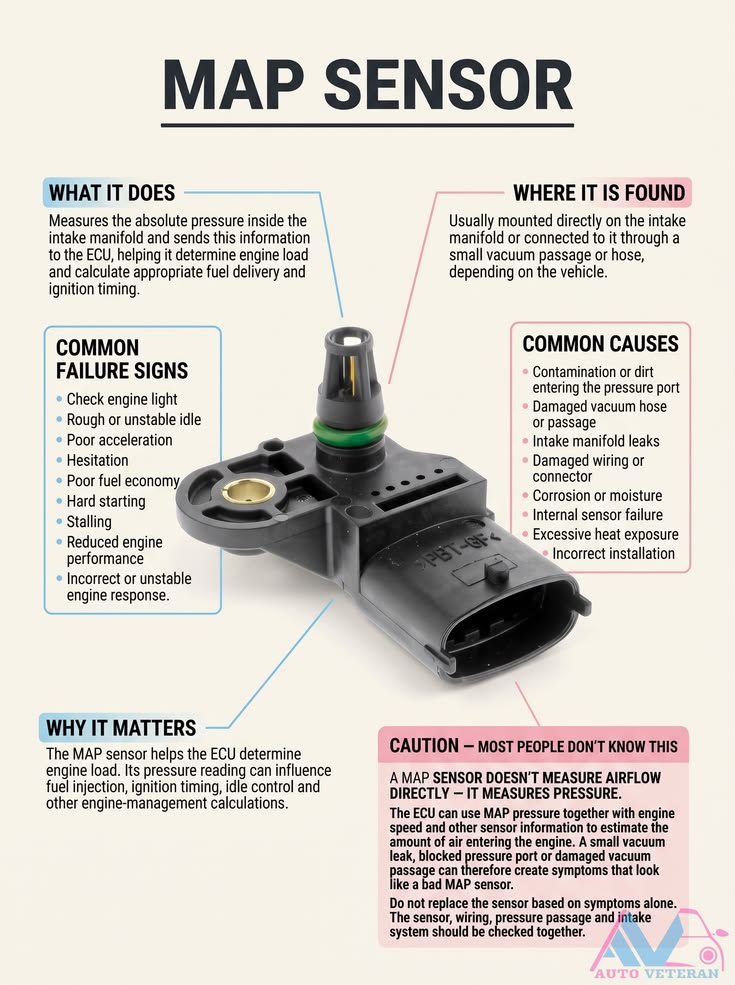
6. Manifold Absolute Pressure Sensor (MAP)
The manifold absolute pressure sensor measures the pressure inside the engine’s intake manifold. The ECU uses this information, together with other sensor readings, to calculate engine load and determine the appropriate fuel delivery.
If the MAP sensor provides incorrect information, the engine may receive too much or too little fuel under certain operating conditions.
Symptoms of a faulty MAP sensor
- Difficult starting.
- Rough idling.
- Poor acceleration.
- Increased fuel consumption.
- Engine hesitation or stalling.
- A check engine warning light.
The symptoms can resemble those of a faulty MAF sensor, vacuum leak, or fuel delivery problem.
How to fix it
A mechanic can check the MAP sensor’s electrical signal and compare its readings with the engine’s operating conditions. The vacuum hose, if fitted, and the intake system should also be checked for leaks or blockages.
If the sensor is confirmed to be faulty, replacement may be required.
7. Oxygen Sensor
The oxygen sensor measures the oxygen content of the exhaust gases and helps the ECU adjust the air-fuel mixture while the engine is running.
Although oxygen sensors are important for fuel efficiency and emissions control, they are less likely than crankshaft or camshaft position sensors to cause a complete no-start condition.
Many vehicles can start with a faulty oxygen sensor because the ECU can use other information during initial starting and warm-up.
Symptoms of a faulty oxygen sensor
- Increased fuel consumption.
- Rough engine operation.
- Higher exhaust emissions.
- A check engine light.
- Poor running after the engine warms up.
A vehicle that will not start should not automatically be diagnosed with a bad oxygen sensor simply because an engine warning light is illuminated.
How to fix it
A mechanic can read the diagnostic trouble codes and check the sensor’s performance, wiring, and related engine systems. The sensor should be replaced only when testing confirms the fault.
If the engine will not start at all, the technician should also investigate the fuel system, ignition system, and crankshaft signal.
8. Fuel Rail Pressure Sensor
The fuel rail pressure sensor monitors fuel pressure in vehicles equipped with systems that use this sensor.
The ECU uses the information to help control fuel delivery. If the sensor provides an incorrect reading, the engine management system may not control fuel pressure correctly.
In some vehicles, a sensor fault or related fuel pressure problem can prevent the engine from starting.
This is particularly important in certain direct-injection petrol engines and common-rail diesel engines, where fuel pressure must reach the required level before normal starting can occur.
Warning signs
- The engine cranks but does not start.
- Starting takes longer than usual.
- The engine stalls unexpectedly.
- Engine performance becomes inconsistent.
- A fuel pressure-related trouble code appears.
These symptoms may also indicate a faulty fuel pump, a blocked fuel filter, a pressure regulator problem, or another fuel system fault.
How to fix it
A qualified technician can compare the commanded fuel pressure with the actual pressure recorded by the engine control system. The sensor, wiring, pump, and pressure control components may need testing.
Do not loosen high-pressure fuel lines yourself. High-pressure fuel systems can cause serious injury, even when the engine is not running.
Which Sensor Is Most Likely to Stop a Car From Starting?
The most useful sensor to investigate depends on whether the engine cranks, the symptoms you observe, and the vehicle model.
| Sensor | Possible effect on starting | Priority for diagnosis |
|---|---|---|
| Crankshaft position sensor | Can cause a complete no-start | High when the engine cranks but will not run |
| Camshaft position sensor | Can cause hard starting or no-start on some vehicles | High when timing or synchronization faults are suspected |
| Coolant temperature sensor | Can cause difficult cold or hot starting | Depends on temperature-related symptoms |
| Mass airflow sensor | Can cause poor starting or running | Depends on the vehicle and fault |
| Throttle position sensor | Can cause starting or throttle-control problems | Depends on the electronic throttle system |
| MAP sensor | Can cause incorrect fuelling and difficult starting | Depends on sensor readings and symptoms |
| Oxygen sensor | Rarely causes a complete no-start by itself | Usually a lower priority |
| Fuel rail pressure sensor | Can cause a no-start in some fuel systems | High when fuel pressure readings are abnormal |
This table is a guide, not a universal ranking. Some vehicles can start despite faults in certain sensors, while others depend more heavily on specific sensor signals.
How to Know if a Faulty Sensor Is Preventing Your Car From Starting
If your car will not start, follow these steps to help identify the likely cause.
Step 1: Determine Whether the Engine Cranks
Turn the key or press the start button briefly and listen.
If the engine does not turn over at all, check the battery, connections, starter motor, starting circuit, and vehicle security system first.
If the engine cranks normally but does not start, a sensor fault becomes one of several possibilities worth investigating.
Step 2: Check the Dashboard Warning Lights
Look for the check engine light, immobilizer warning, or any unusual message.
A warning light may indicate a fault, but it does not identify the exact failed component. Some faults also occur without an obvious warning light.
Step 3: Scan the Vehicle for Diagnostic Trouble Codes
An OBD-II scanner can retrieve stored diagnostic trouble codes from compatible vehicles.
Examples include:
- P0335: Crankshaft position sensor circuit fault.
- P0340: Camshaft position sensor circuit fault.
- P0100: Mass airflow sensor circuit fault.
- P0105: Manifold absolute pressure sensor circuit fault.
- P0115: Engine coolant temperature sensor circuit fault.
- P0120: Throttle position sensor circuit fault.
These codes identify a circuit or system that needs investigation. They do not always prove that the sensor itself is defective. Wiring problems, connector faults, mechanical timing issues, and other component failures may produce similar codes.
Step 4: Check Live Data and Sensor Signals
A qualified mechanic can review live data while the engine is being cranked.
For example, an engine speed reading of zero during cranking may indicate a missing crankshaft signal, although scanner limitations and other faults must also be considered.
The technician can also inspect camshaft synchronization, coolant temperature readings, airflow data, and fuel pressure where supported.
Step 5: Confirm the Fault Before Replacing Parts
Do not replace every sensor simply because your car will not start.
Proper diagnosis may involve electrical testing, checking fuel pressure, inspecting wiring, and verifying engine timing.
Replacing a sensor without confirming the fault can waste money and leave the original problem unresolved.
Can a Car Start With a Bad Sensor?
Yes, some vehicles can continue starting and running with certain faulty sensors. The result depends on the sensor, the vehicle’s design, and whether the ECU can use backup information.
A faulty oxygen sensor, for example, often causes fuel economy or emissions problems rather than a complete no-start.
A missing crankshaft position signal is generally more serious because the ECU may be unable to determine the timing required for ignition and fuel injection.
A camshaft sensor fault may cause hard starting, extended cranking, or a no-start condition on some models, while others can operate using alternative timing information.
Frequently Asked Questions
Which sensor causes a car to crank but not start?
The crankshaft position sensor is an important possibility because the ECU needs a reliable engine position and speed signal to control starting. However, fuel delivery problems, ignition faults, immobilizer issues, and other sensor failures can cause the same symptom.
Can a bad crankshaft sensor stop a car while driving?
Yes. If the sensor or its circuit fails while the engine is running, the engine may stall. The vehicle may then crank without starting until the fault is resolved.
Will a bad sensor always turn on the check engine light?
No. Some sensor faults trigger a warning light or store a diagnostic code, but others may not produce an obvious warning. The result depends on the vehicle’s monitoring system and the nature of the fault.
Can I drive with a faulty engine sensor?
It depends on the sensor and the symptoms. Some faults permit limited driving, while others can cause stalling, unpredictable engine operation, or reduced power. If the engine stalls, runs severely, or displays a critical warning, stop safely and seek professional advice.
How much does it cost to replace a car sensor?
The cost varies according to the sensor, vehicle model, parts availability, labour charges, and the difficulty of accessing the component. Diagnosis should come first so that the correct part is repaired or replaced.
Conclusion
Several sensors can contribute to a car that refuses to start, but the crankshaft position sensor is one of the most important to consider when the engine cranks normally without running. The camshaft position sensor, coolant temperature sensor, mass airflow sensor, MAP sensor, throttle position sensor, and fuel rail pressure sensor can also cause starting difficulties in certain vehicles.
An oxygen sensor is generally less likely to prevent the engine from starting completely.
The best approach is to observe the symptoms, scan the vehicle for trouble codes, and test the relevant sensor signals before replacing any parts. Remember that a no-start problem can also come from the battery, starter motor, fuel system, ignition system, or engine timing.
For more automotive troubleshooting guides, repair tips, and maintenance advice, visit AutoUpdateZone.com to help keep your vehicle in good working condition.