How do you tell if it’s your starter or battery?
When your car refuses to start, one of the first questions that comes to mind is whether the problem is caused by a weak battery or a faulty starter motor. Both components play important roles in starting your vehicle, and when either one fails, you may find yourself stuck with a car that will not start.
The good news is that you can often identify useful warning signs by observing what happens when you turn the ignition key or press the start button.
In this guide, AutoUpdateZone.com explains how to tell if your car’s starting problem is caused by the battery or starter, the symptoms to watch for, simple checks you can perform safely, and when to contact a mechanic.
Understanding the Difference Between a Car Battery and a Starter
Before diagnosing the problem, it helps to understand what each component does.
What Does a Car Battery Do?
A car battery stores electrical energy and supplies power to the vehicle’s electrical systems. When you start the engine, the battery provides the electricity needed to operate the starter motor.
The battery also powers accessories such as interior lights, dashboard displays, and other electrical components when the engine is switched off.
A weak, discharged, damaged, or internally faulty battery may not provide enough current to turn the engine over, even if some electrical accessories still work.
What Does a Starter Motor Do?
The starter motor is an electric motor that turns the engine when you attempt to start the vehicle. This process allows the engine to begin running under its own power.
When you turn the ignition key or press the start button, the starting circuit activates the starter system. The starter motor then rotates the engine until combustion begins.
If the starter motor fails, the battery may still power the headlights, dashboard, and radio, but the engine may not crank.
Understanding this difference is important because a battery problem and a starter problem can produce similar symptoms.
1. Check Whether the Dashboard Lights Are Dim or Bright
One of the easiest ways to begin troubleshooting is to observe your dashboard lights before and during an attempt to start the engine.
Signs that may indicate a weak battery:
- Dashboard lights appear unusually dim.
- Headlights are weaker than normal.
- Interior lights flicker when you try to start the car.
- The dashboard resets or goes dark during cranking.
- Electrical accessories behave inconsistently.
These symptoms can indicate that the battery is discharged or that an electrical connection has excessive resistance.
Signs that may point toward a starter problem:
- Dashboard lights appear normal before starting.
- The radio and other electrical accessories work normally.
- The engine does not crank when you attempt to start it.
- You hear a click, but the starter does not turn the engine.
However, bright dashboard lights do not prove that the battery is healthy. A battery can operate low-power accessories but still fail to supply the high current required by the starter.
2. Listen to the Sound Your Car Makes
The sound your vehicle makes when you attempt to start it can provide useful clues.
Rapid Clicking Sounds
If you hear several rapid clicks when trying to start the car, the battery may be weak or discharged. Poor battery terminal connections or a faulty ground connection can produce similar symptoms.
The clicking occurs because the starting system may not receive enough stable electrical power to engage the starter consistently.
What to do: Have the battery and its connections checked. A battery load test can help determine whether the battery can deliver sufficient current.
One Loud Click
A single click without the engine turning may indicate a faulty starter motor, starter solenoid, or starting circuit.
However, a weak battery, corroded connections, or a damaged ground cable can also cause this symptom.
What to do: Check the battery condition and electrical connections before concluding that the starter needs replacement.
No Sound at All
If nothing happens when you turn the key or press the start button, several problems are possible, including:
- A completely discharged battery.
- Loose or damaged battery connections.
- A faulty starter relay or ignition switch.
- A transmission safety switch problem.
- A key recognition or immobilizer issue.
The absence of sound alone is not enough to identify the failed component.
The Engine Cranks Normally but Will Not Start
If the engine turns over at its usual speed but does not run, the starter is probably performing its basic function.
The problem may instead involve fuel delivery, ignition, engine sensors, compression, or engine management.
A weak battery can still cause slow cranking, so the battery should not be ruled out entirely if the engine turns unusually slowly.
3. Notice Whether the Engine Cranks Slowly
Slow cranking is one of the most useful symptoms to observe.
When you attempt to start the car, listen for whether the engine turns over at its normal speed or struggles to rotate.
A weak battery often produces slow, laboured cranking. You may hear the engine turning gradually, as though it does not have enough power to start.
Possible causes include:
- An old or discharged battery.
- Corroded or loose battery terminals.
- A poor engine ground connection.
- A failing starter motor drawing excessive current.
- Mechanical resistance within the engine.
Because several faults can cause slow cranking, the symptom should be treated as a clue rather than a final diagnosis.
A mechanic can measure battery voltage, perform a battery load test, and check the voltage drop across the starting circuit to identify the cause.
4. Try a Safe Jump-Start When Appropriate
A properly performed jump-start can help distinguish a discharged battery from certain starter problems, but it is not a perfect diagnostic test.
If your vehicle has a conventional 12-volt battery and the manufacturer’s instructions permit jump-starting, you may use a suitable jump starter or another compatible vehicle.
Follow the owner’s manual carefully. Use the designated connection points, correct polarity, and appropriate equipment. Never jump-start a battery that is cracked, leaking, swollen, frozen, or otherwise visibly damaged.
If the engine starts after a successful jump-start:
The battery may have been discharged or unable to supply sufficient current. Possible underlying causes include an ageing battery, a charging system problem, loose connections, or an electrical drain.
Have the battery and charging system tested rather than assuming the problem is solved.
If the engine still does not crank:
The battery may still be defective, the connections may be poor, or the starter motor and its circuit may have failed.
A jump-start that does not work does not automatically mean the starter is bad.
If you are unsure about the procedure, contact roadside assistance or a qualified mechanic.
5. Inspect the Battery Terminals and Connections
Sometimes, the battery itself is not the problem. Loose or corroded connections can prevent electricity from reaching the starter properly.
With the vehicle switched off and the key removed, look for obvious signs of corrosion, damaged cables, or loose connections if they can be inspected safely.
Corrosion may appear as a white, blue-green, or powdery deposit around battery terminals.
Poor connections can cause symptoms similar to those of a weak battery, including clicking, dim lights, and failure to crank.
Do not touch damaged cables or attempt repairs while the starting circuit is energized. If cleaning or tightening the terminals is necessary, follow the vehicle manufacturer’s safety instructions or have a professional perform the work.
6. Check the Battery Voltage and Condition
A battery test is more reliable than judging its condition by the brightness of the headlights alone.
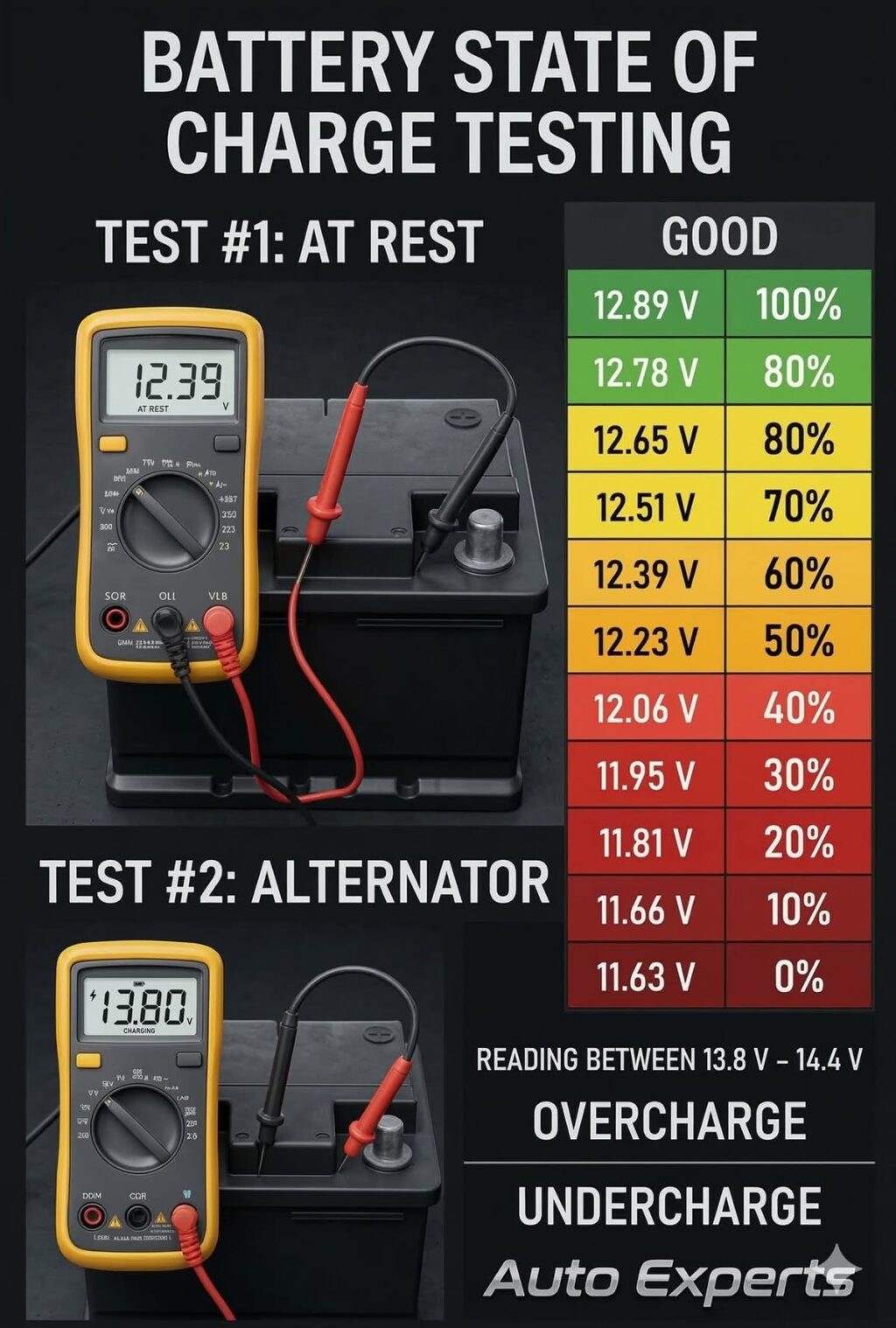
For a conventional, fully charged 12-volt lead-acid battery that has rested, a voltage reading around 12.6 volts is typical. A reading around 12.2 volts generally indicates partial discharge, although exact readings vary with battery type, temperature, and condition.
Voltage alone cannot determine whether a battery can deliver the high current needed to start an engine.
A battery may show a reasonable resting voltage but fail under load. That is why a proper battery load test or conductance test is useful.
A mechanic may also test the charging system to determine whether the alternator is maintaining the battery’s charge while the engine runs.
Important: Hybrid and electric vehicles may contain high-voltage systems. Do not inspect or handle high-voltage components yourself.
7. Look for Signs of a Failing Starter Motor
If the battery is adequately charged and the connections are in good condition, a starter fault becomes more likely when the engine does not crank.
Common warning signs include:
- A single click when attempting to start.
- Intermittent starting problems.
- Grinding noises during starting.
- The dashboard lights work, but the engine does not turn over.
- The starter sometimes works and sometimes fails.
A grinding noise may indicate a problem involving the starter drive or the engine’s flywheel ring gear. Stop attempting to start the vehicle if grinding continues, because further attempts may cause additional damage.
A technician can check the starter motor, solenoid, relay, wiring, ground connections, and the signal reaching the starter.
Battery vs. Starter: Key Differences
| Symptom | Possible battery problem | Possible starter problem |
|---|---|---|
| Dim dashboard lights | Common clue | Less typical on its own |
| Rapid clicking | Common clue | Possible, but less specific |
| One loud click | Possible | Common clue |
| No sound when starting | Possible | Possible |
| Engine cranks slowly | Common clue | Also possible |
| Lights work, engine does not crank | Possible | Possible |
| Starts after a jump-start | Discharged battery or connection issue likely | Starter may still have an intermittent fault |
| Engine cranks normally but will not run | Less likely if cranking speed is normal | Starter is less likely to be the cause |
No single symptom conclusively identifies the failed component. Testing is the best way to avoid replacing parts unnecessarily.
8. When Should You Replace the Battery or Starter?
A battery may need replacement if it fails a proper condition test, cannot hold a charge, or has reached the end of its service life.
A starter motor may need repair or replacement if testing confirms an internal fault or a failure in its solenoid or drive mechanism.
Before replacing either component, make sure the mechanic checks the battery connections, ground cables, starting circuit, and charging system where appropriate.
Replacing a starter will not fix a discharged battery. Similarly, installing a new battery will not resolve a defective starter motor.
Getting an accurate diagnosis can save money and prevent the same problem from returning.
Frequently Asked Questions
Can a bad starter drain a car battery?
A starter motor that has an internal electrical fault or draws excessive current may contribute to starting problems. However, a battery that repeatedly goes flat may also indicate an ageing battery, a charging system problem, or an electrical drain elsewhere in the vehicle.
Can a car battery be bad even when the lights work?
Yes. Headlights and dashboard accessories generally require less current than the starter motor. A weak battery may power these accessories but fail to provide enough current to crank the engine.
How long does a car starter usually last?
Starter lifespan varies considerably depending on the vehicle, driving conditions, usage, and component quality. Rather than relying on a fixed replacement interval, watch for symptoms and have the starting system tested when problems occur.
Is it safe to keep trying to start a car that will not crank?
Repeated attempts are not recommended. They can discharge the battery and overheat the starter or associated components. If the engine does not start after a few brief attempts, stop and investigate the cause.
Conclusion
Knowing how to tell whether your car’s starting problem comes from the battery or starter can help you make a more informed decision when your vehicle refuses to start.
Dim lights, rapid clicking, and slow cranking can point toward a weak battery or poor electrical connections. A single click, intermittent operation, or a grinding noise may indicate a starter-related problem. However, these symptoms can overlap, so they should not be used as the only basis for replacing a component.
Start with safe visual checks, observe what happens when you attempt to start the engine, and arrange for proper battery and starting-system tests if the cause is unclear.
For more practical automotive troubleshooting, repair advice, and maintenance guides, visit AutoUpdateZone.com to help keep your vehicle reliable and road-ready.