Car AC Recharge: Cost, How It Works, and When a Recharge Won’t Fix It
Car AC recharge costs $150–$350 at a shop or $40–$130 as a DIY kit — but here’s what most guides won’t tell you: if your refrigerant went low, your system has a leak. Recharging without fixing the leak means spending that money again in 6–18 months. This guide covers the complete recharge process, R134a vs R1234yf cost difference, when DIY is safe, and when a recharge is just a temporary fix for a bigger problem.
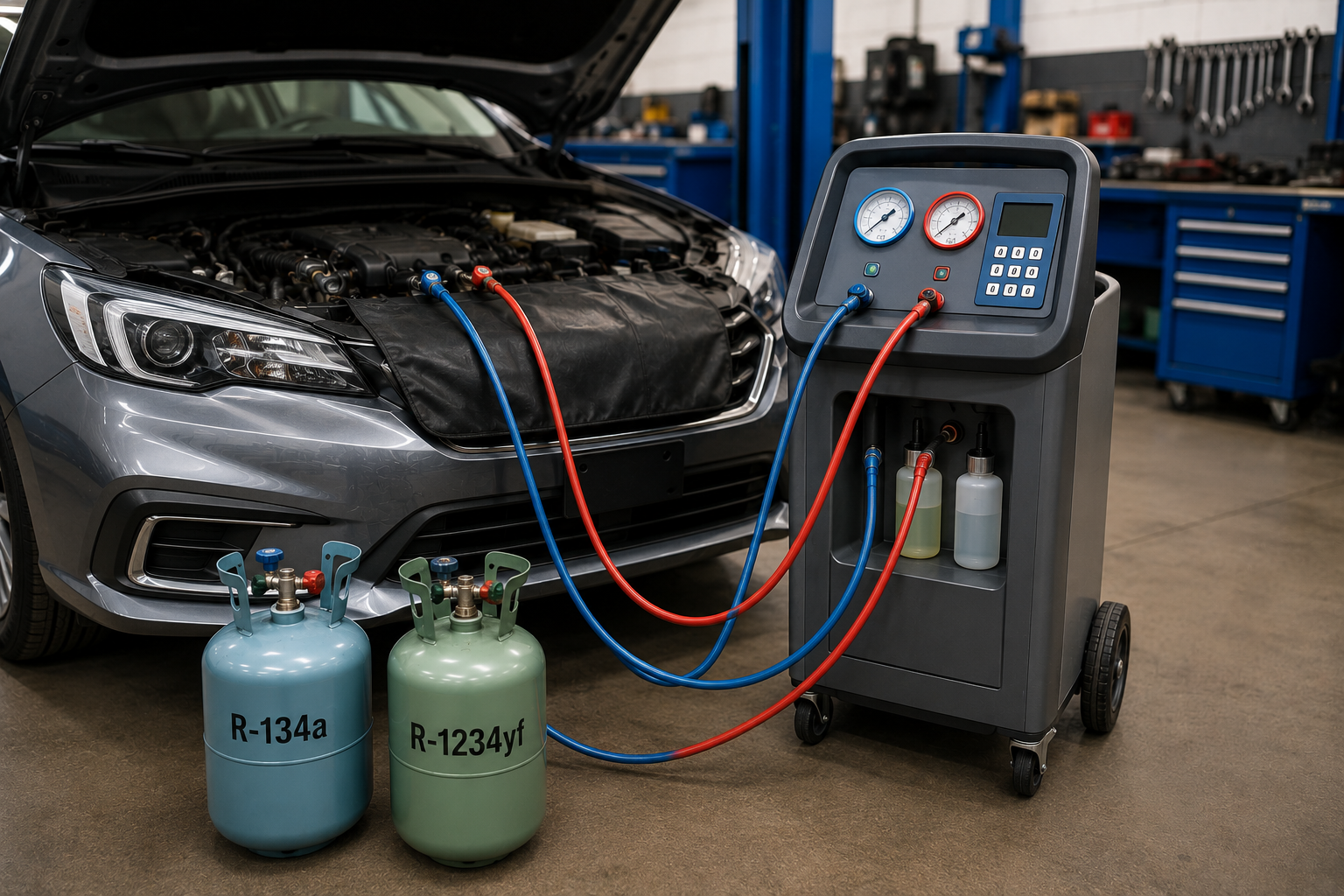
A car AC recharge at a shop costs $150 to $350. A DIY recharge kit costs $40 to $130. Both numbers are accurate — but neither one tells you the most important thing about car AC refrigerant: a sealed system should not lose refrigerant. If your AC stopped being cold, something in the system allowed refrigerant to escape. Recharging without finding and fixing that leak means you are paying the same money again when the refrigerant escapes through the same path — typically 6 to 18 months later. This guide covers the complete recharge process, the cost difference between R134a and R1234yf refrigerant types, when DIY is safe versus when it causes more damage than it fixes, and how to tell whether a recharge will solve your problem or just delay a larger repair.
Unlike a home HVAC system, your car’s AC uses one of two automotive-specific refrigerant types — R134a or R1234yf — with very different price tags, which is the single biggest reason car AC recharge cost estimates online vary so widely. Summer 2026, and car AC complaints are at peak frequency. The combination of record temperatures and gas prices above $4.50 per gallon means more drivers are spending more time in their cars and noticing immediately when the AC stops working. Before spending $150 to $350 on a recharge, spend five minutes understanding what you are actually paying for and whether it will actually solve your specific problem. This guide gives you that information in plain language, without the upsell that comes with taking the car somewhere before you understand the situation.
What a Car AC Recharge Actually Does
Your car’s air conditioning system works by circulating refrigerant — a chemical compound that transitions between liquid and gas states as it moves through the system. As refrigerant evaporates in the evaporator core (inside your dashboard), it absorbs heat from the cabin air. The refrigerant is then compressed, releases that heat through the condenser (the radiator-like component in front of your engine’s radiator), and cycles back to repeat. The process does not consume refrigerant the way an engine consumes oil. In a perfectly sealed system, the same refrigerant would last the lifetime of the vehicle.
When a technician recharges your AC, they connect recovery equipment to the system’s service ports, evacuate any remaining refrigerant (if any), pull a vacuum to test the system for leaks and remove moisture, and then inject a precisely measured quantity of the correct refrigerant type for your vehicle. The “recharge” is adding back the refrigerant that was lost — not changing a fluid that normally degrades, like oil.
R134a vs R1234yf — The Cost Difference Most Drivers Don’t Know About
This is the single biggest factor in why two identical-looking AC recharge quotes can vary by $200 or more. Your vehicle uses one of two refrigerant types, and they have dramatically different costs.
| Refrigerant | Vehicles | Cost Per Pound | Total Recharge Cost | DIY Available? |
|---|---|---|---|---|
| R134a | Most vehicles made 1994–2014, many through 2016 | $15–$30/lb | $150–$250 at shop | ✅ Yes — DIY kits widely available |
| R1234yf | Most vehicles 2015+, required by 2021 for new US vehicles | $80–$150/lb | $250–$450 at shop | ⚠️ Technically yes but not recommended |
| R12 (legacy) | Pre-1994 vehicles (very rare now) | $200+/lb (controlled substance) | $500+ at shop | ❌ Illegal to purchase without EPA certification |
To find out which refrigerant your vehicle uses: open the hood and look for a sticker on the AC compressor or near the service ports — it will specify the refrigerant type and the correct charge weight in ounces or grams. The label is sometimes on the underside of the hood itself. You can also check your owner’s manual under “air conditioning specifications.” Never add the wrong refrigerant type to a system — the two are not interchangeable and mixing them contaminates the system, requiring a full flush and evacuation before it can be properly recharged.
Complete Cost Breakdown — What You Are Actually Paying For
| Service Component | What It Does | Included At? | Cost If Billed Separately |
|---|---|---|---|
| Refrigerant recovery | Removes remaining refrigerant before servicing — EPA required | Most shops | $30–$60 |
| System evacuation (vacuum pull) | Tests for leaks and removes moisture before recharging | Reputable shops only | $30–$50 |
| Refrigerant (R134a — typical car, 1–1.5 lbs) | The actual refrigerant added | All shops | $25–$50 |
| Refrigerant (R1234yf — typical car, 1–1.5 lbs) | Same, newer refrigerant | All shops | $120–$225 |
| UV dye injection | Identifies leak location under UV light | Many shops | $10–$20 |
| Leak check / inspection | Visual + electronic leak detection | Varies | $50–$100 |
| Labor | Technician time — typically 1 hour | All shops | $80–$150/hour |
| EPA refrigerant handling fee | Mandated fee for certified refrigerant handling | All shops | $5–$15 |
The reason quotes vary by $150 to $200 between shops for what sounds like the same service: some shops complete recovery, vacuum test, and proper refrigerant injection. Others skip the vacuum test and just add refrigerant to whatever is left. The shop that skips the vacuum test appears cheaper upfront. The vacuum test is what confirms the system holds pressure before the new refrigerant is added — without it, you may be charging a leaking system and paying again in months. Ask any shop specifically: “Do you vacuum the system before recharging?”
Should You Recharge Car AC Yourself? The Honest Assessment
DIY AC recharge kits — sold at AutoZone, Walmart, O’Reilly, and every auto parts store for $40 to $130 — have become one of the most popular automotive DIY products sold. They are also one of the most frequently misused. Here is the honest breakdown of when they work and when they cause problems.
When DIY Recharge Kits Work Fine
- Vehicle uses R134a refrigerant (not R1234yf — most kits do not support the newer refrigerant correctly)
- System has a very slow, minor leak — lost refrigerant gradually over several years, not in one season
- You understand this is a temporary measure and the leak still needs to be found and fixed
- The AC compressor is engaging — you can hear it click on when you turn AC on and watch the belt-driven compressor clutch engage
When DIY Kits Cause More Problems
- System with a significant leak: Adding refrigerant to a system leaking quickly means it escapes in days or weeks. The real repair — finding and fixing the leak — still needs to happen, and you have wasted the cost of the DIY kit.
- Overcharging: DIY kits make it very easy to add too much refrigerant. An overcharged AC system actually cools worse, puts excessive pressure on the compressor, and can damage the system. Shop equipment measures the precise weight of refrigerant added — DIY kits estimate by pressure, which is less accurate.
- Adding to a compressor that is not engaging: If the compressor clutch is not engaging when you turn on the AC, no amount of refrigerant will fix the problem. The issue is electrical or mechanical, not refrigerant level. Adding refrigerant to a system with a non-running compressor is money wasted.
- R1234yf vehicles: DIY R1234yf kits exist but the refrigerant is expensive ($100+ for the kit), and incorrect handling of R1234yf (which is mildly flammable) has specific safety concerns. Professional service is the right choice for newer vehicles using this refrigerant.
Before You Recharge — Check This First
Two things to verify before spending any money on a recharge:
1. Is the Compressor Actually Running?
Turn on the AC to maximum and open the hood while the engine is running. Find the AC compressor — it is belt-driven and attached to the front of the engine alongside the alternator and power steering pump. Look at the center of the compressor pulley. The outer ring of the pulley spins continuously with the belt. The inner part — the clutch plate — should engage (start spinning with the outer ring) within 30 to 60 seconds of turning on the AC.
If the clutch plate is spinning with the outer ring: the compressor is running. Low refrigerant could be the problem. Proceed with recharge diagnosis.
If the clutch plate is not engaging: the compressor is not running. The problem is not refrigerant level — it is electrical (blown fuse, failed pressure switch, wiring issue) or mechanical (failed compressor clutch, seized compressor). A recharge will not fix this. See our complete guide on car AC not blowing cold air for the full diagnostic including compressor clutch failure.
2. When Did the AC Stop Working?
| Timeline of AC Decline | What It Suggests | Likely Fix |
|---|---|---|
| Gradually got less cold over 2–4 years | Normal very slow permeation loss — minor seepage through hoses and seals over time | Recharge likely to help — minor leak |
| Fine last summer, not cold this summer | Moderate leak developed over winter | Recharge + leak detection recommended |
| Was cold last week, not cold now | Significant sudden leak | Find and fix leak first — recharge will not hold |
| Never cold, even when car was new (used car) | Unknown history — could be many things | Full professional diagnosis before recharge |
| Cold on first use each day, warm after 20 min | Leak that empties under heat-pressurized conditions | Professional leak detection — recharge alone will fail |
What Happens During a Professional AC Recharge
- Visual inspection: Technician checks for obvious oil stains on AC components — refrigerant and AC oil escape through the same leak, and oil deposits around fittings, hoses, and the compressor indicate where refrigerant is escaping.
- Refrigerant recovery: A recovery machine connects to the low and high service ports and recovers any remaining refrigerant. EPA regulations require that refrigerant never be vented to atmosphere — certified shops use recovery equipment. If a cheap shop skips this step, they are likely venting refrigerant — an EPA violation.
- Vacuum test: The system is pulled to deep vacuum (28+ inches Hg) and held for 30 minutes minimum. A system that holds vacuum has no significant leaks. A system that fails to hold vacuum has a leak that must be found before recharging.
- UV dye injection: Many shops add UV dye to the refrigerant at recharge. If the system leaks again, a UV blacklight scan shows exactly where the dye — and therefore the refrigerant — is escaping. This is standard practice at quality shops.
- Refrigerant charge by weight: The correct amount of refrigerant is injected, weighed precisely to the vehicle’s specification (printed on the underhood label). This is where shops significantly outperform DIY kits — weight-based charging is far more accurate than pressure-based estimation.
- Performance verification: Vent temperature is measured — a properly recharged system should produce vent temperatures of 40°F to 50°F on a moderate day. The technician checks for this confirmation before completing the service.
Signs Your AC Problem Is More Than Low Refrigerant
| Symptom | What It Indicates | Recharge Fix It? |
|---|---|---|
| AC was recharged less than 1 year ago — already warm again | Active leak — refrigerant escaping quickly | ❌ No — fix the leak first |
| Hissing sound from AC area when system is running | Active refrigerant leak (audible) | ❌ No — leak repair needed |
| Oil stains on AC hoses or compressor fittings | Refrigerant + oil leak at fitting or seal | ❌ No — seal/fitting replacement first |
| Compressor clutch not engaging | Electrical or mechanical compressor failure | ❌ No — compressor or electrical repair |
| AC cold when first turned on, warm after 15–20 min | Possible leak under pressure, possible expansion valve issue | ⚠️ Partial — leak test needed |
| Musty smell but adequate cooling | Mold on evaporator core — not refrigerant issue | ❌ No — evaporator cleaning needed |
| Cooling fine but loud noise from compressor area | Failing compressor bearings | ❌ No — compressor replacement |
| Gradually got less cold over 2–3 years, no other symptoms | Minor normal permeation loss | ✅ Yes — recharge likely to work well |
Full AC Repair Cost Guide — Recharge vs Other Repairs
| Repair | Cost Range | When Needed |
|---|---|---|
| AC recharge (R134a) — shop | $150–$250 | Refrigerant low, compressor working, no major leak |
| AC recharge (R1234yf) — shop | $250–$450 | Same — vehicles 2015+ |
| DIY recharge kit (R134a only) | $40–$130 | Minor slow leak, compressor confirmed working |
| AC leak detection + repair (minor — O-ring, fitting) | $150–$400 | Active leak found at fitting or seal |
| AC hose replacement | $200–$600 | Cracked or leaking AC hose |
| Evaporator core replacement | $600–$1,200 | Evaporator leak — requires dashboard removal |
| Condenser replacement | $300–$800 | Condenser damaged or leaking |
| AC compressor replacement | $700–$1,800 | Compressor seized, not engaging, or making loud noise |
| Full AC system replacement | $1,500–$4,000 | Catastrophic compressor failure sending debris through system |
How Long Does an AC Recharge Last?
In a system with no leaks, a recharge should last indefinitely — the same refrigerant circulates for the life of the vehicle. In the real world, every AC system has some level of permeation — microscopic refrigerant molecules slowly migrating through rubber hose walls over years. This natural loss is so small that it takes 5 to 10 years to produce a noticeable performance decline in a healthy system.
If your AC needs recharging more frequently than every 3 to 5 years — especially if it needs service annually or more often — there is a leak that needs professional diagnosis and repair. Repeated recharging without addressing the leak is not a maintenance strategy — it is funding a refrigerant leak with your money on a schedule.
Summer 2026 — Best Time to Get AC Serviced
With record temperatures forecast across most of the US this summer and gas prices above $4.50 per gallon keeping more families in their cars for longer trips, a functioning AC system is genuinely a comfort and safety issue — particularly for children, elderly passengers, and pets. Shops doing AC service in June and July typically have 2 to 5 day waits. If your AC is marginal — cooling somewhat but not as cold as it should be — getting it diagnosed now, before the peak heat arrives, saves the wait and the added discomfort of a shop visit during a heat wave.
Frequently Asked Questions
How much does a car AC recharge cost?
A professional car AC recharge costs $150 to $250 for vehicles using R134a refrigerant (most pre-2015 vehicles) and $250 to $450 for vehicles using R1234yf refrigerant (most 2015 and newer vehicles). The difference is the refrigerant cost — R1234yf costs $80 to $150 per pound compared to $15 to $30 per pound for R134a. DIY recharge kits for R134a vehicles cost $40 to $130 but do not include vacuum testing, proper leak detection, or weight-precise charging.
How do I know if my car needs an AC recharge?
The primary sign is AC that blows air but does not cool the cabin adequately — air from the vents is not cold despite the AC being set to maximum. Other signs include: the compressor clutch cycling on and off rapidly (pressure too low for normal operation), the AC working initially then blowing warm after 15 to 20 minutes, or visible performance decline compared to previous summers. First verify the compressor is engaging — if the compressor clutch is not spinning, the problem is not refrigerant level.
Can I recharge my car AC myself?
Yes, for R134a vehicles using DIY kits costing $40 to $130 — with important limitations. DIY kits work best for vehicles with slow, minor refrigerant loss over several years. They are not suitable for vehicles with active leaks (the refrigerant will escape again quickly), R1234yf refrigerant systems (most 2015+ vehicles), or situations where the compressor is not engaging. DIY kits also charge by pressure estimation rather than weight, making overcharging a real risk. A shop recharge with vacuum testing costs more but provides accurate charging, leak detection, and confirmation of system integrity.
How long does a car AC recharge last?
In a system without leaks, a recharge should last years — potentially the life of the vehicle. Normal permeation loss through rubber hoses is slow enough that it takes 5 to 10 years to cause noticeable performance decline in a healthy system. If your AC needed recharging within a year of the previous service, there is an active leak that needs to be found and repaired. Repeated recharging without leak repair is not maintenance — it is paying for refrigerant to escape repeatedly through the same path.
What is the difference between R134a and R1234yf refrigerant?
R134a is the refrigerant used in most vehicles made between 1994 and 2015. R1234yf is the newer, more environmentally friendly refrigerant required in all new US vehicles from 2021 onward and used in most vehicles from 2015 onward. They are not interchangeable — using the wrong type contaminates the system. R1234yf costs significantly more ($80 to $150 per pound versus $15 to $30 for R134a), which is why recharge costs on newer vehicles are substantially higher. Check the underhood label on the AC service port area or your owner’s manual to confirm which type your vehicle requires.
How much does it cost to recharge AC in a car?
A car AC recharge costs $150 to $250 at a shop for R134a vehicles and $250 to $450 for R1234yf vehicles (2015 and newer). This is distinct from home air conditioner recharge pricing, which uses different refrigerants and equipment entirely. DIY car recharge kits run $40 to $130 but skip the vacuum test and leak detection a shop performs.
How much does a freon recharge cost for a car?
“Freon” typically refers to R134a, the refrigerant used in most vehicles made before 2015. A professional freon recharge for a car costs $150 to $250, while newer vehicles using R1234yf refrigerant cost $250 to $450 due to the higher price of that refrigerant type.
Related Guides
If your car’s AC is not blowing cold air and you are not sure whether it is a refrigerant issue or something else, our complete car AC not blowing cold air guide covers all seven causes including compressor failure, expansion valve issues, and cabin air filter restriction — any of which can produce warm air without involving refrigerant level. For keeping your AC running efficiently as part of overall vehicle maintenance, see our complete car maintenance schedule. And for saving on the fuel costs associated with running AC at $4.50 per gallon this summer, our guide to improving fuel economy covers the AC usage strategy that minimizes fuel penalty while keeping you comfortable.