Bad Alternator vs Dead Battery: 15 Symptoms + 5-Step Diagnostic Test
Is it your battery or alternator? Stop guessing and wasting money on wrong parts. Here are 15 definitive symptoms and a free 5-step diagnostic test that tells you exactly which one failed — in your driveway, right now.
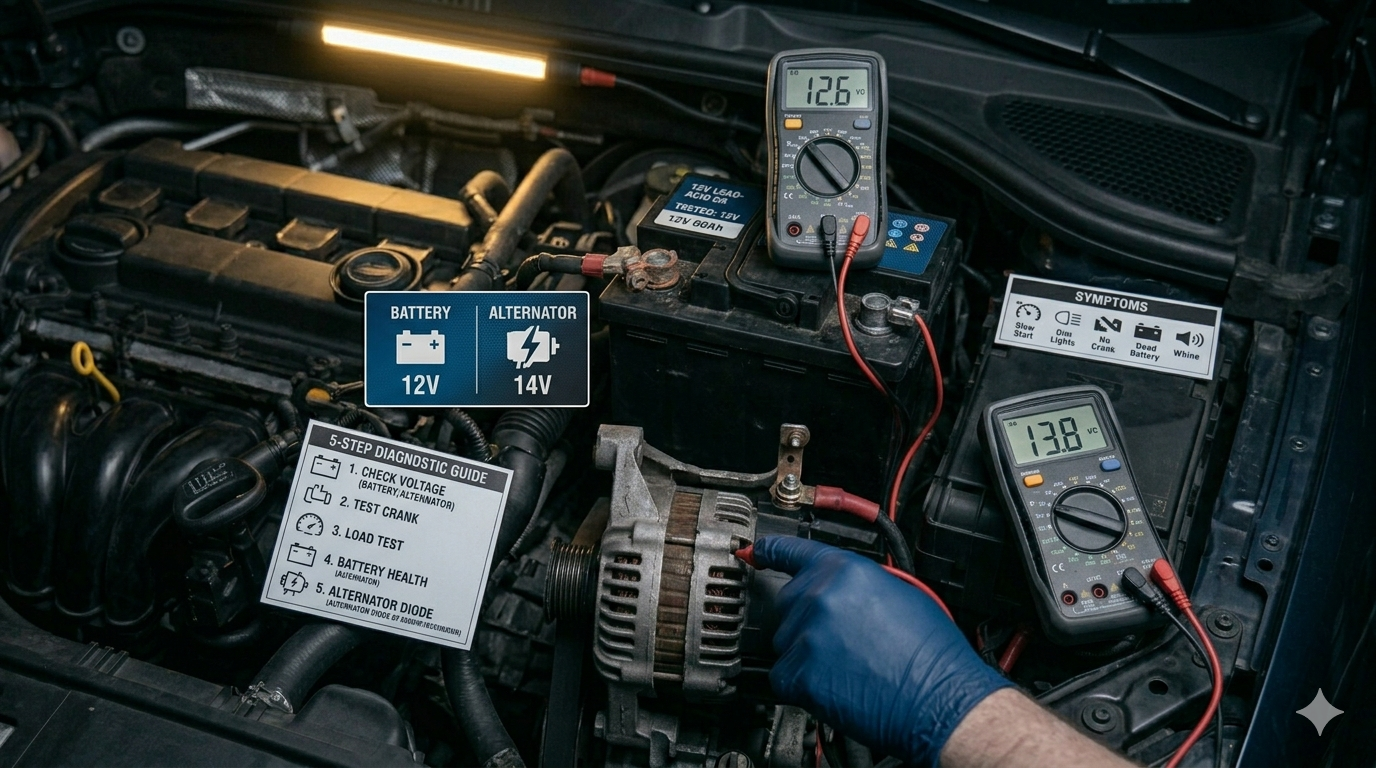
To tell bad alternator vs dead battery: Start the car with a jump. If it dies again within minutes — bad alternator (not charging). If it stays running — dead battery (alternator is fine). Confirm with a multimeter: good alternator reads 13.7–14.7 volts at the battery with engine running. Below 13.5V means the alternator is undercharging and will kill any new battery within days.
Here is the situation most drivers face: the car won’t start. You jump it. It starts. But now you’re standing in a parking lot wondering whether to buy a $180 battery or a $300 alternator — or whether the problem is something else entirely. Making the wrong call means the car won’t start again within days. This guide gives you a definitive 5-step test that tells you exactly which component failed, what each symptom points to, and the repair costs for both.
The 5-Step Definitive Test — Alternator vs Battery
- Jump start the car. If the car starts and runs normally — proceed to Step 2. If it will not start even with a jump — the issue may be a starter motor, ignition system, or severely failed battery. See our guide on car won’t start clicking noise for that diagnosis.
- After jump starting — disconnect the jumper cables and drive normally. Do not rely on the old “disconnect the battery while running” test — this can damage the ECU on modern vehicles. Just drive normally for 10–15 minutes.
- Check voltage at the battery with engine running. Set a multimeter to DC volts. Connect red probe to positive terminal, black to negative. A healthy alternator charging correctly reads 13.7–14.7 volts. Below 13.5V means the alternator is not charging adequately. Above 15V means the alternator is overcharging — also a problem.
- Check battery voltage with engine OFF. Wait 30 minutes after driving, then test voltage. A healthy, fully charged battery reads 12.6V or higher. Below 12.2V means the battery is not holding charge — either it is old and worn out, or it was never recharged because the alternator is failing.
- Have both components load tested at a shop or auto parts store. AutoZone, O’Reilly, and NAPA load test batteries and alternators for free. A load test applies actual current draw and is far more accurate than a simple voltage test — a battery or alternator can pass a voltage test but fail under real load conditions.
15 Symptoms — Alternator vs Battery
| Symptom | Alternator Fault | Battery Fault |
|---|---|---|
| Car won’t start in the morning | ✅ Yes — battery drained overnight | ✅ Yes — battery too weak |
| Car starts fine but dies within minutes | ✅ Yes — not charging while running | ❌ Battery is not the cause |
| Battery warning light on dashboard | ✅ Strong indicator — charging system fault | ⚠️ Sometimes — low voltage |
| Headlights dim while driving | ✅ Yes — insufficient charging output | ❌ Not typical |
| Electrical accessories acting strange | ✅ Yes — voltage instability | ⚠️ Sometimes — very low battery |
| Burning rubber or electrical smell | ✅ Yes — slipping belt or burning coil | ❌ Not from battery |
| Whining or grinding noise from engine area | ✅ Yes — bearing failure in alternator | ❌ Not from battery |
| Car starts fine when temperatures are warm | ❌ Not temperature sensitive | ✅ Yes — cold reduces battery capacity |
| Battery is 4+ years old | ❌ Alternator can fail at any age | ✅ Strong indicator — battery at end of life |
| Replaced battery and car still won’t stay running | ✅ Yes — new battery being drained | ❌ Battery is fine |
| Multiple systems fail simultaneously while driving | ✅ Yes — power loss cascade | ❌ Not typical while running |
| Car jumps fine but dies after short drive | ✅ Yes — alternator not maintaining charge | ❌ Charged battery would hold |
| Slow cranking (slow to turn over) | ❌ Alternator doesn’t affect cranking directly | ✅ Yes — insufficient cranking amps |
| Car starts normally for weeks then suddenly fails | ⚠️ Sometimes | ✅ Yes — battery reaching end of life |
| Corroded or loose battery terminals | ❌ Not alternator | ✅ Yes — poor connection causing starting issues |
Voltage Reading Guide
| Reading | Condition | Interpretation |
|---|---|---|
| 13.7–14.7V (engine running) | Alternator healthy | Normal charging — battery is the suspect |
| Below 13.5V (engine running) | Alternator undercharging | Alternator failing or belt slipping |
| Above 15V (engine running) | Alternator overcharging | Voltage regulator fault — damages battery |
| 12.6V+ (engine off, 30 min rest) | Battery fully charged | Battery is fine — alternator is suspect |
| 12.2–12.5V (engine off) | Battery partially charged | Charge and retest |
| Below 12.0V (engine off) | Battery significantly discharged | Old battery or chronically undercharged by alternator |
Repair Costs
| Repair | DIY Cost | Shop Cost |
|---|---|---|
| Battery replacement | $80–$200 | $150–$300 |
| Battery terminal cleaning | Free | $20–$50 |
| Alternator replacement | $100–$300 parts | $350–$800 |
| Serpentine belt (if alternator belt) | $30–$80 parts | $100–$250 |
Frequently Asked Questions
How do you tell if it’s your alternator or battery?
Jump start the car. If it dies again within minutes — bad alternator. If it stays running — dead battery. Confirm with a multimeter: engine running, a good alternator reads 13.7–14.7 volts at the battery terminals. Below 13.5 volts means the alternator is undercharging and will drain any battery within days of driving.
Can a bad alternator kill a new battery?
Yes — within days. A failing alternator that outputs less than 13.5 volts while running does not fully recharge the battery during driving. Each drive draws the battery down slightly. Within a week of normal driving with a bad alternator, even a brand new battery will be too discharged to start the engine. If you replaced a battery and it failed again quickly — get the alternator tested immediately.
Related Guides
If your car makes clicking sounds when trying to start, see our car won’t start clicking noise guide. For battery lifespan and when to replace proactively, see how long does a car battery last. And if your battery keeps draining overnight even after testing both components, our car battery draining overnight guide covers parasitic drain diagnosis.