Car Shakes When Braking? 7 Real Causes and Exact Fixes
Feeling your car shake or vibrate when you hit the brakes? Here are 7 real causes — from warped rotors to seized calipers — with exact repair costs and how to fix each one safely.
You press the brake pedal and your car starts shaking. Your steering wheel vibrates. The brake pedal pulses under your foot. This is not something to drive through and hope it fixes itself. A car that shakes when braking is your braking system sending you a clear distress signal — and the longer you ignore it, the more expensive and dangerous it becomes.
This guide covers every real cause of brake shaking, how to pinpoint which one is affecting your car, exact repair costs, and how to prevent it from happening again.
Where Do You Feel the Shaking? — Start Here
Before diagnosing, locate where the vibration is strongest. This tells you a lot about the source:
| Where You Feel It | Most Likely Cause | Where to Look First |
|---|---|---|
| Steering wheel only | Front brake or suspension issue | Front rotors, front calipers, tie rods |
| Brake pedal pulsing | Warped rotors (front or rear) | Rotor thickness variation |
| Entire car shaking | Rear brakes, tires, or suspension | Rear rotors, tire balance, wheel bearings |
| Shaking + pulling to one side | Stuck caliper on one side | Caliper slide pins, caliper piston |
| Shaking only at highway speed braking | Warped front rotors (amplified at speed) | Front rotor runout measurement |
| Shaking only at low-speed braking | Glazed pads or debris on rotors | Brake pad surface, rotor face |
7 Real Causes of Car Shaking When Braking
1. Warped Brake Rotors — Most Common Cause
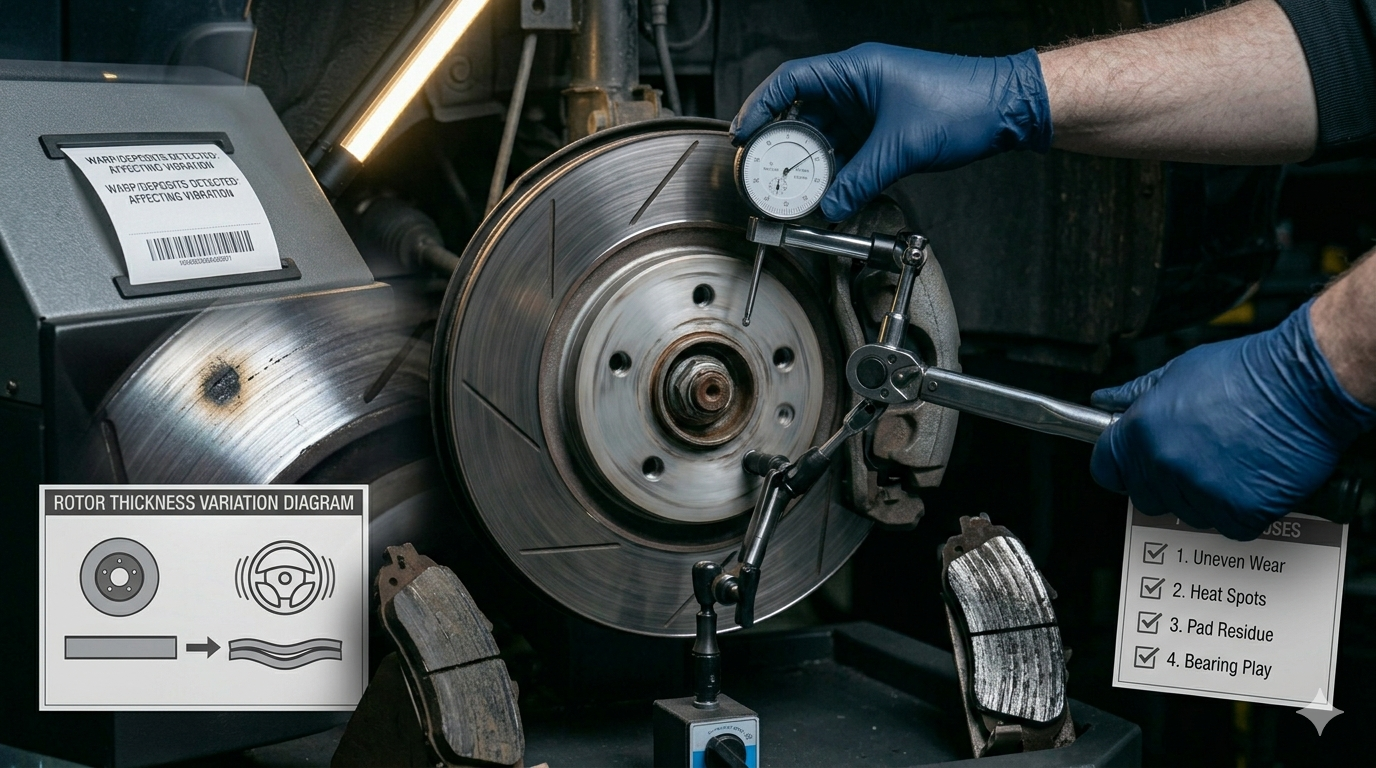
Brake rotors are the large metal discs your brake pads clamp onto to slow the car. Under normal conditions, the rotor surface is perfectly flat and smooth. Over time — especially after aggressive braking, repeated hard stops, or overheating — the rotor develops uneven thickness across its surface. This is called a warped rotor, though technically it is more often “thickness variation” than actual warping.
When brake pads contact a rotor with uneven thickness, they alternately grip and release many times per second. At highway speeds, this creates a rapid pulsing that travels through the brake pedal and steering wheel. The faster you are going when you brake, the worse the vibration feels — because more thickness variations hit per second.
Signs: Pulsing brake pedal, steering wheel shaking during braking especially at 50–70 mph, vibration that increases with brake pedal pressure.
Fix: Resurface rotors if they are within minimum thickness spec. Replace rotors if they are below spec or have deep grooves. Always replace brake pads at the same time — new pads on old rotors creates uneven deposits and the problem returns quickly.
Cost: $250–$600 per axle for rotors and pads (parts and labor). Front axle is most common.
2. Worn or Glazed Brake Pads
Brake pads have a friction material bonded to a metal backing plate. As pads wear down, the friction material gets thinner and can become glazed — hardened and shiny from heat exposure. Glazed pads lose their ability to grip the rotor consistently, creating vibration during braking.
Cheap or mismatched aftermarket brake pads are a common hidden cause. If you recently had a brake job done and the shaking started afterward, the new pads may not be properly matched to your rotors — or they were installed without following the correct “bedding in” procedure.
Signs: High-pitched squealing when braking, vibration during moderate stops, a sharp chemical smell after braking hard, shaking that started after a recent brake job.
Fix: Replace brake pads with quality OEM-equivalent pads. After installation, perform proper brake bedding: 8–10 moderate stops from 30 mph, allowing brakes to cool between each stop. This deposits an even layer of friction material on the rotor.
Cost: $150–$350 per axle for pads only.
3. Stuck or Seized Brake Caliper
The brake caliper is the hydraulic clamp that squeezes the brake pads against the rotor when you press the pedal. Each caliper has a piston that extends under hydraulic pressure and slide pins that allow the caliper to move slightly as pads wear. When the caliper piston seizes or the slide pins corrode and freeze, the caliper cannot apply and release pressure evenly.
A seized caliper causes the pad to continuously drag against the rotor — creating massive heat buildup, rapid pad wear, rotor damage, and strong vibration when braking. In severe cases, a wheel that is much hotter than the others after driving is a dead giveaway of a stuck caliper.
Signs: Car pulls strongly to one side when braking, one wheel is significantly hotter than the others, burning smell coming from one wheel, uneven pad wear (one side worn much faster), vibration plus directional pulling.
Fix: Clean and lubricate caliper slide pins if they are not fully seized. Replace the caliper if the piston is stuck. Also replace the pads and rotors on that axle since they have likely been heat-damaged.
Cost: $150–$400 per caliper plus pads and rotors if needed.
4. Unbalanced or Unevenly Worn Tires
Unbalanced tires create vibration that exists at all times but becomes much more noticeable during braking, because the braking forces amplify any existing imbalance. A tire that is even slightly out of balance can feel dramatically worse when you are decelerating from highway speeds.
Unevenly worn tires are a different issue — they create scalloped or cupped tread patterns that cause rhythmic vibration. This is usually caused by worn suspension components (bad shocks or struts) that allow the tire to bounce against the road surface rather than rolling smoothly.
Quick test: Does your car shake when you are NOT braking, especially at highway speeds? If yes, tires are a strong suspect. If shaking only happens during braking, brakes and suspension are more likely.
Fix: Tire balancing (usually $15–$25 per tire) for imbalance issues. Tire replacement for cupped or unevenly worn tires. Also inspect and replace worn shocks or struts that caused the uneven wear in the first place.
Cost: $60–$100 for balancing all four tires. $400–$800 for new tires depending on size and brand.
5. Worn Suspension Components
Your suspension — ball joints, tie rod ends, control arm bushings, wheel bearings, and struts — keeps your wheels planted on the road and absorbs impacts. When any of these components wear out, there is excessive play in the steering and wheel movement. Under braking loads, this play translates into noticeable shaking and instability.
Worn ball joints are especially dangerous. They connect the wheel hub to the control arm, and significant wear can cause the wheel to move in ways it was never designed to. A worn wheel bearing creates a roaring or humming noise that changes pitch with speed, combined with vibration that worsens under braking.
Signs: Vibration that occurs both when braking and when turning, clunking noises over bumps, car wanders or feels loose at highway speeds, uneven tire wear.
Fix: Replace worn ball joints, tie rods, or bushings. Wheel bearings must be replaced when they develop play or noise — this is a safety item.
Cost: Ball joints $150–$400 each. Wheel bearing replacement $250–$500 per wheel. Control arm bushings $200–$450 per arm.
6. Wheel Alignment Issues
Misaligned wheels mean your tires are not rolling straight — they are fighting each other at slight angles. During braking, this misalignment forces uneven braking force distribution across the tires, creating pulling and shaking. Misalignment also causes accelerated tire wear, which compounds the vibration problem over time.
Alignment goes out from hitting potholes, curbs, or after suspension component replacement. Most vehicles should have alignment checked annually or any time tires are replaced.
Signs: Car pulls to one side without steering input, uneven tire wear, steering wheel is off-center when driving straight, shaking during braking that is mild and difficult to pinpoint.
Fix: Four-wheel alignment at any tire shop. Always get alignment done after replacing suspension components or new tires.
Cost: $80–$150 for a four-wheel alignment.
7. Brake Rotor Heat Spots (Hot Spots)
Hot spots are areas of the rotor that have been overheated and hardened — often caused by holding the brakes lightly while driving (like riding the brakes down a long hill), parking with hot brakes, or aggressive track-style driving on street brake components. Hot spots create hard areas that resist pad clamping, producing vibration and reducing braking effectiveness.
You can often identify hot spots visually — look for a blue tint or discoloration on the rotor surface. This blue color indicates the metal was heated beyond its tempered range, changing its hardness and surface structure.
Fix: Rotor resurfacing removes minor hot spots if the rotor is still within thickness spec. Severe hot spots require full rotor replacement.
Cost: Resurfacing $25–$50 per rotor. Replacement $50–$200 per rotor depending on vehicle.
Repair Cost Summary — All Causes
| Cause | DIY Cost | Shop Cost | Urgency |
|---|---|---|---|
| Warped rotors | $80–$150/axle | $250–$600/axle | 🔴 High |
| Worn brake pads | $40–$80/axle | $150–$350/axle | 🔴 High |
| Seized caliper | $60–$120/caliper | $150–$400/caliper | 🔴 Urgent |
| Tire balancing | N/A | $60–$100 all four | 🟡 Medium |
| Suspension components | Varies | $150–$500/component | 🔴 High |
| Wheel alignment | N/A | $80–$150 | 🟡 Medium |
| Rotor hot spots | $25–$50/rotor | $80–$200/rotor | 🟡 Medium |
Is It Safe to Drive with a Car Shaking When Braking?
Short answer: No, not for long. A mild shake from slightly warped rotors might be manageable for a few days until you can get it repaired. But here is the risk calculation:
- Warped rotors increase your stopping distance — especially in emergency braking situations
- Seized calipers can cause complete brake failure on one wheel and may start a brake fire
- Worn suspension components can fail suddenly, causing loss of steering control
- Vibration worsens over time — what starts as a minor shake turns into rotor replacement plus pad replacement plus caliper replacement
Get any brake shaking diagnosed within a week. If the shaking is severe, pulling to one side, accompanied by grinding noise, or getting rapidly worse — stop driving and have it towed to a shop.
How to Prevent Brake Shaking
- Avoid holding light brake pressure for extended periods — use engine braking on long downhills
- Allow brakes to cool after hard use before parking — drive at low speed for a minute rather than stopping immediately
- Replace pads before they wear to metal — do not wait for grinding sounds
- Always replace rotors and pads together, not one without the other
- Get tire balancing every 5,000–7,500 miles or any time you feel new vibration
- Have alignment checked annually and after any suspension work
- Avoid cheap aftermarket brake pads — use OEM-equivalent quality parts
Frequently Asked Questions
Why does my car shake when braking at high speeds but not at low speeds?
High-speed brake shaking almost always points to warped or unevenly worn front brake rotors. At highway speeds, rotor thickness variations hit the brake pads many more times per second, amplifying the vibration into a noticeable shake. The same rotors may feel fine during gentle city braking. Have the front rotors measured for runout and thickness variation.
Can worn brake pads cause shaking when braking?
Yes. Glazed, unevenly worn, or very thin brake pads create inconsistent friction contact with the rotor. This produces vibration during braking. Cheap aftermarket pads are especially prone to glazing. Always use quality pads and replace them before they wear completely through to metal.
Why does my steering wheel shake when I brake but the car feels fine otherwise?
Steering wheel shaking specifically during braking almost always means a front-end issue — most commonly warped front brake rotors or worn front suspension components like tie rods or ball joints. The steering wheel is directly connected to the front wheels, so any vibration in the front braking system travels directly to your hands.
How much does it cost to fix a car that shakes when braking?
Cost depends entirely on the cause. Tire balancing costs $60–$100. Brake pad replacement runs $150–$350 per axle. Rotor replacement with pads costs $250–$600 per axle. A seized caliper adds $150–$400. Suspension components range from $150–$500 per component. Always get a proper diagnosis first to avoid replacing parts that are not the actual problem.
Does a car shaking when braking mean I need new brakes?
Usually yes — but not always. The most common causes (warped rotors, worn pads, seized calipers) are all brake-related. However, unbalanced tires, bad wheel bearings, worn ball joints, and alignment issues can also cause brake shaking without any actual brake problem. A proper inspection checks all these systems, not just the brakes.
Related Guides
If your car is showing multiple warning signs, these guides can help: Car Battery Draining Overnight? 11 Real Causes and Fixes — and learn the 10 Signs Your Car Needs an Oil Change before engine problems add to brake issues.