10 Signs Your Car Needs an Oil Change (Don’t Ignore #3)
Is your car trying to tell you something? Here are 10 warning signs your car needs an oil change — from engine knocking to dark oil on the dipstick — and what to do about each one.
Your engine oil is not something you see every day — but your engine feels it constantly. Most drivers wait until something goes wrong before thinking about an oil change. By that point, the damage has already started. Knowing the signs your car needs an oil change before it becomes an emergency is one of the simplest ways to protect your engine and avoid expensive repairs.
Here are 10 warning signs you should never ignore, plus a clear breakdown of when to change your oil based on your car type.
10 Signs Your Car Needs an Oil Change
1. Oil Change Warning Light Is On
This is the most direct signal your car can give you. Modern vehicles — including virtually every car built after 2010 — have an oil life monitoring system that tracks driving conditions, mileage, and engine stress. When the system determines the oil can no longer do its job effectively, it triggers a warning light on your dashboard.
The light typically looks like an oil can or says “Oil Life: 0%” or “Change Oil Soon.” Do not confuse this with the low oil pressure light, which is a more serious warning (a glowing red oil can). If the oil change light comes on, schedule service within a week. If the oil pressure light comes on, pull over immediately and do not drive the car.
2. Dark, Dirty Oil on the Dipstick
Fresh engine oil is amber or honey-colored and translucent. Over time, as it absorbs combustion byproducts, metal particles, and contaminants, it turns dark brown and eventually black. Dirty oil also becomes thick and gritty — it cannot flow properly through tight engine tolerances.
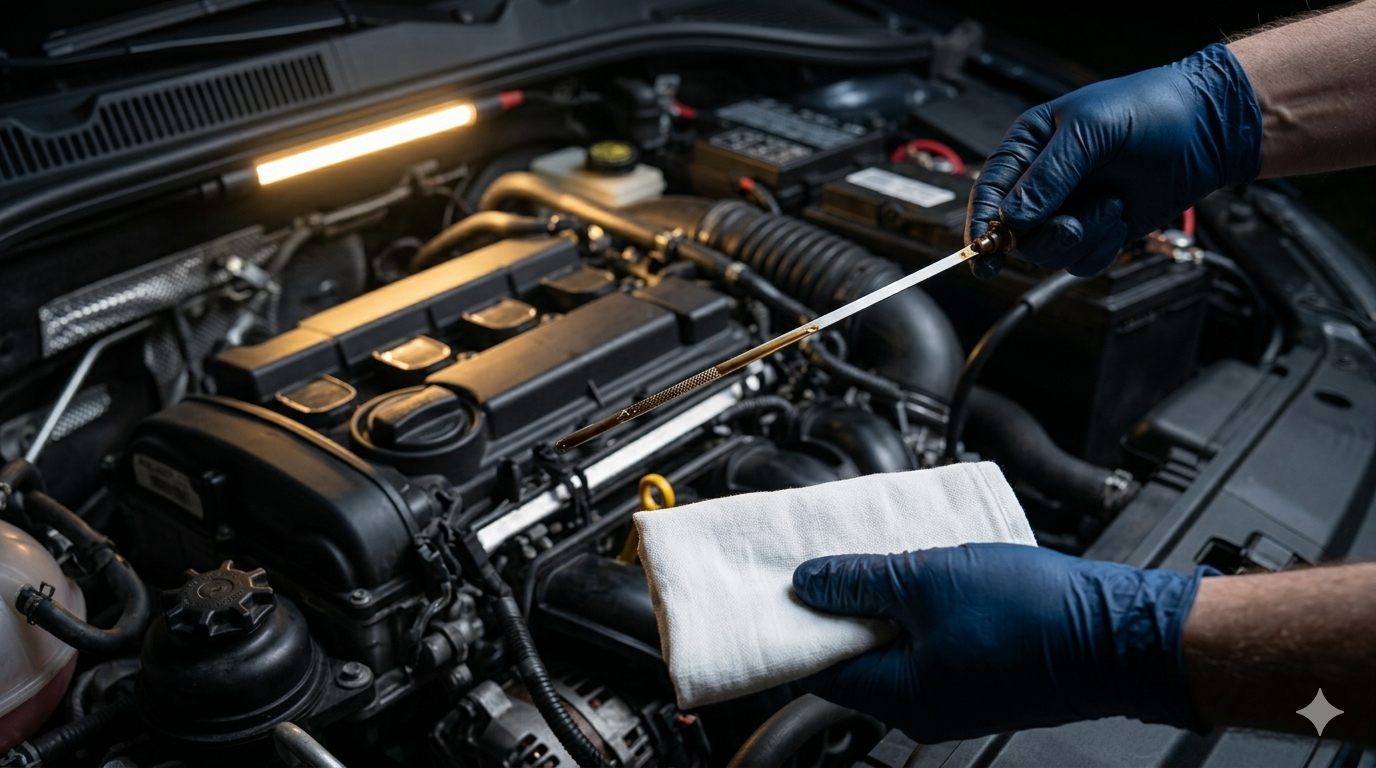
How to check it correctly: With the engine off and cool, pull the dipstick, wipe it clean, reinsert it fully, and pull it out again. Hold it up to light. If the oil is black, opaque, or has visible particles in it, it is overdue for a change regardless of mileage.
Note: Diesel engine oil turns dark very quickly — this is normal for diesel and does not indicate the oil is worn out.
3. Engine Knocking or Ticking Sounds
A healthy engine runs quietly. When oil degrades or drops too low, metal components inside the engine — pistons, rods, cam lobes, lifters — lose their protective oil film and begin to contact each other directly. This produces knocking, ticking, or rumbling sounds, especially on cold starts or under acceleration.
A ticking sound on startup that goes away after a minute can mean the oil is not circulating fast enough — often because it is too old or too thick. A constant knock under load is more serious and may indicate the oil has been neglected long enough to cause wear. Either way, change the oil immediately and have the engine inspected.
4. Burning Oil Smell Inside the Cabin
If you smell burnt oil inside your car — especially with the heater or AC running — your engine is either overheating or you have an oil leak dripping onto a hot surface like the exhaust manifold. Old, degraded oil loses its heat resistance and begins to burn off at lower temperatures.
A burning smell combined with white or blue smoke from the exhaust means your engine is actively burning oil through the combustion chamber — a sign of worn piston rings or valve seals. Do not ignore this. Start with a fresh oil change and monitor closely.
5. Exhaust Smoke Turning Blue or White
Some exhaust vapor on a cold morning is normal — it is condensation burning off. But continuous blue or gray smoke from the exhaust means your engine is burning oil. White smoke (thick and persistent) usually means coolant is entering the combustion chamber — a serious issue. Blue or blue-gray smoke specifically points to oil burning.
In either case, check your oil level immediately. If it is low, top it off and schedule an oil change. If the smoke continues after a fresh oil change, the engine has a mechanical issue requiring professional diagnosis.
6. Low Oil Level on the Dipstick
If your oil level consistently reads below the minimum mark on the dipstick, your engine is either burning oil, leaking it, or both. A healthy engine should not consume noticeable amounts of oil between changes. Burning 1 quart per 3,000 miles is considered acceptable by most manufacturers; burning more than that indicates a problem.
| Oil Consumption Rate | What It Means | Action |
|---|---|---|
| Less than 1 qt / 3,000 miles | Normal | Continue regular changes |
| 1 qt / 1,000–2,000 miles | High consumption | Diagnose the cause |
| 1 qt / under 1,000 miles | Severe problem | Immediate professional inspection |
7. Reduced Fuel Economy
Old, thickened engine oil creates more internal friction — the engine has to work harder to push oil through passages and move parts against each other. This increased workload translates directly into worse fuel economy. If you notice you are stopping at the gas station more often without changing your driving habits, degraded oil could be a contributing factor.
Fresh synthetic oil can improve fuel economy by 1–2% compared to old conventional oil. On a vehicle that normally gets 30 MPG, that is a measurable difference over time.
8. Engine Feels Rough or Sluggish
Old oil loses its ability to cushion engine components and maintain stable viscosity across temperature ranges. When this happens, you may notice the engine feels rougher at idle, hesitates during acceleration, or simply feels less responsive than it used to. The engine is working harder than it should for the same output.
This is especially noticeable in older vehicles where the owner has stretched oil change intervals. A fresh oil change often makes the engine feel noticeably smoother and more responsive immediately after service.
9. Check Engine Light Comes On
While the check engine light covers hundreds of possible fault codes, low oil pressure and oil quality issues can trigger it in many vehicles. Some cars store specific codes related to oil life (like the Honda Maintenance Minder system). If your check engine light comes on and you are overdue for an oil change, start there before spending money on diagnostics.
A simple OBD-II scanner (available at AutoZone or O’Reilly for free) will tell you the exact fault code. Any code related to oil pressure, lubrication, or engine temperature should be addressed immediately.
10. It Has Been Over 5,000 Miles or 6 Months
Even if your car shows none of the above symptoms, time and mileage are their own indicators. Oil breaks down chemically over time — even in a car that sits unused. The old 3,000-mile rule is outdated for modern vehicles, but there is still a maximum interval you should not exceed:
| Oil Type | Maximum Interval | Time Limit |
|---|---|---|
| Conventional | 3,000–5,000 miles | Every 6 months |
| Synthetic Blend | 5,000–7,500 miles | Every 6 months |
| Full Synthetic | 7,500–10,000 miles | Every 12 months |
| Extended Life Synthetic | 10,000–15,000 miles | Every 12 months |
Always follow whichever limit comes first — mileage or time — not just the mileage alone.
How to Check Your Oil in 3 Minutes
- Park on level ground and turn off the engine — wait 5 minutes for oil to settle
- Open the hood and locate the dipstick — usually a brightly colored handle (yellow or orange)
- Pull the dipstick out and wipe it completely clean with a rag
- Reinsert the dipstick all the way, then pull it out again slowly
- Check the oil level — should be between the MIN and MAX markers
- Check the oil color — should be amber to dark brown, not black or gritty
- Check for milky or frothy appearance — this indicates coolant contamination, a serious issue
What Happens If You Ignore These Signs?
Skipping oil changes is not just bad practice — it is one of the fastest ways to destroy an engine. Here is what happens progressively when oil is left too long:
- 0–10% overdue: Oil is degrading but still offering some protection
- 10–25% overdue: Sludge begins forming in oil passages, restricting flow
- 25–50% overdue: Metal wear accelerates, engine sounds change
- 50%+ overdue: Oil passages clog, oil pressure drops, catastrophic engine damage risk
- Extreme neglect: Complete engine failure — repair costs $3,000–$10,000+
An oil change costs $30–$80 for conventional, $60–$120 for full synthetic. An engine replacement costs $4,000–$10,000. The math is simple.
Frequently Asked Questions
What are the most obvious signs your car needs an oil change?
The most obvious signs are the oil change warning light on your dashboard, dark and gritty oil on the dipstick, unusual engine knocking or ticking sounds, and a burning oil smell inside the cabin. Any one of these signals means you are overdue and should schedule a change immediately.
Can I drive with the oil change light on?
Yes, but not for long. The oil change warning light means your oil life is at or near zero — the oil is degraded and no longer protecting your engine effectively. You can typically drive for another 500–1,000 miles safely, but do not push beyond that. If the red oil pressure warning light comes on (not the service reminder), stop driving immediately.
How often should I check my engine oil?
Check your engine oil level at least once a month and before any long road trip. It takes under 3 minutes with the dipstick and can prevent serious engine damage. Many modern cars alert you to low oil, but do not rely solely on the warning system — a small ongoing leak can drain your oil level before the sensor triggers.
Is it bad to go 1,000 miles over the oil change interval?
Going 500–1,000 miles over on a full synthetic oil is unlikely to cause immediate damage in a healthy engine. However, going over on conventional oil, doing it repeatedly, or driving in severe conditions (towing, extreme heat, lots of short trips) while overdue accelerates wear significantly. Build in a buffer and change oil before the limit, not after.
Does the type of oil affect how often I need to change it?
Absolutely. Conventional oil degrades faster and needs changing every 3,000–5,000 miles. Full synthetic oil lasts 7,500–10,000 miles and sometimes up to 15,000 miles with extended-life formulas. Switching from conventional to full synthetic is one of the best things you can do for your engine’s long-term health — and it reduces how often you need to visit a shop.
Related Guides
Learn more about keeping your car running at its best: Car Battery Draining Overnight? 11 Real Causes and Fixes — because a battery problem and an oil problem can sometimes feel like the same symptom.