How to Check Power Steering Fluid: Level, Color, and When to Change
How to check power steering fluid in 3 steps — find the reservoir, read the dipstick or markings, check color. But most drivers do not know their car may have no power steering fluid at all if it has electric power steering. This guide covers both systems, the complete color diagnostic, and exactly when fluid needs changing versus when the pump is failing.
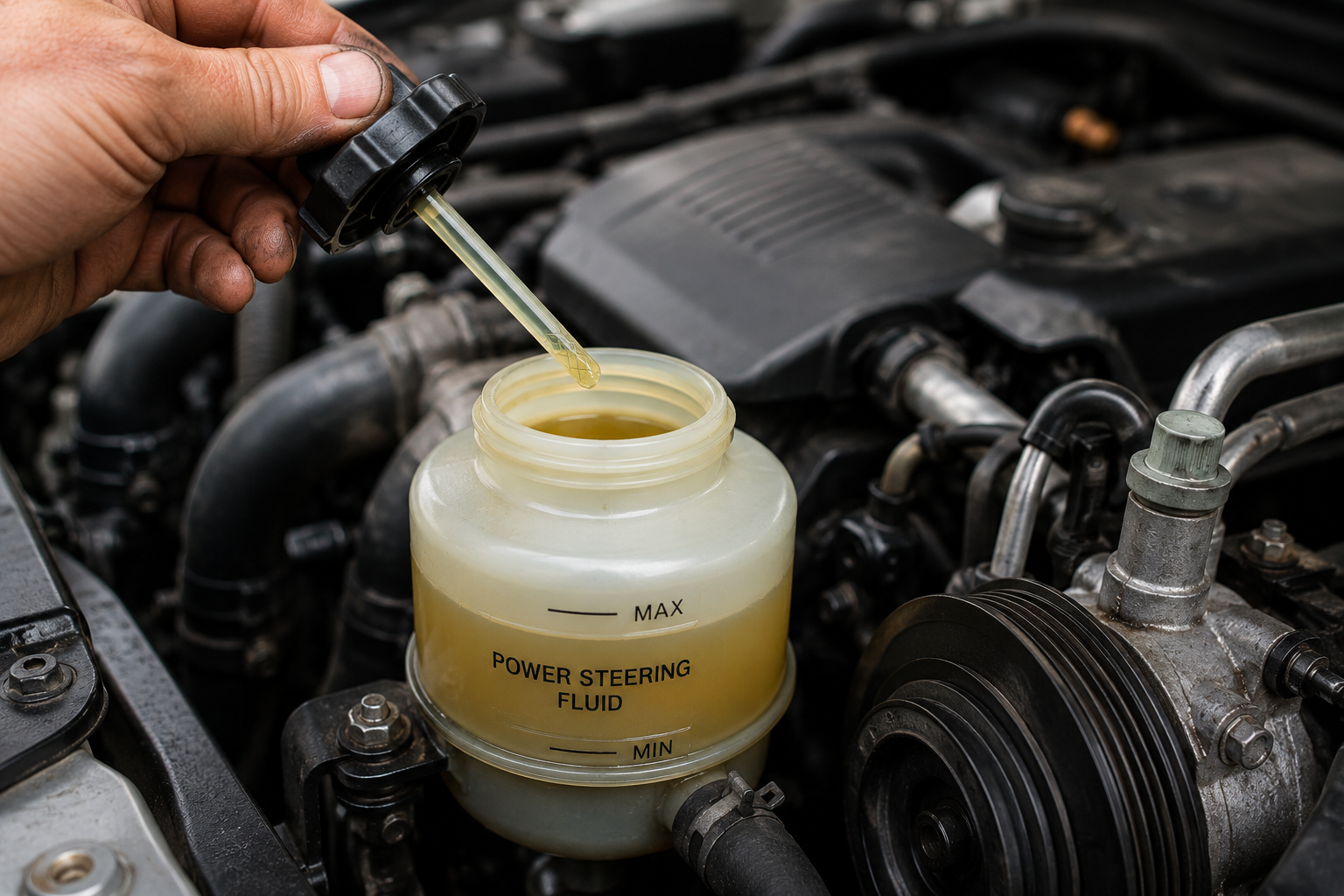
To check power steering fluid: locate the reservoir — a small, translucent or opaque container near the engine firewall marked with a steering wheel symbol — check the level against the MIN and MAX markings, and assess the fluid color. Clear to light amber fluid in good condition. Dark brown to black fluid is degraded and should be changed. Pink or milky fluid means contamination. The entire check takes 60 seconds. But first — confirm your vehicle actually has power steering fluid. Approximately half of all cars made after 2012 use electric power steering and have no fluid reservoir at all.
Power steering fluid is one of the most neglected fluids in routine maintenance — partly because most vehicles give no warning until something goes wrong, and partly because many drivers do not even know where to find it. It does not have a dashboard warning light on most vehicles, it rarely requires topping off on a healthy system, and the reservoir is often tucked in an inconspicuous location. The consequence of neglect: a whining pump, heavy steering, or a rack that fails prematurely — repairs that run $350 to $1,800 and are almost entirely preventable with basic fluid maintenance.
First: Does Your Car Actually Have Power Steering Fluid?
This is the question most guides skip, and it is the first thing to establish. Two completely different power steering technologies exist, and only one uses fluid.
| System Type | Has Fluid? | Typical Vehicles | How to Identify |
|---|---|---|---|
| Hydraulic Power Steering (HPS) | ✅ Yes — check regularly | Most pre-2012 vehicles, many trucks and SUVs still today | Has a reservoir under hood with steering wheel symbol cap |
| Electric Power Steering (EPS) | ❌ No fluid at all | Most passenger cars from 2012 onward, many from 2010 | No reservoir found under hood — only an electric motor on steering column |
| Electro-Hydraulic (EHPS) | ✅ Yes — small reservoir | Some 2008–2015 vehicles in transition period | Small reservoir present but electric pump drives the hydraulics |
If you open the hood and cannot find a reservoir after 2 minutes of looking — you almost certainly have electric power steering. Check your owner’s manual under “power steering” to confirm. EPS systems use an electric motor to provide steering assist and require zero fluid maintenance. Any whining or heavy steering on an EPS vehicle is not a fluid problem — it is a motor, sensor, or mechanical issue requiring different diagnosis.
How to Find the Power Steering Reservoir
The power steering reservoir is a small container — usually 4 to 8 inches tall — located somewhere in the engine bay, typically near the firewall or on the side of the engine. It has a cap marked with one of these identifiers: a steering wheel symbol (most common), the letters “PS,” “PWR STR,” or “POWER STEERING,” or a warning symbol with a steering wheel and wave lines.
| Make | Reservoir Location (HPS vehicles) | Cap Color |
|---|---|---|
| Toyota / Lexus | Passenger side, near firewall | Yellow or white cap |
| Honda / Acura | Passenger side front of engine bay | Yellow cap with steering wheel icon |
| Ford (HPS models) | Driver side, near power steering pump | Black or yellow cap |
| Chevrolet / GMC (HPS) | Driver side near firewall | Black cap with steering icon |
| Dodge / Chrysler / RAM (HPS) | Driver or passenger side depending on engine | Black cap |
| BMW (older HPS) | Driver side near front of engine | Black cap with MIN/MAX on side |
| Mercedes (older HPS) | Passenger side near firewall | Black or silver cap |
Do not confuse the power steering reservoir with the brake fluid reservoir — the brake reservoir is typically directly above the brake master cylinder on the firewall, has a smaller diameter, and is almost always black with a yellow or white cap marked “BRAKE FLUID.” Power steering fluid and brake fluid are completely different and incompatible — putting power steering fluid in the brake reservoir or vice versa causes immediate damage to seals and hoses. Always read the cap label before adding any fluid.
How to Check Power Steering Fluid Level — Step by Step
Cold Check vs Hot Check — This Matters
Most power steering reservoirs have two sets of markings: one for fluid checked cold (engine not run recently) and one for fluid checked hot (at operating temperature). The fluid level appears different at each temperature because power steering fluid expands when hot — a cold system may read slightly below the HOT/MAX line, which is correct because that space is left for thermal expansion.
| Engine State | Which Markings to Use | Notes |
|---|---|---|
| Cold — not started recently | COLD or MIN/MAX (lower range) | Most accurate for spotting a slow leak over time |
| Hot — after driving to operating temp | HOT or MAX (upper range) | Use for topping off — fluid expands when hot |
| Reservoir has only one set of markings | Check when cold unless specified otherwise | Most older vehicles have single markings |
Step 1 — Park on Level Ground
Any slope changes the apparent level of fluid in the reservoir. A 3-degree incline is enough to shift the reading by 10 to 15 percent. Park on flat ground before checking any fluid level. Engage the parking brake.
Step 2 — Locate and Clean the Reservoir Exterior
Wipe the outside of the reservoir with a clean rag before opening. This prevents dirt from falling into the fluid when you remove the cap. Power steering systems are sensitive to contamination — any particulate matter that enters the fluid circulates through the pump and rack, accelerating wear on precision internal surfaces.
Step 3 — Read the Level
On translucent reservoirs: read the level through the side of the reservoir without opening the cap. The fluid level is visible against the MIN and MAX markings on the outside of the container.
On opaque reservoirs with a dipstick cap: remove the cap, wipe the dipstick on the underside of the cap with a clean rag, reinsert completely, remove again, and read the level. Do not read the dipstick on first removal — it gives an inaccurate reading from fluid that has run up the stick during your drive.
The level should be between MIN and MAX. At or below MIN means low — add fluid. Above MAX means overfilled — remove excess with a turkey baster to prevent seal damage from excess pressure.
Step 4 — Check the Fluid Color and Condition
Level is only half the check. Fluid that is at the correct level but severely degraded still damages the power steering system. Look at the color and consistency of the fluid on the dipstick or through the reservoir wall.
| Fluid Color / Appearance | Condition | Action |
|---|---|---|
| Clear to light amber — transparent | Fresh and in good condition | No action needed |
| Light tan to golden — slightly darker | Normal aging — still acceptable | Plan flush within next 30,000 miles |
| Dark brown — murky | Significantly degraded | Flush recommended soon |
| Black — opaque | Severely degraded — additive package failed | Flush immediately |
| Pink, reddish, or foamy | Air entrainment or contamination | Check for leaks, check if air is being drawn in |
| Milky or frothy white | Water contamination | Flush immediately — moisture destroys pump seals |
What Type of Power Steering Fluid Does Your Car Need?
Power steering fluid is not universal. Using the wrong type damages seals and hoses within weeks, causing leaks that cost significantly more than the fluid itself. The two main categories:
| Vehicle | Required Fluid Type | Common Brand |
|---|---|---|
| Toyota / Lexus | Dexron II or III ATF (or Toyota PSF) | Toyota Genuine PSF or compatible ATF |
| Honda / Acura (older HPS) | Honda PSF (specific Honda formulation) | Honda Genuine Power Steering Fluid |
| Ford (HPS models) | Motorcraft MERCON V ATF or Motorcraft PSF | Motorcraft branded |
| GM (HPS models) | GM Power Steering Fluid or Dexron VI | ACDelco |
| BMW (HPS models) | Pentosin CHF 11S or 202 | Pentosin — do not substitute |
| Mercedes (HPS models) | Pentosin CHF 202 or MB spec fluid | Pentosin or genuine MB |
| VW / Audi (HPS models) | Pentosin CHF 11S | Pentosin — critical to use correct spec |
| Chrysler / Dodge / RAM | Mopar Power Steering Fluid or compatible | Check reservoir cap for specification |
Always check the reservoir cap or your owner’s manual before purchasing fluid. Some vehicles — notably European brands — require specific mineral-based synthetic fluids (Pentosin CHF series) that are incompatible with standard American ATF-based power steering fluids. Mixing incompatible fluids swells rubber seals and destroys hoses. The correct fluid is always listed on the reservoir cap itself on most modern vehicles.
How to Add Power Steering Fluid
- Confirm correct fluid type from reservoir cap or owner’s manual before purchasing.
- Park on level ground and let engine reach operating temperature if checking hot markings.
- Clean the reservoir cap and surrounding area before opening.
- Remove cap and use a clean funnel to add fluid slowly in small increments.
- Check level frequently as you add — overfilling is worse than being slightly low. Stop at the MAX marking appropriate for your engine’s current temperature.
- Replace cap firmly and wipe away any spilled fluid.
- Find and address the leak if the level was low — a healthy sealed power steering system should not need fluid addition. Low fluid means a leak exists somewhere in the system.
Power Steering Fluid Symptoms — What Needs Attention
| Symptom | Most Likely Cause | Action |
|---|---|---|
| Whining or groaning when turning wheel | Low fluid or failing pump | Check level first — top off if low, then reassess |
| Heavy steering — more effort required than usual | Low fluid, failing pump, or rack issue | Check level immediately |
| Steering normal when cold, heavy when hot | Fluid breakdown or pump heat sensitivity | Check fluid color — flush if dark |
| Fluid level dropping over time | Leak — hose, pump seal, or rack seal | Find and fix leak — do not just keep adding fluid |
| Fluid leaking on driveway — reddish or clear fluid | Hose, pump, or rack seal failure | Locate leak source — see our fluid leak guide |
| Foamy fluid in reservoir | Air entrainment from low level or damaged hose | Check for leaks allowing air into system |
| Jerky or inconsistent steering feel | Degraded fluid or rack wear | Flush fluid — if problem persists, rack inspection |
How Often to Change Power Steering Fluid
Power steering fluid does not have a universal change interval specified by most manufacturers — it is one of the most under-specified fluids in automotive maintenance. Most manufacturers either say “as needed” or specify an interval only in the severe maintenance schedule. The practical industry guideline used by most independent shops: change power steering fluid every 50,000 to 75,000 miles or every 3 to 5 years, whichever comes first.
The argument for changing it: power steering fluid is a hydraulic oil that contains anti-wear additives, seal conditioners, and corrosion inhibitors. These additives deplete with use and heat cycling. Degraded power steering fluid has reduced lubricity for the pump’s internal vanes and reduced seal-conditioning properties that allow seals to dry and crack over time. The power steering pump is one of the most expensive components to replace in the steering system — $350 to $800 at a shop — and degraded fluid is a significant contributing factor to early pump failure.
For high-mileage vehicles over 100,000 miles — flush the power steering system as part of a comprehensive fluid service. The darkened, additive-depleted fluid that has been in the system for years is actively accelerating wear on the pump and rack seals. A power steering flush costs $80 to $150 at a shop and is one of the highest-value fluid services for a vehicle approaching or past 100,000 miles.
Frequently Asked Questions
How do you check power steering fluid?
To check power steering fluid: park on level ground, locate the reservoir in the engine bay with the steering wheel symbol cap, and read the level against the MIN and MAX markings — either through the translucent reservoir wall or on the integrated dipstick cap. The fluid should be between MIN and MAX. Also check the fluid color — clear to amber is good, dark brown or black means degraded and in need of changing. If your car is from 2012 or newer and you cannot find a reservoir, it likely has electric power steering and uses no fluid.
What color should power steering fluid be?
Fresh power steering fluid is clear to light amber and transparent. Fluid that has aged normally becomes a light tan or golden color — still functional. Dark brown or black fluid is significantly degraded and should be flushed. Pink or foamy fluid indicates air contamination or a wrong fluid type was added. Milky white fluid means water contamination — flush immediately as moisture destroys pump seals. The color check takes 10 seconds and tells you as much as the level check.
What happens if power steering fluid is low?
Low power steering fluid causes the pump to work without adequate hydraulic fluid, producing a whining or groaning noise when turning, progressively heavier steering that requires more wheel effort, and eventual pump failure if the fluid level drops critically. The pump is designed to operate submerged in fluid — running it dry generates heat that destroys internal seals and vane surfaces within minutes. A healthy power steering system should not need fluid addition between services — low fluid means a leak exists somewhere.
Can I use any power steering fluid in my car?
No. Power steering fluid specifications vary by manufacturer and using the wrong type damages seals and hoses. Most American vehicles use ATF-based power steering fluid. European vehicles — BMW, Mercedes, VW, Audi — typically require specific mineral-based synthetic fluids like Pentosin CHF 11S that are incompatible with ATF. Honda vehicles require Honda-specific PSF. Always check the reservoir cap label or owner’s manual for the exact specification before purchasing any power steering fluid.
Related Guides
Power steering fluid maintenance is one part of a complete vehicle fluid schedule. For the full picture of every fluid check and change interval, our complete car maintenance schedule covers every service from 3,000-mile oil changes to 100,000-mile major inspections. If your car is making noise when turning regardless of fluid level, our car making noise when turning guide covers CV joints, ball joints, and bearing causes that are unrelated to power steering fluid. And if you noticed a reddish fluid puddle under the car — which can be either power steering fluid or transmission fluid — our fluid leak location guide explains how to identify which system is leaking by puddle position and fluid characteristics.