Car Shudders When Braking: 7 Causes by Speed and Pedal Feel
Car shudders when braking? The speed at which the shudder occurs and whether it comes through the steering wheel or the brake pedal identifies the cause precisely. Steering wheel shudder at highway speed means front rotors. Brake pedal pulsing at lower speeds means rear rotors. Shudder only at near-stop means ABS activating normally or a sticking caliper. This guide diagnoses all 7 causes using those patterns.
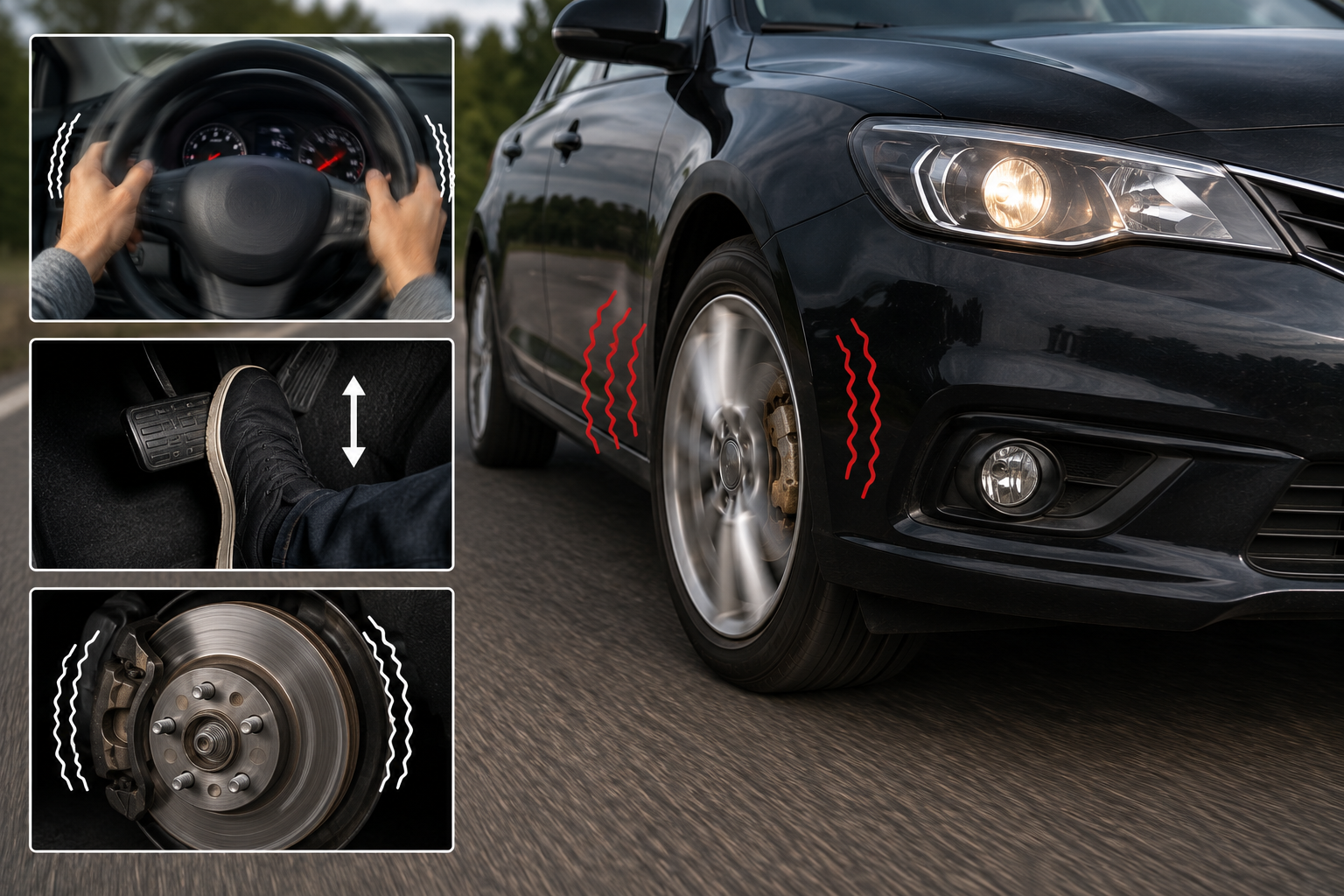
Car shudders when braking is identified by two observations: where the shudder is felt and at what speed it occurs. Steering wheel vibration during braking at highway speeds points to warped front rotors — the most common cause overall. A pulsing sensation through the brake pedal itself points to rear rotor issues. Shudder specifically at the very end of a stop — the last few mph — is usually the ABS system activating normally on a low-traction surface, which requires no repair at all. Each pattern eliminates most causes immediately before any money is spent on diagnosis.
Car shudders when braking is one of the most frequently misdiagnosed symptoms in routine brake service — because warped rotors are blamed for virtually every braking vibration regardless of the actual cause. Rotor issues account for perhaps 60 percent of braking shudder complaints. The remaining 40 percent have different causes — sticking calipers, brake pad deposits, worn wheel bearings, ABS activation, and loose wheel hardware — that do not get better from rotor replacement and may get worse if the wrong repair is performed.
Car Shudders When Braking — Primary Diagnostic Matrix
| Where Is the Shudder Felt? | At What Speed? | When During Stop? | Primary Cause |
|---|---|---|---|
| Through steering wheel | Highway speed 50–70 mph | Throughout brake application | Front rotor disc thickness variation |
| Through brake pedal — pulsing | Any speed | Throughout brake application | Rear rotor disc thickness variation |
| Through entire car | Any speed | Throughout or end of stop | Multiple rotors or severe single-rotor issue |
| Only at very last moment — near stop | Under 10 mph | Final seconds only | Normal ABS activation — not a fault |
| Shudder plus pulling to one side | Any speed | Any point | Sticking caliper — uneven braking force |
| After new brake pads installed | Any speed | Throughout | Pad deposits — incomplete bedding |
| During AND outside of braking | Specific speed range | Not brake-specific | Wheel bearing — not rotor related |
What Actually Causes Car Shudders When Braking — DTV Explained
The root cause of rotor-related car shudders when braking is not truly “warping” in most cases — though that term is universally used. What actually causes the majority of braking shudder is disc thickness variation (DTV) — microscopic differences in rotor thickness around its circumference. When a rotor with thickness variation rotates under brake pad pressure, the pads alternately encounter slightly thicker and thinner sections. This alternating force at the pad-rotor interface transmits as rhythmic vibration through the caliper, into the suspension, and up through the steering column or brake pedal.
7 Causes — Car Shudders When Braking
Cause 1: Front Rotor Disc Thickness Variation — Most Common Car Shudders When Braking Cause
Front rotor disc thickness variation is the most common cause of car shudders when braking at highway speed. The front rotors handle 60 to 70 percent of total braking work — more heat, more stress, and faster wear than rear rotors. This makes them more susceptible to the uneven wear patterns that produce thickness variation.
The diagnostic signature: shudder manifests as vibration through the steering wheel during braking from higher speeds. From 60 or 70 mph, applying moderate brake pressure produces a rhythmic pulsing vibration in the steering wheel that corresponds to rotor rotation speed. The shudder may diminish during light braking from low speeds because braking forces are insufficient to make the thickness variation detectable.
Rotor resurfacing corrects disc thickness variation if sufficient material remains above minimum thickness specification. The Car Care Council recommends rotor inspection at every brake pad replacement to catch disc thickness variation before it causes braking shudder. Resurfacing costs $20 to $40 per rotor at a shop. If the rotor is at or below minimum thickness it must be replaced — $30 to $100 per rotor for parts. Combined front pad and rotor service typically runs $250 to $500 at a shop.
Cause 2: Rear Rotor Issues — Pedal Pulsing
Rear rotor disc thickness variation or surface issues produce a noticeably different sensation than front rotor problems — shudder is felt through the brake pedal as a rhythmic pulsing underfoot rather than through the steering wheel. This distinction exists because the rear brakes are physically isolated from the steering column: their vibration transmits through brake fluid and the pedal mechanism.
Rear brake shudder is less common than front because rear rotors handle only 30 to 40 percent of total braking force. However it occurs more frequently on vehicles with electronic parking brakes where the parking brake applies rear pads while stationary, sometimes causing uneven deposits. See our guide on grinding noise when braking for complete rotor condition assessment including when resurfacing versus replacement is appropriate.
Cause 3: Normal ABS Activation — Not a Fault
This is the most commonly misdiagnosed cause of car shudders when braking — because the sensation is identical to a brake problem, yet it requires no repair. The ABS system activates when a wheel begins to lock under braking, rapidly cycling brake pressure 10 to 15 times per second. This produces a pronounced pulsing through the brake pedal and sometimes the vehicle body.
Normal ABS activation: the car shudders when braking only during hard emergency stops, braking on low-traction surfaces (wet pavement, gravel, ice), or during the final few mph of a stop with firm pedal. If the shudder happens during normal moderate braking on dry pavement — it is not ABS. If it only occurs during aggressive stops especially in wet conditions — it is ABS functioning normally. No repair needed.
Cause 4: Sticking Brake Caliper — Shudder Plus Pulling
A caliper partially seized due to a corroded piston, seized slide pins, or deteriorated guide pin boots applies uneven braking force. The result is a car that shudders when braking and pulls to one side simultaneously. The rotor on the stuck caliper overheats and develops hot spots from continuous partial contact.
The distinguishing characteristic: shudder accompanied by consistent directional pull to the side of the stuck caliper. One wheel will be noticeably hotter than its partner after a normal drive. Slide pin service costs $80 to $200 at a shop. Full caliper replacement runs $200 to $450 per corner. A stuck caliper accelerates pad and rotor wear dramatically.
Cause 5: Brake Pad Deposits on Rotor Surface
When brake pad transfer film deposits unevenly — in patches rather than uniformly — it creates high spots on the rotor surface that produce shudder when the pad contacts them. This cause is common after new brake pad installation without performing the bedding-in procedure, after aggressive braking that leaves pads pressed against hot rotors while stationary, or when incompatible pad and rotor materials are combined.
Car shudders when braking from pad deposits: shudder appeared specifically after recent brake service, most noticeable at moderate braking from medium speeds, rotors are relatively new. Performing the pad bedding procedure — 10 moderate stops from 30 mph with 30-second cool-down intervals — often resolves mild pad deposit shudder within 20 to 30 brake applications.
Cause 6: Worn Wheel Bearing
A failing wheel bearing can produce vibration that intensifies during braking — because brake application shifts weight onto the affected corner and changes load on the deteriorating bearing. This can be mistaken for rotor shudder.
The key distinction: a wheel bearing problem produces vibration also present outside of braking — during straight-line highway driving, changing character when the car is steered slightly left or right. Pure rotor-related car shudders when braking appears specifically during brake application. If vibration is present both during and outside of braking, see our car shaking guide for the wheel bearing sway test before authorizing any rotor work.
Cause 7: Loose Wheel Lug Nuts
Loose lug nuts allow the wheel to shift microscopically relative to the hub during braking, creating shudder — particularly pronounced during hard stops. The shudder from loose lug nuts tends to be accompanied by a subtle clunking sensation. After any tire service or rotation, verify lug nut torque with a torque wrench to the vehicle’s specification — typically 80 to 120 ft-lbs for passenger cars. The NHTSA recommends re-torquing wheel lug nuts 50 to 100 miles after any wheel service as standard safety practice. Check lug nuts before attributing any post-service car shudders when braking to brake components.
Speed and Urgency Guide
| Car Shudders When Braking — Cause | Safe to Drive? | Urgency |
|---|---|---|
| Front or rear rotor disc thickness variation | ⚠️ Short term only | Schedule brake service within 2 weeks |
| Normal ABS activation | ✅ Yes — not a fault | No action needed |
| Sticking caliper | 🔴 Inspect soon | Accelerating damage — repair this week |
| Pad deposits — mild | ✅ Yes | Perform bedding procedure |
| Worn wheel bearing | 🔴 Inspect soon | Bearing failure at speed is a safety risk |
| Loose lug nuts | 🚨 Do not drive | Torque lug nuts immediately |
Repair Cost Guide
| Repair | DIY Cost | Shop Cost |
|---|---|---|
| Rotor resurfacing per rotor | N/A — lathe required | $20–$40 per rotor + labor |
| Front rotor replacement pair | $60–$200 parts | $200–$400 + labor |
| Front pads + rotors service | $100–$300 parts | $250–$500 |
| Rear rotor replacement pair | $60–$180 parts | $180–$400 + labor |
| Caliper slide pin service | $10–$30 parts | $80–$200 |
| Full caliper replacement | $50–$150 parts | $200–$450 per corner |
| Wheel bearing replacement | Not recommended DIY | $250–$500 per corner |
| Torque lug nuts | Free with torque wrench | Free at any shop |
Frequently Asked Questions — Car Shudders When Braking
Why does my car shudder when I brake?
Car shudders when braking has 7 main causes identified by where the shudder is felt and at what speed. Steering wheel vibration during highway-speed braking means front rotor disc thickness variation. Brake pedal pulsing means rear rotor issues. Shudder only at the very end of a stop is normal ABS activation requiring no repair. Shudder plus pulling to one side indicates a sticking caliper. Post-service shudder with new pads indicates incomplete bedding-in. Shudder both during and outside of braking points to a wheel bearing rather than the brakes.
Is it safe to drive if my car shudders when braking?
Depends on the cause. Rotor disc thickness variation is generally manageable for short-term driving while service is arranged. A sticking caliper requires service within days. Loose lug nuts mean do not drive — torque them immediately. Normal ABS activation requires no action. Any car shudders when braking scenario with significantly longer stopping distances or brake fade means park and arrange service before further driving.
Can warped rotors cause a car to shudder when braking?
Yes. What most people call warped rotors is actually disc thickness variation — microscopic differences in rotor thickness that cause the brake pad to alternately encounter thicker and thinner sections. This alternating force transmits as rhythmic vibration through the braking system. Both disc thickness variation and true geometric warping cause car shudders when braking and are corrected by resurfacing if sufficient material remains, or rotor replacement.
Why does my car shudder when braking at high speed but not at low speed?
Car shudders when braking specifically at high speed but not at low speed is the characteristic pattern of front rotor disc thickness variation. At high speed, the rotor completes more revolutions per second during braking — vibration from thickness variation is amplified by higher braking forces required to decelerate from speed. At low speeds with light brake application, the same thickness variation produces forces too small to transmit noticeable vibration. This is one of the most reliable diagnostic indicators of front rotor issues specifically.
Can new brake pads cause a car to shudder when braking?
Yes. New pads must transfer a uniform film of pad compound onto the rotor surface during bedding-in. Without proper bedding-in — or when old rotors are reused with new pads — the transfer film deposits unevenly and creates disc thickness variation. Perform the bedding procedure: 10 moderate stops from 30 mph with 30-second cool-down intervals. This typically eliminates post-installation car shudders when braking within 20 to 30 brake applications.
Related Guides
Car shudders when braking often overlaps with other brake symptoms. If braking shudder is accompanied by grinding sounds, our grinding noise when braking guide covers rotor damage assessment. For squealing alongside the shudder, see our car squeaks when braking guide. And if vibration is also present while driving without braking, our car shaking diagnosis guide covers wheel bearing sway test and wheel balance causes independent of brake application.